If you’ve turned your television on in the last 6 months, you’ll know there’s been a lot of discussion on the latest tax bill barreling through Congress. The massive 800-page bill has officially been passed. Some of the questions you might be asking are: What does this mean for me? What stays the same? What’s going to change? How does this affect my retirement plan? In this blog, we’ll give you a preview of some of the critical provisions most likely to impact your current or future retirement planning strategies.
Permanent Extension of Lower Tax Brackets
Under the original Tax Cuts and Jobs Act of 2017 (TCJA), tax brackets were set to revert to their previous levels. Under the Big Beautiful Bill, the tax brackets under the TCJA are made permanent. This extends favorable tax rates for middle and upper-middle-income retirees. Not only does it affect your marginal tax brackets, but it has implications on any Roth conversions you might do, how you manage your Required Minimum Distributions, and even how you look at recognizing capital gains.
Permanent Increase to the Standard Deduction
The standard deduction under the TCJA has also been made permanent. This increases the amount of income shielded from taxation for single and married taxpayers. Below is a chart showing the difference between the standard deduction before the TJCA and now.
Pre-Tax Cut & Jobs Act
Now (2025)
Difference
$6,350 (Single)
$15,750 (Single)
$9,400
$12,700 (Married)
$31,500 (Married)
$18,800
Temporary Bonus Senior Deduction
Under the Big Beautiful Bill, individuals 65 or older will also receive an additional $6,000 deduction per person. This applies whether you take the standard or itemize your deductions. It is subject to an income phase-out of $75,000 (single) and $150,000 (married filing jointly).
This bonus deduction does not change how Social Security is taxed. That remains the same under this new law. Also, you do not need to have claimed your Social Security benefits to receive this deduction.
Example: For a married filing jointly couple both over the age of 65 who take the standard deduction, your standard deduction would be $34,700 ($31,500 standard plus $1,600 for each filer over the age of 65), then they also get the new bonus senior deduction, which is $6,000 per individual age 65 and older. This makes their total deductions $46,700.
Charitable Deduction Changes
Under the new tax law, an additional deduction was created for charitable donations for those claiming the standard deduction. This means that you can deduct up to $1,000 (single) or $2,000 (Married Filing Joint) for cash contributions made to qualified charitable organizations starting in 2026. This deduction is a welcome addition for those who are charitably inclined but don’t meet the threshold to itemize on their return.
Another change is for those who itemize their deductions. There is now a 0.5% AGI floor for deducting their charitable donations. For example, if you have an Adjusted Gross Income of $100,000 in 2026, you must donate at least $500 to charity before you can claim any charitable donations on your taxes. You need to be aware of this hurdle when itemizing your charitable donations.
Increased temporary SALT Deduction
The additional SALT (State and Local Tax) deduction offers relief for residents of high-tax states. Under the TCJA, this deduction was limited to $10,000. From 2025 to 2030, the expanded SALT deduction rises to $40,000. This $40,000 limit will increase by 1% for inflation through 2029. This deduction will most likely benefit those living in states like California or New York with upper-middle-class incomes. There is a phase-out for individuals with a modified Adjusted Gross Income exceeding $500,000, regardless of whether they file as single or married.
For example, if you itemize, with state taxes of $15,000 and property taxes of $10,000, you can now deduct the full $25,000 as an itemized deduction as long as you’re under the phaseout. Before, under the TCJA, you were limited to the $10,000 cap.
Estate & Gift Tax Exemption Set at $15 Million
Under the TCJA, the estate tax exemption was set to sunset from $13,900,000 to roughly $5 million. Under this new law, that exemption is permanently increased to $15 million per individual, or $30 million per couple. Portability, or the ability for one spouse to use the remaining estate tax exemption from their deceased spouse, also remains intact.
While most individuals will not have an estate that exceeds $30 million, this increased exemption is not a suitable replacement for an estate plan. Make sure you have a competent attorney who can help you put the necessary provisions in place to make a smooth transition of assets for you and your family.
Healthcare updates under the Big Beautiful Bill
The One Big Beautiful Bill expands the definition of a High-Deductible Health Plan (HDHP), which individuals must have to be able to contribute to a Health Savings Account. With the new rules, all “Bronze” and “Catastrophic” plans offered on Affordable Care Act exchanges qualify as HDHPs.
Additionally, the Affordable Care Act (ACA) subsidies that were extended post-COVID are ending in 2025. This affects retirees under 65 receiving subsidies under these marketplace plans. Don’t hesitate to get in touch with your financial advisor to revisit what income thresholds are affected by this change. You may also want to consider making adjustments to your healthcare plan and review your timeline for Roth conversions.
Conclusion
The One Big Beautiful Bill does provide at least one promising thing to retirees – clarity. With many of the Tax Cuts and Jobs Act provisions being made permanent, including tax brackets, an enhanced standard deduction, and the new changes to charitable giving, the future looks bright for those entering retirement. If you’d like to discuss how these new provisions will affect your retirement plan in greater detail, contact one of our retirement planning specialists at Peterson Wealth Advisors.
Information on these provisions is discussed in greater detail in a previously recorded webinar on our website. Watch the webinar here.
Most of us sacrifice and save for four decades in preparation for what we hope will be a comfortable retirement. We are laser-focused during our working years on accumulating as much as possible, and by the time we retire, many of us have refined the art of wealth accumulation in our IRAs, 401(k)s, and a variety of other investment accounts. We feel pretty confident in our retirement preparation and then something happens that shatters our confidence…we retire. We quickly come to the realization that successfully investing and managing the distribution part of retirement takes a completely different skill set than accumulating money in retirement accounts.
Besides the universal question of how to invest, there are questions regarding distributions, taxes, risk, and keeping our income up with inflation that will all have to be addressed as we transition from accumulating to distributing our retirement accounts. All these questions bleed into the single, overarching question that every retiree needs to figure out: How am I going to create an inflation-adjusted stream of income from my investments that will last for the rest of my life?
The Need for a Retirement Income Plan
The quality of the next 30 years of your life is dependent upon the decisions that you make at retirement and the plan you put in place. There is so much on the line, and mistakes made at the beginning of retirement are not forgiving. There are no do-overs. A well-thought-out retirement income plan will provide discipline, order, safety, and peace of mind. A sound retirement income plan will allow you to focus on your retirement dreams and not be obsessed with the daily movement of markets, interest rates, or how current events will impact your retirement.
A retirement income plan should be unique to you and your specific needs. So, copying your retired neighbor’s retirement income plan won’t work. Following some generic, “rule of thumb” withdrawal advice from your financial advisor won’t get it done, and buying an annuity that will never keep up with inflation over a long retirement will only serve to crush your future purchasing power. And finally, decades of investing have already taught you the futility of market timing and betting your future on guessing the direction of the stock market.
Now that I have shot down all the popular attempts to create retirement income streams, and before I show you how a professional retirement income plan is created, let’s address what it is that we need a retirement income plan to do.
A Successful Retirement Income Plan Must Address Five Objectives
It must be goal specific.
It must create a framework for investing.
It must create a framework for distributing.
It must create a framework to reduce risk.
It must create a framework for reducing taxes.
Goal Specific
A retirement income plan that is goal-driven provides detailed objectives. It is a date-specific, dollar-specific blueprint that will guide you throughout retirement. A date-specific, dollar-specific plan defines how much income will be needed during retirement, and when it will be needed. Its objective is to deliver future income to the retiree with the least amount of risk, after all risks have been considered. A properly structured retirement income plan matches your current investment strategy with your future income needs. Like any goal-driven program, the performance toward reaching the goal must be monitored to maintain discipline and allow for adjustments if the goal is to be realized.
Create a Framework for Investing
Retirees must find the proper investment mix of low-volatility fixed-income investments and higher-yielding, more volatile equities.
Fixed-income investments such as bank deposits and certain types of bonds can provide a haven to draw income from when the stock market takes its occasional dive. As valuable as these types of investments can be in the short term, they are a long-term liability that will never keep up with inflation.
On the flip side, retirees need to own some equities in their portfolios. Owning higher yielding equities is a logical way to keep ahead of inflation over the long run. But we all know that short-term volatility and unpredictability afflict all who own equities. Creating a retirement income plan that takes advantage of the opposing nature of fixed-income and equities is an essential component in creating a long-lasting retirement income plan.
It’s just commonsense to invest the money we’ll need in the short-term into fixed-income type investments and invest the money we don’t think we will need for a while into stock-related investments. But, most retirees and their advisors don’t invest this way. Unfortunately, the failed practices of chasing last year’s returns and making investment decisions based upon guessing the future direction of the stock market continue to be the prevalent methods used to determine investment allocations, even though these methods have proven to be extremely unreliable.
Following a plan that allocates retirement savings by determining short versus long-term income needs liberates the retiree from having to time the markets or beat the stock market average by superior investment selection. With an investment plan that matches current investments with future income needs, the retiree only needs to concentrate on maintaining discipline and following the plan.
Create a Framework for Distributing
When it comes to withdrawals from investments at retirement, I have noticed two types of personality traits. The first trait is manifested in individuals I will call the “entitled spenders” who think to themselves, “I have been saving all my life for retirement, and I am now retired, so I am going to spend however much I want on whatever I want.” The second type I will call the “paranoid savers”. These people are those who think, “I may have a lot of money, but it has to last a long time. And who knows what the future might bring?” These types of individuals are often afraid of spending any of their retirement funds at all.
The “entitled spenders” sabotage their retirement by spending too much, too early, as they burn through all their retirement savings in the first ten years of possibly a thirty year retirement. The “paranoid savers” likewise harm their retirement by living below their privilege by denying themselves many of the simple pleasures and opportunities of retirement. Ironically, both the spenders and the savers would greatly benefit from the same date-specific, dollar-specific retirement income plan, a plan that outlines how much money can and should be withdrawn from investment accounts and when.
Quite literally, the million dollar question is, “How much can/should I withdraw from my investments each year?” You must be able to answer this question if you’re going to have a sustainable income stream throughout retirement, and if you’re going to be able to enjoy your retirement experience to the fullest.
A sustainable withdrawal rate can be created through determining the answers to three important questions:
How much income will I need to pull from my investments to sustain my retirement lifestyle?
When will retirement savings need to be converted into retirement income?
How should retirement accounts be invested until they are needed to be converted into income?
Again, having a retirement income plan that includes date-and-dollar specifics should drive your withdrawal decisions. Adjustments in either the timing of withdrawals, the withdrawal amounts, or how retirement funds are invested between now and the future income date will impact your future income stream.
Create a Framework to Reduce Risk
A viable retirement income plan must recognize and minimize risks where possible. Retirees are particularly susceptible to three kinds of risks:
Inflation risk
Stock market risk
Behavioral risk
Inflation Risk
When it comes to inflation, you must ask yourself the following, “How do I invest to maintain my purchasing power and stay ahead of inflation?”
Inflation is the gradual but lethal loss of purchasing power. Currently, we are going through a period of high inflation but historically, the long-term inflation rate has averaged 3%. At just a 3% inflation rate, $1.00 will only be able to purchase $0.41 worth of goods and services at the end of a 30-year retirement. Unless you are willing to reduce your lifestyle and spending habits by about 60% during your retirement, inflation must be dealt with. Fortunately, the risk of inflation can be mitigated by investing in inflation-beating equities. The retirement income plan I will show you later in this blog helps by deliberately designating a portion of a portfolio toward long-term inflation protection.
Stock Market Risk
How do I maintain investment discipline throughout retirement and not make major mistakes during periods of market volatility? Market corrections are part of the investment cycle and should be planned for. Successful investors follow plans and are patient, while unsuccessful investors follow the breaking news and daily movements of the stock market and are prone to panic. Informed investors manage stock market risk by being diversified and patient because they understand every bear market is eventually followed by a bull market. Having a plan in place is the antidote to panic. Knowing what you own, and why you own it, goes a long way towards helping you stay the course during periods of market turbulence.
Behavioral Risk
Two related questions come to mind when considering the behavioral aspects of a retirement income plan:
How do I protect myself from my older self when my financial judgement is clouded by age?
How do I provide the less financially savvy spouse with a plan to follow that will provide for his or her financial needs after my death?
Retirement is not a time for investment experimentation. It’s not a time to be tossed about by every headline on the nightly news or story on the internet. It isn’t a time to change your investments based on irrational exuberance or equally irrational fear. A goal-specific income plan goes a long way toward helping to navigate the emotional roller coaster of investment management now, and especially as you age. It can also be a valuable tool to provide guidance to a spouse upon your death. A date-specific, dollar-specific retirement income plan helps protect your future from perhaps its greatest threat — you.
Create a Framework for Reducing Taxes
From which accounts, or combination of accounts, should I withdraw retirement income from to give myself the most tax-efficient income stream? Should I withdraw from my IRA, my Roth IRA, or my non-retirement accounts? How do I go about managing my Required Minimum Distributions?
Tax-saving opportunities rarely happen by accident. Rather, they come about through careful planning. This is especially true with retirees. Keeping retirees in lower tax brackets throughout retirement can be done by managing withdrawals from pre-tax versus after-tax investment accounts. In other words, the retiree can take income from IRA accounts until they reach the top of a tax-bracket and then take the balance of their needed income for the year from an after-tax account. This is an easy concept to visualize but a little more difficult to implement. What adds to the complexity is that implementing this plan has to integrate with the framework for investing and the framework for distribution sections that I just mentioned. At this point, it might sound daunting to bring all of this together. As we create the income plan in the next section, you will be able to see how all these components can integrate with each other.
Retirement Income Plan Creation
Now that I have explained the retirement income challenge, and what your retirement income plan must address, let me demonstrate how a professional retirement income plan is structured. In 2007, we created our proprietary retirement income plan that we call the Perennial Income Model™. It has helped hundreds of retired families successfully navigate their retirements during the volatile years since its inception. The Perennial Income Model is goal-based and creates the essential frameworks for investing, distributing, reducing risk, and reducing taxation, as previously mentioned.
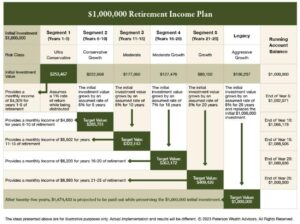
Allow me to introduce the Lee family who we will build a retirement income plan for. Tony and Kathy Lee are both 65 and are ready to retire. They have accumulated $1,000,000 in their 401(k) and their after-tax brokerage accounts. They want to know how they should invest the million dollars and how much income they should expect to receive from that sum of money. They feel a retirement income plan spanning 25 years should be sufficient, and they would like to pass the full $1,000,000 to their children upon their deaths, if possible.
When it comes to making investment decisions, the most important consideration is an investment’s time horizon. In other words, how long will the money be invested? The Perennial Income Model matches the Lee’s current investment portfolio with their future income needs by dividing their money into various investments that have different objectives based upon when a particular segment of their money will be called upon to provide future income. Therefore, the Perennial Income Model will divide the $1,000,000 they have accumulated for retirement into six different accounts. The first five of these accounts are responsible for creating retirement income for five different five-year periods of the Lee family’s retirement. I will refer to the accounts that cover the five-year period of income as segments. So, Segment 1 is responsible for providing the income for the first 5 years of retirement, Segment 2 for years 6-10 of retirement, Segment 3 for years 11-15 of retirement, and so on… until 25 years of retirement are covered.
The sixth segment, or Legacy Segment, is designed to create a fund that will replace the original investment of $1,000,000 to the Lee family at the end of 25 years. This provides money for their heirs or can serve as an insurance policy should they live longer than 25 years or experience large end-of-life expenses like nursing home costs. The accompanying chart shows the retirement income plan being built for the Lee family — I will walk you through it to make sure it all makes sense to you.
The Perennial Income Model Walk-Through
The underlying principle of the Perennial Income Model is matching current investment portfolios with future income needs. Therefore, the money that the Lee’s depend on to provide income in the short-term is invested in conservative investments that provide safety from volatile markets. The money that won’t be needed to create income for a prolonged period is invested into more aggressive investments that keep up with inflation. Segment 1 will provide income for the first five years of retirement. It will be invested into a conservative account that will systematically distribute $4,329 monthly to the Lee’s checking account.
Segment 1’s primary responsibility is safety of principle because it’s sending out a monthly payment immediately; so, this segment is the most conservatively invested. We assume only a 1% rate of return on the money invested in Segment 1. Certainly, in today’s environment retirees can, and should, expect a higher return than 1% on their conservative money. We also expect to outperform the conservative assumptions for the other segments as well. By choosing to underestimate performance, we avoid creating a false sense of security and unrealistic income expectations. Obviously, if the Perennial Income Model works with the conservative assumptions we are using, it will work better as investment performance exceeds these assumptions.
Segment 2 will take over the role of providing monthly income to the Lees once Segment 1 runs out of money at the end of the fifth year. Since the money from Segment 2 will not be needed for at least five years, it can be more aggressively invested than Segment 1, but it can’t be significantly more aggressive. A prolonged bear market could last longer than five years, so the bulk of this money should also avoid volatile investments. That’s why only a 5% return is assumed during the five years it’s invested before being turned into income in year 6.
Segment 3 will be invested for ten years before it will be called upon to create income for years 11-15. Because the money in this segment won’t be used for ten years, Segment 3 is moderately invested in a 50% stock/50% bond portfolio. A conservative 6% return is assumed for this segment.
You can see from the chart, Segment 4 assumes a 7% growth rate and Segment 5 and the Legacy Segment assumes an 8% growth rate. We use these higher growth assumptions because these segments are more aggressively invested. Investments that will not be needed for fifteen years and beyond must invest into a diversified portfolio of equities to keep up these higher growth assumptions. History has shown us that, in the long run, equities have always beaten inflation and have given us superior returns. It’s understood these inflation-fighting segments will experience occasional bouts of volatility that the stock market imposes with regularity. But given the long-term nature of these segments, short-term volatility is inconsequential. The key to making the stock market work for you is to maintain discipline and stay invested during periods of volatility. Following the Perennial Income Model will provide the discipline that is needed.
Harvesting
At first glance, the Perennial Income Model appears to become more aggressively invested as the retiree ages and gets into the latter segments of the plan. Having 80–90-year-old retirees with all their money invested in long-term, aggressive equity portfolios doesn’t make any sense. Fortunately, this is not how this retirement income plan works when the income model is properly managed and “harvested.” In financial terms, the process of harvesting is transferring riskier, more volatile investments into a conservative and less volatile portfolio once the target, or goal, of each segment is realized. The target, or goal of each segment is the number found in the dark green box associated with each segment.
For an example of harvesting, let’s look at Segment 4. You can see that the initial investment in Segment 4 is $127,476 and we know that if this initial investment grows by the assumed growth rate of 7%, it will reach its target, or goal amount by the projected fifteenth year. Segment 4 is invested in a moderate growth portfolio (70% stocks, 30% bonds). According to a study done by Vanguard, the historical return of a moderate growth portfolio has averaged an annualized return of 9.4% since 1926. So, it would be plausible, if history simply repeated itself, that the investment portfolio in Segment 4 would reach its goal of $363,172 before year 15 (at a 9% growth rate, the segment reaches its target in 12 years). Once the target is reached, no matter what year that happens, the investment needs to be harvested and preserved. That means the equities in the segment that have reached their target goal must be moved into more stable and conservative investments.
We have found, the key to successful outcomes is to begin with conservative growth assumptions and then maintain the discipline to harvest portfolios in the segments when they reach their targets.
Five Insights to Point Out:
Notice the account balance stays roughly the same throughout retirement (see the far-right column of the chart). People often assume that as segments are liquidated, the overall portfolio balance is going down, but that’s not the case. Recall that as the early segments are being liquidated, the later segments are invested and growing.
Notice that the retirement income plan is projected to automatically increase the Lee’s income every fifth year by an annualized 2.6% rate to help offset the effects of inflation.
To keep things simple and to help you to understand how the Perennial Income Model works, I have not incorporated any other sources of income such as Social Security or pensions into our example. But, for tax planning purposes, projected Social Security, pension, and other sources of taxable income should be incorporated into the retirement income stream projections. Once the income stream is created by adding all sources of income, thoughtful consideration should be made to determine which type of account (IRA, Roth IRA or after-tax account) should be allocated into the various segments for maximum tax efficiency.
Assumed growth rates are purposefully overly conservative. Historically, the S&P 500 has averaged more than 10%, and the largest assumed growth rate used in the most aggressive segment is only 8%. If you feel that these assumed growth rates are not realistic, you can always adjust the income plan to run at lower or higher growth assumptions. The Perennial Income Model uses conservative growth assumptions within the retirement income plan in hopes that the target for each segment is reached prior to the date it’s needed to provide income.
Please look at the bottom line of the chart. Based upon these conservative assumptions, the Lee family will receive $1,674,433 of income during their 25-year retirement and leave $1,000,000 to their heirs.
Conclusion
I end with the question that all new retirees and those approaching retirement need to ask themselves, “Will I outlive my money, or will my money outlive me?” Without knowing anything about your finances, I can tell you that you will be much more likely to have your money outlast you if you follow a plan. Your retirement income plan should be goal-based and should serve as a guide to your financial decision-making for the rest of your life. It should drive your investments, withdrawals, and even influence your spending and gifting decisions.
The Perennial Income Model appeals to those seeking a logical, goal-based roadmap for investment management during retirement. It reduces the retirees’ need to be anchored to the daily movements of the stock market which, in turn, will provide them with greater peace of mind and will make them less vulnerable to making the irrecoverable investment mistakes that so many retirees make.
Retirees that follow the Perennial Income Model understand why they are invested, when they will need a specific portion of their investments to provide future income, how much they can safely withdraw, and how their dollars will need to be invested to accomplish their goals. They will also realize a more tax-friendly way to navigate retirement. The Perennial Income Model is designed to provide a secure stream of income in the short-term, while providing an inflation-adjusted stream of income for the retiree’s future.
Hopefully, you can now see that there is so much more to planning retirement income streams than buying an annuity and more to consider than following generic and overly simplistic rule of thumb guidelines to manage your finances during retirement.
My hope is that this blog has opened your eyes to a better way to invest during retirement and that you might be able to incorporate some of the ideas found in this blog so you might face your financial future with confidence and have the peace of mind to free you to pursue your retirement dreams.
The Perennial Income Model is explained in greater detail in my book “Plan On Living”. You can get a complimentary copy of my book and get a better understanding of the services that we offer by visiting here.
Scott Peterson was a guest writer on the popular White Coat Investor blog—a blog esteemed amongst physicians and other high-income professionals. Scott’s blog outlines our proprietary process for investing, The Perennial Income Model™. The article also presents a retirement income plan creation example of a couple who have accumulated $1 million for their retirement.
“You must pay taxes. But there is no law that says you gotta leave a tip.” -Morgan Stanley
How can any retiree make a good decision about reducing taxes in retirement, or any financial professional recommend a proper course of action, without first mapping out, and projecting a future income stream?
The answer is . . . they can’t. Retirees often end up making only short-term, immediate tax-saving decisions, while missing out on more advantageous, long-term tax reduction opportunities because neither they nor their advisor project income streams across a full retirement. Focusing only on the current tax year ends up costing retirees many thousands of dollars because they fail to recognize, and then to organize, their finances to take advantage of long-term opportunities to reduce taxes.
A comprehensive retirement income plan must consider a lifetime tax reduction strategy that focuses on how today’s decisions to withdraw money from the various types of accounts will impact their tax liability years into the future. The Perennial Income Model™ is the ideal tool to help retirees recognize and organize long-term tax-saving opportunities to keep more of their wealth.
Three retirement account tax categories
Before looking at strategies to maximize your lifetime tax savings, you must first understand the categories of retirement accounts and the tax implications of each. How your investments are taxed depends on the type of account in which they are held. There are three categories of accounts to consider:
Tax-deferred retirement accounts
The money in IRAs/401(k)s and a variety of other company-sponsored retirement saving plans are 100% taxable upon withdrawal unless you use the Qualified Charitable Distributions exception (to be explained). Non-IRA annuities can likewise be lumped into this category with the exception that only the interest earned on the non-IRA annuity is taxed upon withdrawal, not the entire value of the annuity.
Tax-free retirement accounts
The funds in Roth IRAs and Roth 401(k)s can be withdrawn tax-free.
Non-retirement accounts (after-tax money)
Investments that are individually owned, jointly owned, or trust owned have their dividends and interest taxed annually. They are also subject to capital gains taxation in years when investments are sold at a profit.
Three strategies to reduce your taxes in retirement
At Peterson Wealth Advisors we use our Perennial Income Model to provide the organizational structure to recognize and benefit from major opportunities to reduce your taxes. Let’s consider three of these tax-saving strategies that can benefit you in retirement:
1. Managing investment income according to tax brackets
Thankfully, your retirement income stream can come from a mix of tax-deferred, tax-free, and non-retirement accounts used in combination to lower your tax liability. Even though income stemming from tax-deferred accounts is 100% taxable, Roth IRA funds can be withdrawn tax-free and money coming from non-retirement accounts hold investment dollars that can oftentimes be withdrawn with limited tax consequences.
The key is to determine which of the above categories of accounts should be tapped for future income needs . . . and when. Tax-efficient income streams that are thoughtfully mapped out at the beginning of a retirement, as we do with the Perennial Income Model, can be extremely effective to help minimize your lifetime tax burden. With advanced planning, you can avoid the costly mistakes of conventional wisdom: paying almost zero tax from retirement date to age 72, then paying high taxes and higher Medicare premiums until death. The Perennial Income Model shows us that it is better to pay minimal taxes from retirement date to age 72, along with how to be able to pay minimal taxes and minimal Medicare premiums from age 72 to death. When you structure your retirement income streams from a variety of tax locations within your portfolios, thoughtfully planned out, you can experience a higher standard of living while still paying very low tax rates.
2. Qualified Charitable Distributions
The most overlooked, least understood, and one of the most profitable tax benefits recognized by forecasting income streams through the Perennial Income Model comes from the use of Qualified Charitable Distributions. A Qualified Charitable Distribution, or a QCD, is a provision of the tax code that allows a withdrawal from an IRA to be tax-free if that withdrawal is paid directly to a qualified charity. Our clientele consists of retired people who regularly donate generous sums to charities. By simply altering the way contributions are made to charity, you can make the same charitable contribution amounts and reduce your taxes at the same time.
The ability to transfer money tax-free from an IRA to a charity has been around for a while, but the doubling of the standard deduction from the 2018 Tax Cuts and Jobs Act, was the catalyst that brought this valuable benefit to the forefront. With larger standard deductions, only 10% of taxpayers itemize deductions. Here is the catch: you only get a tax benefit from making charitable contributions if you itemize your deductions, and with the higher standard deduction, fewer of us will be itemizing. So, a 65-year-old single taxpayer, with no other itemized deductions, could end up contributing up to $13,000 and a 65-year-old couple could end up contributing up to $27,000 to charity and it would not make any difference on their tax returns, or their tax liability, because both generous charitable contribution amounts were lower than the standard deduction. So, they will just end up taking the standard deduction. Another way of saying this is that these charitable donors will not receive a penny’s worth of tax benefit for giving so generously to charity.
Doing a direct transfer of funds to a charity by doing a QCD versus the traditional writing a check to a charity, can restore tax benefits lost to charitable donors. QCDs are only available to people older than age 70 1/2, they are only available when distributions come from IRA accounts, and a maximum of $100,000 of IRA money per person is allowed to be transferred via QCD to charities each year.
3. Roth IRA Conversions
Converting a tax-deferred IRA into a tax-free Roth IRA can be a valuable tool in the quest to reduce taxes during retirement. Unfortunately, few retirees get it right deciding when to do a Roth conversion, deciding how much of their traditional IRA they should convert, or even deciding if they should convert any of their traditional IRAs at all. Without a projection of future income that the Perennial Income Model provides and the subsequent projection of future tax liability, it is virtually impossible to determine whether a Roth IRA conversion is the right course of action. Perhaps the greatest unanticipated benefit that we have observed since creating the Perennial Income Model is its ability to clearly estimate future cash flows and subsequent future tax obligations for our retired clients. Given this information, the decision whether to do a Roth conversion becomes apparent.
As advantageous as Roth IRA conversions can be, they are not free! The price you pay to convert a traditional IRA to a Roth IRA comes in the form of immediate taxation. 100% of the conversion amount is taxable in the year of the conversion. For this reason, investors must carefully weigh whether doing a Roth conversion will improve their bottom line.
Too much of a good thing usually turns a good thing into a bad thing. So, it is with Roth conversions. Excessively converting traditional IRAs into Roth IRAs without fully considering the tax consequences, can cause some investors to pay more tax than they otherwise would if they didn’t do a Roth conversion in the first place. So, it’s important to recognize when, and when not, to do a Roth conversion.
The Perennial Income Model™ as a tax planner
We first designed the Perennial Income Model to provide the structure to reinforce rational decision-making. It started with a focus on helping retirees match their current investments with their future income needs. Now, we see that the Perennial Income Model’s role is much bigger, including providing the benefit of reducing your taxes throughout the entirety of your retirement.
An emergency fund is a portion of money set aside to be used as a buffer in the event of an emergency or for an unforeseen expense. During the accumulation phase of life, or the years in which a household is reliant on a paycheck and actively saving toward retirement, an emergency fund provides a safety net to balance the budget during events such as loss of work, an expensive medical bill, or a car repair. In every personal finance textbook, you will find details on how to best manage an emergency fund. However, most of these texts focus on the accumulation phase of life. They aren’t focused on applying these beneficial principles to retirees. So, let’s go over the details of an emergency fund for retirees.
How much should I have in an emergency fund?
There is a rule of thumb that is used when determining how much a household should have in an emergency fund. The guidance is to have at least three to six months’ worth of expenses set aside. This can be a good benchmark to measure yourself against. But the problem with a rule of thumb is that everyone’s individual situation is different and may require more customization.
Calculating an emergency fund during retirement is different than during accumulation. For instance, the risk of losing your job when you’re retired is zero percent. However, in most cases, this does not completely eliminate the risk of income loss. You must determine, based on your own cash flow risks, what amount is right. For example, a retiree with multiple rentals and a history of renter turnover will require more cash on hand than a retiree whose only income source is from Social Security and a steady pension.
Where should you invest your emergency fund? How much cash should I have on hand?
The goal of an emergency fund is not to earn the highest return possible. It is to have the funds accessible when needed. A common place for an emergency fund to be kept is in a savings or money market account. You can do this at your preferred bank or credit union. Online banks that pay higher interest rates can also be a good choice. Any of these options will work, as long as your money is easily accessible.
Do not keep your entire emergency fund in hard cash. Having a limited amount on hand in your home is reasonable. However, there are added risks in having large sums of cash in your home.
Once you have determined the amount for a comfortable emergency fund, you may need to add or subtract from your current account. If you need to increase your emergency fund, the best way to do this is by adding a portion of your monthly income to the fund until you have the desired balance. Anytime you use your emergency fund, immediately work toward increasing it back to the desired amount.
It can also be common for retirees to accumulate large sums of cash in savings accounts. These are much greater than an adequate emergency fund requires. During the accumulation phase, the guidance is to put 15 – 20% of our income away into savings. In retirement, this mindset changes. Keeping extra savings in the bank, in excess of your emergency fund, can be a missed investment opportunity. This will hamper your ability to keep your investments up with inflation. If you have a balance in your bank account on top of your emergency fund needs and what you might reasonably spend in a short period of time, consider investing these funds for a greater opportunity for growth. You should also consider reducing income from sources such as taxable retirement accounts to avoid paying taxes on this unspent income just to have it accumulate in the bank.
A good question to ask yourself if you are in this situation is “when do I plan on spending this money?” If it is more than five years out, investing the funds in a diversified portfolio will result in greater growth opportunities. Talk to your advisor to determine the right investment allocation.
Conclusion
Though the amount and use of an emergency fund slightly change for individuals moving from the accumulation phase to the retirement phase of life, it is still an important part of a retiree’s financial household. Having too little or too much in savings for a rainy day could cost you thousands of dollars over the course of your retirement. Talk to one of Peterson Wealth Advisors’ Certified Financial Planners with your questions about an emergency fund for retirees and start your retirement income planning with our Perennial Income Model.
Entering retirement can be both thrilling and intimidating at the same time. The thought of “hanging up the cape” and permanently leaving the workforce behind can be viewed as unburdening and relieving to one individual, but completely frightening to another. Regardless of the viewpoint you have on retirement, it will undoubtedly come with new challenges and troubles to overcome. Among the different problems to solve for retirement, one of the biggest challenges is that of early retirement health insurance options.
For those age 65 and older, or certain younger individuals with disabilities, Medicare has you covered. Medicare is the country’s health insurance program managed by the federal government. Once you enroll, there is very little management that you have to do throughout retirement.
But what about those who retire earlier than age 65? An early retirement is certainly achievable, but requires careful planning, especially when it comes to your healthcare. This article will enlighten you on the different healthcare options available for early retirees, with a focus on the Marketplace. If you are not familiar with what the Marketplace is, don’t worry, we will get to the details soon.
Health Insurance Options for Early Retirees
If neither you nor your spouse will be covered through an employer plan, fear not! There may be more options than you think. Below is a summary of a few options. I highly recommend speaking with your financial advisor about which route makes the most sense for you.
COBRA
A law that allows employees and their dependents to keep their group coverage from their former employer’s health plan. This coverage can last for 18 months after termination from the employer, but beware, this can be very costly.
Medicaid
Though unlikely for some retirees to qualify due to the low-income requirements (i.e., in Utah, coverage is available for those with household incomes up to 138% of the federal poverty level), this may be the cheapest option for those who do qualify. However, many doctors don’t accept Medicaid, so you may have to change your primary providers if you qualify for coverage.
Christian Healthcare Ministries
This is not traditional insurance, but rather a Christian-based method of sharing the costs with others around you. Each member pays a monthly premium, and those funds are used to help other members cover their healthcare costs.
The Marketplace
Finally, we have the Marketplace, which tends to be the route most early retirees take. For this reason, I want to expound upon how the Marketplace insurance really works.
The Marketplace – What is it?
In March of 2010, the Affordable Care Act (sometimes called Obamacare) was passed with the goal of making health insurance more affordable. The law provides individuals and families with government subsidies (otherwise known as premium tax credits). This helps lower the costs for households with an income between 100% and 400% of the federal poverty line. As a reference, in 2022, 400% of the federal poverty level for a retired couple is $73,240. The federal government operates the Health Insurance Marketplace, or “the Marketplace” for short. This is an online service that helps you enroll for health insurance. You can access the Marketplace at HealthCare.gov.
How does the Marketplace work?
First and foremost, I recommend you work with a trusted, licensed health insurance agent to help you navigate the waters of the Marketplace. Especially if you’ve only ever received health insurance through your employer. There is no additional cost to you to use an agent – they will be compensated by the insurance company directly. You can then tell the agent any specifics you are looking for with your coverage (such as certain doctors, hospitals, etc.). They can help narrow the available plans down to your liking.
That being said, let’s look at how this actually works.
You can enroll in health insurance during open enrollment, which generally runs from November 1st to December 15th. This is for coverage starting January 1st of the following year. You also have the option to enroll during a special enrollment period. This is based upon major life events, such as a change in household or residence.
You’ll be rewarded with a special enrollment period when you’re looking for health insurance options as an early retiree. Don’t feel like your retirement date needs to line up with the open enrollment period. During this special enrollment, you’ll have a 60-day window to enroll through the Marketplace.
During enrollment, you will fill out an application with basic personal information. Included with this application, you will give them your best estimate of what your income will be for the coming year. The Marketplace uses your Modified Adjusted Gross Income – MAGI – to define “income.”
When evaluating early retirement health insurance options, it’s important to understand how Marketplace subsidies work. The Health Insurance Marketplace bases eligibility on your projected income for the upcoming coverage year — not your prior year’s income. This distinction is especially important when considering health insurance options for early retirees, since retirement often significantly reduces taxable income.
For 2026 coverage, if your projected household income falls between approximately 100% and 400% of the federal poverty level (FPL), you may qualify for a federal premium tax credit to help lower the cost of your insurance premiums. If your income exceeds 400% of FPL, you generally will not qualify for a subsidy and must pay the full premium yourself.
The temporary subsidy enhancements created under pandemic-era legislation — which allowed households above 400% of the poverty level to receive assistance — expired after 2025. Unless new legislation is passed, Marketplace subsidy eligibility for 2026 and beyond follows the original Affordable Care Act structure. Because of this, managing your projected retirement income carefully can play a significant role in keeping your early retirement health insurance costs affordable.
What happens if your income isn’t exactly what I put on the application?
The answer is that you will reconcile any differences when you file your taxes.
If your income was less than what you projected, you’ll get a credit as you qualified for more of a subsidy throughout the year. If your income was more than what you projected, you will have to pay some of that subsidy back. Generally, this isn’t that big of an issue unless you projected your income to be less than 400% of the poverty level, but it was actually more. In this case, you are required to pay back the entire subsidy. Even if your income was only $1 more than the threshold.
For this reason, I suggest consulting with your financial advisor to pinpoint what your income will be through your early years of retirement. I also suggest you speak with your advisor about potential planning strategies available to control your Modified Adjusted Gross Income, as there are certain strategies that can help you qualify for a subsidy while enjoying the income you desire throughout retirement. For an example of how this might work, Mark Whitaker wrote an article in 2020 describing a case study that explored these strategies.
As far as the plans that are available, the Marketplace ranks them in four different categories. These categories are Bronze, Silver, Gold, and Platinum. The Bronze plans typically tend to have the lowest premiums, but they are also the most catastrophic plans. This means they have high deductibles and out-of-pocket maximums. Gold and Platinum plans typically tend to be better plans as far as coverage, but have higher premium costs. Again, working with an agent can help you navigate which plan is best for you.
Frequently Asked Questions About Early Retirement Health Insurance Options
Choosing the right early retirement health insurance option can significantly impact your long-term retirement plan. Below are answers to common questions about health insurance options for early retirees and how to manage coverage before Medicare eligibility.
1. What are the best early retirement health insurance options before Medicare?
If you retire before age 65, you’ll need coverage until Medicare eligibility. The most common early retirement health insurance options include:
COBRA continuation coverage from your former employer
ACA Marketplace (Affordable Care Act) plans
Coverage through a spouse’s employer plan
Part-time employment with health benefits
Private individual insurance plans
For many early retirees, the ACA Marketplace is the most flexible and potentially affordable option, especially if income qualifies for premium tax credits.
2. How do health insurance options for early retirees work with the ACA Marketplace?
Marketplace plans determine subsidy eligibility based on your projected income for the upcoming year, not your prior year’s earnings.
For 2026 coverage, households with income between approximately 100% and 400% of the federal poverty level (FPL) may qualify for premium tax credits. If income exceeds 400% of FPL, subsidies generally are not available under current law.
Because retirement often reduces taxable income, careful income planning can significantly lower health insurance premiums.
3. Can early retirees qualify for government subsidies?
Yes — many early retirees qualify for premium tax credits through the ACA Marketplace.
Subsidy eligibility depends on:
Projected Modified Adjusted Gross Income (MAGI)
Household size
Federal poverty level thresholds
Strategically managing withdrawals from retirement accounts (such as IRAs, Roth IRAs, and brokerage accounts) may help maintain income within subsidy-eligible ranges.
4. Is COBRA a good health insurance option for early retirees?
COBRA allows you to continue your employer-sponsored coverage for up to 18 months (sometimes longer in certain circumstances).
However:
You pay the full premium (including the employer portion)
It is usually more expensive than Marketplace options
It is temporary and not a long-term pre-Medicare solution
COBRA can serve as a short-term bridge to Medicare or to the next Marketplace enrollment period.
5. How much does health insurance cost in early retirement?
Costs vary widely depending on:
Age
Location
Plan type (Bronze, Silver, Gold)
Income (which affects subsidy eligibility)
Without subsidies, premiums for early retirees can be substantial. With subsidies, however, coverage may be significantly reduced — especially for households near the lower end of the income range.
This is why income planning is one of the most important factors when evaluating early retirement health insurance options.
6. What happens when I turn 65?
Once you turn 65, you become eligible for Medicare.
Many early retirees structure their health insurance decisions as a bridge to Medicare, choosing options that provide stable coverage until Medicare enrollment begins. Planning ahead helps avoid coverage gaps and late enrollment penalties.
7. What is the biggest mistake early retirees make with health insurance?
One of the most common mistakes is failing to coordinate retirement income planning with Marketplace subsidy rules.
Large IRA withdrawals, Roth conversions, or capital gains in a single year can push income above the subsidy threshold — dramatically increasing premium costs.
Proactive tax planning can help maintain eligibility and reduce overall healthcare costs during early retirement.
What Health Insurance is Available for Early Retirees?
There is more to the Marketplace and the other health insurance options for the early retiree mentioned than can be discussed in this article. Hopefully, this provides you with a framework of the options you have as an early retiree. Early retirement is achievable for those who are prepared and understand how their healthcare needs can be met.
At Peterson Wealth Advisors, we manage the retirements of several retired commercial pilots. As I have discussed these pilots’ careers with them, one of the retired pilots explained that being a pilot can be described as, “hours and hours of boredom punctuated by moments of sheer terror.” Although these moments of sheer terror are rare, pilots will spend countless hours of training throughout their careers. They are preparing for that moment when their flight plan might not go according to plan.
Just as pilots have a plan, investors also need to have a plan to follow when their investments are not going according to plan. The last couple of years have provided investors ample unplanned and unforeseen market turbulence. A pandemic, a supply chain crisis, the highest inflation rate in our lifetimes, and the prospects of another world war in Europe have certainly rocked the investment world. It’s even caused the best-made investment plans to not go according to plan.
Investors should always be asking, “what is my plan when things temporarily aren’t going according to plan?” Let me share with you the Peterson Wealth Advisors’ perspective and what we are doing for our clients. Especially when it appears that things aren’t going according to plan due to ‘investment turbulence’.
Embrace the Volatility
First, temporary downturns are not a deviation from the plan. Rather, they are an expected part of the plan. Stock and bond market downturns are always temporary. Historically the duration of almost every major decline is measured in months, not years. The media would have you think that market corrections, “are unexpected events that are shocking in both their occurrence as well as their impact.” As investors with longer-term perspectives, we understand that the price you pay for inflation-beating investment returns consist of enduring occasional periods of market volatility. Few of us would pass up a Hawaiian vacation because there will surely be some turbulence in our flight to and from Hawaii. We likewise need to keep temporary market downturns in perspective and remember that turbulence is a planned for event.
Even though the exact timing of a correction is difficult, we should expect and even embrace market volatility. Investors should seize the opportunity to make wise tax moves during declining markets by doing Roth conversions, rebalancing portfolios, and tax-loss harvesting. They should also be opportunistic by purchasing depreciated equities while they are being sold on discount.
Protect Gains
We believe that investors should never be in a position where they need to liquidate depleted investments due to a temporary market downturn. This is difficult to do if an investor is not preparing for the downturns before they happen. With the Perennial Income Model™, we proactively attempt to protect our clients from selling investments at a loss. This is done by following a rigid, goal-centric, approach to harvesting investment gains once the goal of an investment has been reached. Harvesting is the process of transferring aggressive investments to more conservative investments as goals are achieved.
Navigating retirement with a plan that establishes investment goals and appropriately harvests gains can bring order, discipline, peace of mind, and added security to the retiree.
Maintain Flexibility
If you have the flexibility, you can wait out market downturns and wait for good investment opportunities. The best way to add flexibility, and tip the investment odds in your favor, is by increasing your time horizon. The longer you are invested, the better opportunity you have to endure a range of market turbulence. This endurance flexibility lets you stick around long enough to let the odds of benefiting from a positive outcome fall in your favor.
Additionally, flexibility within an investment portfolio allows Peterson Wealth Advisors to select only positive-performing investments within a portfolio to be drawn upon for income. This allows investments within that same portfolio, that may have temporarily dropped in value, to rebound.
Flexibility gives you room for error. Giving yourself a margin of error is the only way to safely navigate the world of investing. The world of investing is governed by probabilities, not certainties.
Create a Plan that has Conservative Projections
In other words, plan for the worst and hope for the best. As the creators of the Perennial Income Model™ we project retirement income streams over decades. This process is unique to our firm. We have concluded that it is in everybody’s best interest to project low. We assume future investment returns 30% less than historical averages in all of our planning and projections. If an acceptable retirement income stream can be created from the conservative assumptions that we use, an actual income stream that spins off more income than originally projected will certainly be welcomed.
Conclusion
Market turbulence has and will continue to afflict investors with regularity. This is why we choose to create retirement income streams. We follow the goal-based, time-segmented processes of the Perennial Income Model.
A retirement income plan is only successful if it can survive reality. A future filled with unknowns is everybody’s reality. That is why we feel it is important that retirees understand and embrace volatility, follow a goal-based plan to protect investment gains, maintain investment flexibility, and use conservative estimates as retirement income streams are projected. If retirees understand and embrace these points, they will be prepared to answer the question, “what is my plan when things temporarily aren’t going according to plan?”
The Perennial Income Model™ was created and launched in 2007. Through all the ups and downs of the stock market, it has withstood the test of time. The initial goal of the model was to provide a logical format for investing and for generating inflation-adjusted income from investments during retirement. In the beginning, we did not fully anticipate all the accompanying benefits that would result from projecting a retiree’s income over such a long timeframe. However, our eyes have been opened to a number of benefits, one of them being how the Perennial Income Model acts as a ‘bad luck insurance policy’.
The Perennial Income Model can help protect your retirement income during a bad market
The Perennial Income Model can protect you if you are unlucky and happen to retire about the same time as a stock market crash. Every stock market correction is temporary, but that knowledge isn’t helpful if you are ill-prepared and are having to liquidate equities in down markets to support yourself.
Let me share with you an example, Mike had been carefully planning for his retirement for years and it was finally his turn. He wanted to be conservative as he selected investments for his retirement years, but he knew enough about investing to realize that a good part of his investment portfolio had to be invested into equities if he was going to keep ahead of inflation.
So, he reluctantly invested more than half of his portfolio in stock-related investments. Mike retired, and almost immediately his worst fears were realized, as the stock market dropped by 50%. His money was invested in a balanced mutual fund that was composed of 60% stock and 40% bonds. Unlike the working years, Mike couldn’t just wait for the stock market to recover, he had to withdraw a portion of his money every month from his mutual fund just to pay the bills. As Mike withdrew his monthly stipend, he realized that he was liquidating a proportional amount of stocks and bonds each month from his balanced mutual fund. This meant, he was systematically selling stocks at a loss every month that the stock market was down, and it could take months, or even a couple of years before the stock market recovered.
Mike was frustrated, and even a little angry. He thought to himself, “why did this happen to me? I anticipated, and planned for, every contingency of my retirement in detail, then the one thing that I have no control over trips me up. I must be the unluckiest person on the planet!”
Mike is not alone; this exact scenario happens and will continue to happen to millions of new retirees every time there is a market correction. It’s true when we are no longer contributing and we begin taking withdrawals from our accounts, the temporary ups and downs of the market can have a much bigger impact on our investments than when we were working and had time to wait out market corrections.
To be clear, Mike’s mistake wasn’t in being too aggressively invested because a 60% stock, 40% bond portfolio is a very reasonable allocation for a new retiree. His mistake was failing to have a plan that allowed him to only liquidate the least impacted, non-stock portion of his portfolio to provide immediate income during a market downturn.
To illustrate this point, let’s take the example of two investors, Mr. Green and Mr. Red. Both have decided to retire at age 65 and both have saved up a $1,000,000 nest egg. Each of them plan to withdraw 5% of their initial balance each year to have an annual income of $50,000. As you can see from the table, both average the same 6% return during their 25-year retirements, but Mr. Green ends up with more than $2,500,000 to pass on to his heirs at death, while Mr. Red runs out of money halfway through his retirement. How can this be?
Every aspect of their retirement experience is identical except for one thing: the sequence of their investment returns.
As you can see from the chart, Mr. Green experiences overall positive returns at the beginning of his retirement and a string of negative returns towards the end. Mr. Red experiences the same returns only in reverse. He goes through a series of negative returns at the beginning of retirement and the more positive returns come at the end. Again, both investors average the same 6% return over their 25 years of retirement. The sequence of those returns is the only difference. We can see from the table just how much of a difference the order of returns makes.
Set yourself up for retirement success
The good news is that it’s possible to set ourselves up to be successful no matter what the markets happen to do year by year. The Perennial Income Model is the bad luck insurance policy that can protect you from the pitfalls that Mr. Red experienced.
I’m not suggesting that following the Perennial Income Model will guarantee that your account balance will never go down, or suffer temporarily because it will. What I am saying is, that by following the Perennial Income Model, you shouldn’t find yourself having to sell stocks at a loss during a stock market correction.
Mr. Red’s losses are realized as he liquidates equities in down years at a loss to cover his expenses. If Mr. Red were to have his portfolio organized according to the investment regimen provided by the Perennial Income Model, he would not be in a position where he would have to liquidate stocks in down years to provide income. He would have a buffer of conservative investments to draw income from while giving the more aggressive part of his portfolio a chance to rebound when the stock market temporarily experiences periods of turbulence.
The Perennial Income Model’s design is intended to give immediate income from safe, low-volatility types of investments. At the same time, it furnishes you with long-term, inflation-fighting equities in your portfolio, equities that won’t be called upon to provide income for years down the road. Market corrections typically last for months, not years. So, even if you are the unluckiest person on the planet and your retirement coincides with a market crash, your long-term retirement plans won’t be derailed as long as you are following the investment guidelines found within the Perennial Income Model.
Ready to talk? Schedule your complimentary consultation here.
Creating a retirement plan can be a daunting task. At Peterson Wealth Advisors, we use our propriety process, the Perennial Income Model™, which outlines three ‘building blocks’ to a retirement plan. Whether you use the Perennial Income Model or another type of retirement plan, these building blocks will make sure you are on the right track to a successful retirement.
The three building blocks to a retirement plan are income and investments, taxes, and legacy. If your plan is built on these three blocks you should have the necessary information to answer the following crucial retirement planning questions.
4 Questions your Retirement Plan Should Answer
1. Do I have enough money to satisfy my income needs in retirement?
2. How do I invest my money to ensure this income lasts throughout retirement?
3. What can I do to protect my income from taxes?
4. How can I make sure my money goes to who I want it to go to when I want it to go to them?
If your retirement plan doesn’t give you the necessary information to answer those four questions, then it’s a poor plan and you should find something better. If it does, then you’re on the right track.
3 Building Blocks to a Retirement Plan
Block 1: Income and Investments
The income and investment block is the foundation to a retirement plan. Income and investments go hand in hand because how much income you can expect to have in retirement is determined in large part on how you invest your money.
The income portion of the block is where your different sources of retirement income – investments, social security, pensions, rentals, etc. – are gathered to create a consistent single stream of income throughout your retirement. To maximize your income, you must look at each source in the context of your entire plan, not in a vacuum. For example, the goal is not to maximize your Social Security income, but the goal is to maximize your retirement income.
The investment portion of the block determines how to invest your money while balancing risk and return. The money you need to live off in the early years of retirement needs to be invested conservatively to limit volatility, where the money you don’t need for decades needs to be invested aggressively to keep pace with inflation.
The Perennial Income Model achieves both these objectives, letting you know how much income you can expect to have in retirement and how to invest your money to ensure your income lasts throughout retirement. It’s up to you to determine if this amount of income will satisfy your income needs in retirement.
Block 2: Taxes
The goal of tax planning is to pay the least amount of income tax, not just in the first year of retirement but throughout all of retirement. Knowing what your income will be over the next 30 years allows you to build a long-term tax plan. This is exactly what the Perennial Income Model does, allowing you to build an efficient tax plan throughout your retirement.
The different tax strategies that can be used are beyond the scope of this post, you can learn more about them here, but they include using tax-efficient investment funds, minimizing Required Minimum Distributions, utilizing Roth conversion, and charitable giving strategies.
Block 3: Legacy
Once your income is secure throughout retirement you move on to the Legacy building block.
The goal of the Legacy building block is to effectively and efficiently transfer your assets to who you want them to go to when you die.
Knowing how much you will have at the end of your retirement plan gives you the insight needed to make those decisions and to know if you should be concerned about estate taxes. People typically fall into one of three groups:
Simple: This group wants their money split evenly between their heirs when they die, and their estate isn’t large enough to be affected by estate taxes (an individual’s estate needs to be over $12.06 million, in 2022, before estate taxes affect it).
Minor Complexity: This group wants more control, outlining when the money goes to their heirs and what they can use it for, and their estate still isn’t large enough to be affected by estate taxes.
Complex: This group has a large enough estate where estate taxes will be a concern – they need to not only think about who will receive their money and when they will receive it, but also how they will avoid paying estate tax on their money.
The different estate tax strategies that can be used are more than can be covered here but they include creating a gifting plan, knowing which accounts should be donated to charity, and moving money out of your estate to avoid estate taxes.
The Perennial Income Model lets you know how much you will have at the end of your plan, giving you the necessary insight into how much you’d like your heirs to have and when they receive their money. It also allows you to know if you need an estate tax plan.
Will Your Retirement Plan Succeed?
When presented with a retirement plan, whether it be by Peterson Wealth Advisors or someone else, you need to first ask yourself “will the income from this plan be enough for my retirement needs?” If the answer is yes, then ask your advisor these three crucial follow-up questions to make sure your retirement plan will succeed:
How do I invest my money to ensure this income lasts throughout retirement?
How can I make sure my money goes to who I want it to go to when I want it to go to them?
The Perennial Income Model is based upon the three building blocks of a retirement plan – income and investments, taxes, and legacy – giving you the necessary information to answer these retirement questions.
Warren Buffet once called the babies born today “the luckiest crop in history” because they are expected to live longer and enjoy greater prosperity than any previous generation. I believe it would be a fair assumption to add that the baby-boomer generation is the “luckiest crop” of retirees to have ever lived. Today’s retirees are healthier, wealthier, happier, safer, freer, more educated, more equal, more charitable, and more technologically advanced than any previous generation.
4 Common Threats to Retirement Savings
Ironically, the wonderful advancements that current retirees are blessed with are also the root of the problems that retirees will face. Longevity, inflation, and the retiree’s individual responsibility to manage their own investments will be the challenges that this generation of retirees will have to grapple with.
1. Longevity
Not only are we living better, we are also living longer. Therein lies the challenge: We are living too long. Life expectancies are steadily climbing. According to the Social Security Administration, a couple who is currently 65 years old have a 48% chance that one of them will live to be the age of 90.
Because of long life expectancies, many retirees face the very real risk that they will outlive their money if they don’t plan for a lengthy retirement. Planning on living to the average life expectancy is not enough. It is best to plan on living longer than your life expectancy, because life expectancy estimates the average time a person will live. To be certain, some people will die before their life expectancy, but some will live beyond, sometimes many years beyond, their projected life expectancy.
2. Inflation
Longevity is the catalyst for today’s retirees’ second challenge: their dollars are shrinking.
Every day, the purchasing power of the retiree is eroding as goods and services are getting more expensive. Although inflation has always existed, no previous generation has had to deal with it to the extent that today’s retiree does. Our parents and grandparents lived ten or fifteen years past retirement, inflation never had time to develop into a problem for them.
A retirement lasting thirty years or more is a game-changer. Inflation isn’t something that may happen, it will happen. In our opinion, inflation has confiscated more wealth, destroyed more retirements, and crushed more dreams than the combined effects of all stock market crashes. Historically the average inflation rate has been more than 3% annually. To put that into perspective, at a 3% inflation rate, a dollar’s worth of purchasing power today will only purchase forty-one cents worth of goods and services in thirty years from now.
Inflation poses a “stealth” threat to investors as it chips away at real savings and investment returns. The goal of every investor is to increase their long-term purchasing power. Inflation puts this goal at risk, because investment returns must match the rate of inflation just to break even. An investment that returns 2% before inflation in an environment of 3% inflation will actually lose 1% of its purchasing power. This erosion of purchasing power might seem incidental, but this type of loss, compounded over the duration of a retirement, is life-changing.
Dollars invested into money market accounts, certificates of deposits, fixed annuities, and bonds, never have, and never will, keep up with inflation. Uninformed, anxious, stock market-leery investors that depend on these types of investments for long-term growth may be insulating themselves from stock market volatility, but they are committing financial suicide, slowly but surely. To make matters worse, the paltry gains associated with these products must be taxed, which makes it that much more unlikely that they will be able to preserve purchasing power.
In the current environment of huge government budget deficits and spending, it is likely that inflation will continue to rise at least at the same pace as its historical average. Given the one-two punch of longevity and inflation, it is imperative that retirees are mindful of inflation as they invest and plan for the future.
3. Investment Management Risk
A third challenge for retirees to be aware of is the personal responsibility they now have to manage their own investments.
During the last couple of decades, a subtle transfer happened. The responsibility to provide retirement income shifted from the employers to the employees. The popular pension plans of the past, which guaranteed a lifetime of monthly income to retired employees and their spouses, are disappearing. Pensions have been replaced by 401(k)s and other similar plans that all place the burden of funding, managing, and properly distributing investments to last a lifetime, squarely on the backs of the unprepared employee. Like it or not… you, not your employer, hold the keys to your financial future.
An annual study done by DALBAR, Inc. shows that the average stock fund investor managed to capture only 60% of the return of the stock market over twenty years. Ouch! The largest contributing factor that explains this blatant underperformance was the investor’s own behavior. It appears that the typical investor followed the herd mentality, buying when stocks were high and selling in a panic when stocks were low. Seldom was the investor guided by a comprehensive investment plan. Consequently, little or no discipline was demonstrated. What is most concerning, is that for the most part, the investor failed at the easy part of investment management: the accumulation phase.
4. Retirement Income Distribution Risk
When people enter retirement, they also enter the distribution phase of investment management. In other words, they start withdrawing their investments. The distribution phase is much more difficult to manage than the accumulation phase. In the distribution phase, it is still crucial to know how to properly allocate and invest a portfolio, but additional complexity is added to the mix. Therefore, income-hungry retirees need to know how to create a distribution plan that will provide a stream of income that will last until the end of their lives. They need to create and then follow a Retirement Income Plan.
Retirees need to be kept informed in order to make the best financial decisions. It is also important to work with a financial professional that specializes in retirement issues and that is a fiduciary who puts the retiree’s best interest ahead of their own.
 801.225.0000
 info@petersonwealth.com
 Orem, UT 84057
 Client Login
 Schedule a Free Consultation