How The SECURE Act 2.0 Impacts Your Retirement

How The SECURE Act 2.0 Impacts Your Retirement

Alex Call: Thank you everybody for attending. We’re really looking forward to going over this with everybody. My name is Alex. I am a financial advisor here at Peterson Wealth. And Carson is also a financial advisor, and he will be helping us present.

So, before we jump in, we will be having a Q&A at the end. So, any questions that you have just feel free to put them in the chat or in the question part. And we do have Daniel and Josh manning those questions. So they’ll be able to help answer any of those, and any that they don’t get to, we will be answering in the webinar. And then also we will get back to you with an email or a phone call to make sure that all the questions are answered.

So with that being said, let’s just go ahead and jump right in.

What is The SECURE Act 2.0? (1:02)

So what I want to talk about first is really what is The SECURE Act 2.0. And so really it was part of the consolidated appropriation act of 2023, which was just a really big 1.7 trillion bill that was passed right at the end of the year. And this was a small part of that. And what it stands for, SECURE is for Setting Every Community Up for Retirement. And then the 2.0 part is because this is an extension of The SECURE Act that was passed in 2019.

And what’s the purpose of this act? I really think of it as there’s two purposes. One is encouragement. It’s to encourage people to contribute to their retirement plans. And along with that is access. It’s giving people greater access to retirement plans. And so it’s easier for them to make contributions and save for retirement.

~ Time to fix screen ~

So the purpose is encouragement and access. And so then the next thing is, what are we going to cover today? And so what I will tell you what we are not going to cover is that within this act there are hundreds of minor changes to retirement plans that have happened. Things that are not really going to affect anybody here and that will just be gradually implemented and changed to retirement plans over the upcoming years. We don’t want to talk about that.

What we want to cover are what we feel are really the five most impactful changes for current and soon-to-be retirees. And that’s going to be a combination of retirement catch-up contribution limits, QCDs, RMDs, Required Minimum Distributions. And we’ll go through all of these today.

Transferring a 529 Plan to a Roth IRA (3:37)

But the one that I want to go over first is one that has probably been receiving a little too much attention within the financial media that I have seen at least for what it actually is. And the reason why is because in theory, this sounds awesome.

And that has been able to transfer a 529 plan. And a 529 plan is an education savings account that you can contribute. It’s essentially a vehicle to help you save for college, for kids, grandkids, and so forth. And that you’re able to transfer that into a Roth IRA. It sounds awesome. But there’s a lot of rules and restrictions around it. And so, these rules are first, that the IRA receiving the funds, it must be in the name of the beneficiary of the 529 plan.

The next, the 529 plan, it must have been maintained for 15 years or longer. Meaning it has to have been opened for at least 15 years before you can make those transfers into a Roth IRA. Any contributions to the 529 plan within the last five years are ineligible to be moved to a Roth IRA. And then for the other ones, there’s a maximum lifetime limit of $35,000 that can be moved into an individual’s Roth IRA. There’s also an annual limit. And this annual limit is the contribution limit, that for a Roth IRA, just the normal contribution, limit less any regular contributions that have been made.

For example, today the Roth IRA contribution limit is $6,500. So, if I were to contribute if I were doing this for myself, and were to contribute $3,000 as regular contributions, then the most I could transfer from a 529 plan to a Roth IRA is $3,500. So the most combined is that $6,500 amount.

And then next, the Roth IRA earner, or owner, must have earned income the year of the transfer. Meaning if you’re retired, you’re not going to be able to transfer money from a 529 plan into your Roth IRA because you don’t have earned income because you’re not working anymore.

When and How to Use the 529 to Roth IRA Transfer Option

So those are the six rules. Now if we look at when can we use these, what’s a good time to use these and how does this actually be applicable?

So, the first one is what the intended purpose of it is. And that is for allowing money that was earmarked for educational purposes to be repurposed as retirement savings in the event those funds are not needed for education after all. So, you save money for your child’s education. They don’t use all of their money in their 529 plan whether it maybe they got scholarships, maybe they didn’t go to college, something like that. Now you can repurpose those funds into your Roth IRA, and that’s the intended purpose. But there’s another strategy that could be used for, what I think of it as Legacy Planning.

And essentially what this is, it is giving you the ability to help fund your grandkid’s retirement. And how this would work is the time a child is born, say a grandchild is born, you make a meaningful contribution to a 529 plan for their benefit. And then later, you know 15 years later, the child turns 15, 16 years old, and the account funds in the 529 plan could begin to be moved to a Roth IRA for the child’s benefit. Again, following all of those rules and the amount to the maximum IRA contribution each year and so forth.

And so with proper planning and continued annual transfers, until that $ 35,000 lifetime transfer limit is reached, this child’s, your grandkid’s Roth IRA when they turned 65, that could easily approach about roughly a million dollars. And so, it’s giving you the opportunity to really pre-fund your grandkid’s retirement. Those what I would say would be the two main purposes or strategies to be able to use this for.

So the next thing we want to talk about that Carson will dive into is Required Minimum Distributions.

Required Minimum Distribution Age Changes (8:48)

Carson Johnson: Thank you, Alex. So I’m excited to be here with everybody to talk about these important changes as it pertains to retirement. And specifically, Required Minimum Distributions is probably what many of you have already heard about that was going to change. And so there’s actually two main things about the RMDs that I wanted to talk about.

So first, the biggest change to Required Minimum Distributions is that the age at which you begin Required Minimum Distributions is being pushed back. So to make it a little easier for everybody, I created a table that summarizes those changes that were included in The SECURE Act 2.0.

So for those that were born in 1950 or earlier or those who have already started Required Minimum Distributions, because they reached the age 72, the old RMD age, their age will be age 72. Their Required Minimum Distributions will continue on. SECURE Act 2.0 did not impact those that were already taking Required Minimum Distributions. Those that are born between 1951 and 1959 will begin taking Required Minimum Distributions at age 73. And those born in 1960 or later will start Required Minimum Distributions at age 75.
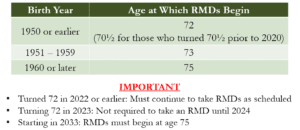
Now, this is pretty simple, but I want to make a couple of important points here. First, like I mentioned, those who have already turned 72 in 2022 or earlier will continue to take their RMDs as planned. The SECURE Act does not impact those. Those turning 72 in this year will not be required to take their RMDs until 2024. So that they won’t have to take that until they’re age 73. And lastly, those starting in 2033, all Required Minimum Distributions will begin at age 75. So, some really important changes there. It’s a phased-in RMD change.

Now, how does this impact retirement? How does it impact those that are preparing for retirement? There is just a few points I want to make here on this. First, those that are planning on and living on all the Required Minimum Distribution or all of their IRA income, will have a very little impact with this. They’re living off of all the Required Minimum Distribution whether they take that, whether their RMD starts at 72 or 75, they’re going to be living on all of it. It’s going to have very little impact to them.

The RMD age change did not impact Qualified Charitable Distributions, the age at which you can begin that. It’s the tax strategy where you can pull money out of your IRA retirement accounts tax-free, as long as it goes to a qualified charity. That still can continue at age 70 and a half. So, the RMD changes did not impact that.

Ultimately, the biggest thing that this does is that it gives you more time for planning. Particularly, the one strategy in mind that this could be very beneficial is doing Roth conversions where you’re taking money out of your IRA, converting it into a Roth IRA so that it’s now tax-free, and can grow tax-free. And I can see this being beneficial because those that are actively doing these Roth conversions and instead of, you know, having to do conversions until age 72 or 73 may now have more years, a few more years to age 75 or 73, depending on your situation, to do these additional conversions. And that way you can take advantage of those lower tax brackets and better planning there.

Surviving Spouse – Required Minimum Distributions (12:36)

The next big change related to Required Minimum Distributions is it impacts surviving spouses. So before The SECURE Act 2.0, generally surviving spouses, so if a spouse has passed away, the surviving spouse would take their IRA account as their own. And once they start Required Minimum Distributions, it would be based on their age. With The SECURE Act 2.0, you still have that option where you can take your IRA and your deceased spouse’s IRA and roll it over into your own IRA and take RMDs based on your age.

But you also have the option, the surviving spouse, to take Required Minimum Distributions based on your deceased spouse’s age. And so you’re probably thinking, why is that important? It’s mainly important for those that apply where the deceased spouse here is much younger than you. Think about it this way. If your deceased spouse is 65 and you are at RMD age at 73 let’s say, you have the ability to rather than taking your RMD right away because you’ve reached your Required Minimum Distribution age. You may be able to delay that until your deceased spouse would have started Required Minimum Distributions and therefore give you more time again for Roth conversions, or any other tax, or financial planning strategies that you’re working on.

And so, this is a small change, but I think it does make a big impact when it comes to planning. So that’s the two major changes related to the Required Minimum Distributions. I’ll let Alex take over here and talk about how Qualified Charitable Distributions have slightly changed.

Qualified Charitable Distribution Changes (14:24)

Alex Call: So Qualified Charitable Distributions as many of you know, it’s one of our favorite tax planning strategies. As Carson highlighted, it’s the ability to put money, it’s a tax-free transfer, from your IRA to a qualified charity. The big thing here is that there’s really only one change that has happened, and it’s for the better. The annual amount that you can contribute as a QCD is now going to increase with inflation starting in 2024. So, before it capped out at $100,000 and now that will be inflation adjusted.

And so what this means is that we can still do QCDs at age 70 and a half. They still satisfy your Required Minimum Distribution. You’re still only able to do it out of an IRA. You’re not able to do QCDs out of a 401k. And probably most importantly is that it doesn’t look like this strategy is going anywhere. They’ve just improved it and made it better.

Catch-Up Contributions in 401k or IRA (15:38)

The next thing I want to talk about are catch-up contributions. So catch-up contributions are when you turn 50 years old, you are able to contribute more to your 401k, or IRA, or retirement plan. Allowing you to catch up your retirement contributions.

And so, there’s really three main changes that have happened here. The first one is that it is now with your IRA, it is that the catch-up amount for your IRA has been stuck at $1,000 for about the past 10 years. Well, now that $1,000 is going to be inflation adjusted.

The next is there’s going to be an extra catch-up contribution for people between the ages of 60 and 63. The amount on this, we’re not quite sure on. The language used in The Act, it’s a little confusing. And so, we are still waiting for Congress to share some additional information or some clarity on that. But just know that when you turn 60 to 63, you’ll be able to contribute an extra catch-up during that time.

The last one is what I call “rothification” of these catch-up contributions. And what that means is, if you are making over $145,000, then any catch-up contribution to your 401k has to go into a Roth 401k. You’re not able to make a contribution to a traditional 401k.

And so you may be thinking, well what happens if my plan does not offer a Roth if there is no Roth option within my plan? Well, unfortunately, you’re not able to make catch-up contributions if that’s the case. With that said though, a lot of these minor changes that we talked about earlier in The Act go towards making Roth plans more accessible and encouraging more people to set up Roth plans.

So what I would expect and really assume is many if not all 40lks, simple IRAs, and so forth moving forward, will have Roth options. It might take a year or two for the plans to implement, but I would assume that most if not all of them will begin to have Roth options as well.

And now I’m going to turn it over to Carson just so he can highlight a couple of things that were not covered in the plan or in The Act.

What was not covered in The SECURE Act 2.0 (18:36)

Carson Johnson: Thank you, Alex. So when it comes to legislation that’s passed like this. A lot of times many retirees and many, many people are concerned about current tax or financial planning strategies going away or being limited. And so we thought this would be helpful to include a few items that were not impacted, not changed by The SECURE Act 2.0.

The first of which was the elimination or restricting of Roth IRAs or Roth 401ks, that nothing has changed regarding those accounts. And including as part of that, the use of backdoor Roth conversions or mega backdoor Roth contributions, which is a more, a little more complex tax strategies have also not been impacted. So in that, it includes normal Roth conversions. There aren’t any provisions in The SECURE Act 2.0 that addressed those changes.

The age at which you can begin Qualified Charitable Distributions has not changed like Alex has mentioned. It continues to be age 70 and a half. And so, even if your RMD age is pushed back to 75, you’ll still be able to take advantage of this awesome tax strategy once you’ve reached that age.

And then lastly is the clarification on what’s called the 10-year rule that was originally created by the first SECURE Act. And it really only applies to those that inherited IRA accounts from non-spouses. Meaning if you inherited an account from an aunt or an uncle that was already taking Required Minimum Distributions, it was on the original understanding that you had 10 years to be able to pull that money out from that account. You had 10 years to pull all that account money out of that account.

But there might be some additional clarification where you might have to take some Required Minimum Distributions each year within that 10-year window or some other changes that they’re going to come out with. So that clarification has not come out yet. We’re expecting an answer, some additional insight on that later this year or even next year, the beginning of next year. And so we’ll be keeping an eye on that.

But those were some of the four main things that people were worried about that was going to change with this bill that actually was not covered and not changed.

So in summary, like Alex talked about, there is a lot of different things that the bill covered. There was about 4,000 different pages that was included in this bill, but we wanted to cover the most important things that pertains to retirement. We talked about how the 529 transfer rule works to Roth IRAs and how that can be used as a legacy planning tool. We talked about Required Minimum Distributions and how those ages have been pushed back as well as the additional changes for surviving spouses. We talked about the inflation adjustments to Qualified Charitable Distributions and how they will adjust each year for inflation as well as the retirement catch-up contributions. And ultimately what was covered and what was not covered in The SECURE Act 2.0.

So we want to leave you with a couple of questions here today. First, think about how will these changes affect my plan and how can I best plan going forward.

For clients of Peterson Wealth Advisors, reach out to your advisor if you have questions. Be rest assured your advisor will bring these changes up to you if it applies to your situation. But during your spring meeting, feel free to reach out or sooner to see how these changes might apply.

And those that aren’t clients of Peterson Wealth, but would like to know how these changes might impact your retirement and your situation, feel free to reach out to our office and schedule a free consultation. We’d be happy to meet with you and at least point you in the right direction.

So now we’ll leave the rest of the time for questions. We may not be able to get to everybody’s question today. But if we don’t, feel free to send an email to info@petersonwealth.com. We will make sure that one of our Certified Financial Planners will reach out to you and answer your questions. But for now, we’ll leave the rest of the time for you and your questions that you may have.

SECURE Act 2.0 Question and Answer (23:01)

Daniel Ruske: Oh, I didn’t mean to interrupt. Sorry, Alex. I have a question here that Greg wants to know the answer to, are you ready for it?

Alex Call: Yeah.

Daniel Ruske: So it says, is it only the extra catch-up amount that has to go into a Roth, or is it all catch-up contributions now?

Alex Call: It’s a great question and I appreciate that. To get that clarification, it is all catch-up contributions. So once you turn 50, if you’re doing the catch-up, that has to go into a Roth 401k.

Daniel Ruske: Awesome, and then we had some other questions that I know Carson answered by typing, but I’ll read them here for the class. It says, any moved funds from a 401k to an IRA so one can do a Qualified Charitable Distribution?

Carson Johnson: Yeah, so on that one, the answer is yes. So it’s important to remember with this Qualified Charitable Distribution strategy that you can only do that from an IRA retirement account. So QCDs are not eligible and 401k’s or 403b’s or other retirement plans are only eligible from an IRA, and it’s actually pretty easy. If you roll over money from your 401k, you can actually set up an IRA account at Fidelity, Schwab, Vanguard, or any of the major companies. And just roll it over so that money goes from your 401k to your IRA and to be able to do that strategy.

Daniel Ruske: Awesome. A couple more coming in that I think are good. How do you differentiate between a catch-up contribution and a regular contribution?

Alex Call: That’s a great question. We don’t really know how that’s actually going to be applied and that will likely be something that the 401k plan administrator, the one who manages the 401k, will have options and be able to help you differentiate between those two. Between what’s a catch-up and what’s the regular.

Carson Johnson: Generally though, if you haven’t reached your 401k contribution limit, your first contributions will be the 401k or will be the regular contributions. And then once you’ve reached that limit, then that’s when the catch-up contributions kick into place. But every plan is different. So it’s up to like Alex said, the plan administrator there.

Alex Call: Yeah, but Carson just again to reiterate that it will be having the first money in will always be the regular, and then it’s the last money. So let’s say the regulars $20,000 for the year and the catch-up is $4,000. Those numbers aren’t accurate. But for the first $20,000 it is the regular. And then the last $4,000 that you put in would be catch up.

Daniel Ruske: Very good. So Kevin has a question, here’s the question. And make sure to sort this out here. It says, when RMD start, first day of the month following the month turning the required age, or is it April the year following the year you turn the required age, say 73? I’ve heard different definitions of what the actual RMD is required to start.

Carson Johnson: Yeah, great question there. So with Required Minimum Distributions, how it works is generally your first one is due by December of that current calendar year. However, there’s an exception for your very first one. So The SECURE Act did not change this at all actually. So if you’re taking your very first Required Minimum Distribution, let’s say you’re turning 72 in this year, 2023. With the change to The SECURE Act 2.0, you don’t have to take it this year, you can take it in 2024. But because it’s your first RMD, you actually have the ability to wait to take your RMD until April of 2025.

And you can do that if you want. But then the danger with that is that if you wait till April 2025, you’ll have to take that RMD plus the RMD that’s due for 2025 by December of that same year. So essentially, you’re going to have two RMDs due in 2025, in that particular example.

Daniel Ruske: Very good, so I’ll do one last one if that’s okay. So Dave wants to know, it says, a QCD transfers funds to a charity but has no tax advantage in the year the funds transfer such as a donation to a Donor Advised Fund. Is that true?

Alex Call: So with that, to answer the question David, you’re not able to, you don’t get the charitable contribution deduction in that year. But what you are able to do is that the money that you take out of the IRA, instead of you paying taxes on it and then donating it to charity, it just goes directly to charity.

And so it’s a tax-free transfer. So a lot of what we have found is that for about the majority of our clients, that the QCD is more advantageous at 70 and a half than a Donor Advised Fund. But there are always exceptions with that. And for your case, or for anybody else’s, your advisor will be able to let you know if it makes sense to do a Donor Advised Fund instead of a QCD. But for the majority of people, we have found that the QCD is more beneficial.

And then I was going to do, just really quick, we had somebody ask us if we can notify you through email when we find out the details on the amount allowed on the extra catch-up contributions for those between 60 and 63? Absolutely, we’ll go ahead with that. We’ll put a note in that and we’ll send out more of a mass email to our email list for that.

And then Carson, we had one more. So do the Roth earning limits apply to the catch-up contributions now that catch-up needs to go into a Roth 401k?

Carson Johnson: Yeah, so on that, how I understand it, and Alex you can correct me here if I’m wrong, but when it comes to the actual amount that’s contributed that’s counted towards the limit is just your contribution that you make. The earnings that are on those contributions are going to apply to the catch-up contribution there.

Oh, on that one, so that’s a great question. So Alex asked, or talked about a lot of the catch-up contributions for 401k plans, retirement plans, and how if you exceed a certain dollar amount that those catch-up contributions have to go into a Roth 401k. That does not apply to catch-up contributions for IRA accounts.

So you can still earn more than the $145,000 limit and your catch-up contributions, your additional amount that you can make to IRAs, does not have to be Roth it can still be traditional IRA.

Alex Call: That’s good. Well, that’s all the questions that we have. Thank you very much everybody for attending. If you could there will be a really brief survey. If you could fill that out as soon as we end this that would be great. We’re always looking for input of how we can improve, and probably more importantly what it is that you want to learn about so that we can get you the information that you’re wanting to know about.

So, thank you again. And Carson thank you so much for helping.

Carson Johnson: Yeah, you’re welcome. Thanks guys.
3 Strategies for Retirees to Save Taxes Through Charitable Giving

3 Strategies for Retirees to Save Taxes Through Charitable Giving

Mark Whitaker: Alright, well we’re just about ready to get started here. We’ve got a question for everybody as your joining the meeting here. We’d love to know where you’re joining from. So in the Zoom meeting, if you’re familiar with using the Zoom platform, there is a chat feature. We’d love to hear where you’re from and tuning in from. So if you want to put down your city, or state, or whatever it be. We’d like to see where everybody is joining from.

We got someone here from Provo. We’ve got a local, a local in the audience. Let’s see, we got South Jordan here and Payson. Utah is well represented.

Mark Whitaker: HK, we got one that came in HK, and does that ring a bell to you? Daniel, what is HK?

Daniel Ruske: Hong Kong? I don’t know.

Mark Whitaker: Oh maybe. Maybe I’m looking for a clarification from that one. We got Nevada, Hong Kong, you were right from Hong, Kong, very cool.

So it looks like we essentially have Utah, Nevada, and Hong Kong here. Here we got southern California. Okay, alright very fun. Well, welcome everyone. I think we’ll go ahead and get started for those of you who signed up for the webinar. You probably noticed there was a different face initially on the webinar invite. Carson Johnson, he was going to present today, but unfortunately, he woke up this morning and was feeling awful. And so he asked that we get someone to fill in. So Daniel, one of our senior lead financial advisors, will be joining me today to cover the part of the presentation that Carson won’t be able to cover today.

For those of you who are unfamiliar with Peterson Wealth Advisors, we specialize in providing retirement planning services – financial planning, investment management, and tax planning – for people who are about to retire, or who are already in retirement. As it might indicate from today’s topic, taxes used for retirees are a very important issue to get right. And so we’re excited to do this webinar.

A little bit about Daniel Ruske, he’s one of our lead financial advisors. He has both a Bachelors’s and a Master’s degree in personal financial planning. He’s also a Certified Financial Planner™ professional, and he’s been with the firm for a number of years. Before joining the firm he worked for another financial planning company here in Utah.

A couple of housekeeping items, for those of you who’ve been on our webinars in the past, this will be very familiar. But we have a couple of things to note. Today’s presentation will be about 20 minutes. We want to cover these topics fairly quickly. So we’re not going to go into a lot of detail, but we like to hit the high-level topics and allow for more time at the end for questions and answers. As you’re listening to the presentation today, as you listen to the webinar, Alek Johnson another one of our financial advisors, he’s also a Certified Financial Planner, he will be monitoring the chat line and the Q&A box.

While we’re going through the presentation, if there’s a question that comes up, you don’t have to wait till the end to type it in. Go ahead and type it in and he’ll be able to answer some of those questions during the presentation. And at the end of the webinar, I think we’ll choose a few of them that will be helpful that would be good to cover for everybody attending today. So please use that feature.

Inevitably, as we talk about taxes, as we talk about these topics there are always going to be things that we can’t cover in detail. So if there’s something that wasn’t addressed clearly, or you’d like to follow up with us to get some questions answered, you can reach out to our firm afterwards, and I think Alek, he’s going to go ahead and put in a link within the chat box. So if you’d like to just schedule a time to meet with one of our Certified Financial Planners to ask some specific questions or to go over something in more detail, please take advantage of that. Or if later on, if you just have a question and you just would like a one-off, you’re not necessarily interested in having a dialogue, but maybe just have a single question, please feel free to reach out to our firm through phone or email and we’d be happy to help you out.

A couple of other housekeeping items. Let’s see, at the end of today’s presentation, we’re also going to have a survey. We appreciate your feedback and every time that you answer those we always look at them. And hopefully, we can make these presentations better and more helpful for everybody.

With that all being said, Daniel, do you think I missed anything that maybe we need to cover for housekeeping items?

Daniel Ruske: Alek covered the question that came through the chat. The recording will be sent out to everybody who’s registered. So if you’re not able to attend the whole time or if you want to go back and watch another part again, you’re able to do that. We normally get that email out the following day.

Mark Whitaker: Oh wonderful, thank you Daniel. That’s perfect. So let’s go over to our outline for today’s presentation. We’re going to go over a quick tax refresher before you jump in, and we learn about strategies and talk about how to apply them for retirees.

A brief review of some core principles of the tax code I think are important. So we’ll do that and then we’re going to get right into the strategy that we talked about. Different ways of doing charitable giving to maximize tax benefits for retirees.

So we’ll talk about bunching. We’re gonna talk about donating appreciated assets. We’re also going to talk about using a Donor Advised Fund and making Qualified Charitable Distributions. Like I said, at the end we’ll make time to have a Question and Answer portion.

So with that all being said, let’s jump into, let’s call it Tax 101.

Tax 101 (5:50)

Now I’ve used the analogy, maybe a bit well-worn, but I think it serves its purpose. When you play a board game, and I’ll use the example of monopoly. You have specific rules. And if you want to win, you want to do well in the game, you got to understand what those rules are. And if you don’t understand the rules then you know you’re going to have trouble developing a strategy to have the most advantage.

And as far as taxes go, it’s the same thing. There are rules, and the rules for taxes change from year to year. And so it’s important to work with somebody who can help you understand what those rules are. But there are some general concepts with taxes that basically stay the same from year to year. So that’s what we’ll cover today.

So, with taxes, the individual income tax formula is the basic kind of order of operations for calculating how much taxes somebody has to pay. So for everyone, we start with income.

There’s a lot of different types of income and each one of those different types of income might be taxed at different rates, or there might be a different percentage applied to those kinds or to the different sources of income. Well, when you have income come in, you’re able to exclude some of that income from taxes. So, you don’t even have to count it as income. Those are called above-the-line deductions, or exclusions. These are things that you’re probably familiar with like making a contribution to a Health Saving Account or making a contribution to your 401k or IRA account.

When you make those contributions, you’re making them from income. And that kind of contribution excludes that dollar amount from income. That’s how we arrive at something called your AGI, or Adjusted Gross Income, and this is an important number.

The Significance of AGI

This line right here, your AGI, you’ve probably heard about that because this is the line in the tax code that many of the tax credits and different rates are applicable to. So how much you pay for your Medicare Part B premium in retirement is based off what your AGI is. Whether or not you qualify for certain retirement tax credits in your state or at the federal level is contingent on your Adjusted Gross Income. So this is a very important number, and anything that we can do to manage this number for taxes is very important.

Well, from there, everybody gets to take some additional deductions. You’ve likely heard of something called the standard deduction and something called itemized deductions. A standard deduction is a particular number based on your filing status, whether you’re filing as an individual, or whether you’re filing as a couple married filing jointly.

For example, those are the two most common filing statuses. This is a deduction that you’re able to take. In addition to that you can also, or I should say, kind of alongside that, there are certain things that qualify for tax deductions. And if you add up all of those other deductions and it’s greater than your standard deduction, then you get to deduct the itemized deductions. But if it’s not, you just take the standard.

So fairly familiar ideas. Once you’ve taken off your standard or itemized deduction, that’s how you get to your taxable income there. That’s where you calculate based on your rates, you’re able to deduct credits. And that’s how you know how much of a refund or how much taxes you have too.

Okay, everyone is entitled to tax deductions. And as a quick refresher, these numbers here, these are the numbers for, I’ll pull up my little laser pointer, for the different filing statuses for single and married filing jointly. Now one thing for retirees after you’ve reached age 65, if you’re taking the standard deduction, you get to add an extra deduction to your standard deduction. So, if you’re married, each person gets to add $1,400 to the standard deduction. That’s $1,400 per person. Or if you’re a single filer, you get to add $1,750 and additional deductions.

Okay, a quick refresher. Because of tax law changes that happened back in 2018, most people who file their taxes are just going to take a standard deduction and that’s remained the case for the last several years. So, the question is, with the new tax law, I should say the tax law that was implemented then, how can retirees still get a tax benefit from making charitable contributions?

So that’s what we’ll get in now. So, Daniel do you want to cover today, do you want to cover our first strategy?

Tax Strategy #1: Maximize your Deductions by “Bunching” (10:41)

Daniel Ruske: Yeah, absolutely. So, the first strategy is bunching. Now, as Mark mentioned with the change to the increase in the standard deduction, a lot of taxpayers really take the standard. And what this means is they don’t really get tax benefit for the charitable donations that they make.

What is Bunching?

And so, the first strategy we’re going to talk about today is bunching. Now, what bunching is, it’s basically lumping multiple years of donations into the same year for the purpose of trying to get above that standard deduction and get a charitable tax credit for your donations. Now, I want to introduce to you the most famous bunch family I know, and this is the Brady Bunch.

Now, as we go through the Brady’s tax situation, theirs might seem pretty similar to some of you. So, Mike and Carol, they kept a detailed record. And this is what they’ve had for their itemized deductions for the year. And keep in mind that these deductions, the goal is to get it higher than the standard so that we can take the higher of the two.

Bunching Tax Example

So, for these two, they have the property and state income tax of $6,000. They have mortgage interest of $4,000, and then they have their charitable donations that they’ve made in 2022 of $12,000. If we add up all those itemized deductions together, it’s $22,000. And we cross that to the standard deduction and we’re obviously going to take what’s higher. It would be better for them to take the standard deduction.

Now, as you can see in this scenario, let’s go back just for a quick second Mark, the $12,000 that they donated, they could have 0 on that line and their taxes would be the exact same. So, they’re getting no credit for that $12,000 donation.

Now the next scenario that we’re going to talk about is the same, everything is exactly the same. Except for this time, they donate 2022 and 2023’s charity in the same year. The same property in state income tax is $6,000. The same mortgage interest is $4,000. But this time you can see on the line there, 2022 and 2023 donations are paid to total $24,000. In this case, we add up the itemized deductions, a total of $34,000. We cross that to the standard deduction. The Brady family this year, they’re going to take the itemized deduction, which is higher.

Now the plan when you do a bunch like this, a 2-year bunching strategy would be every other year in 2022. You itemized by donating 2-years’ worth of charity. The next year you’ve already paid the charity at the prior year, so you’ll take the standard and as a result, this gives you an average deduction of $29,400. In this scenario, obviously, your numbers will be a little different. But in this scenario, it results in a yearly savings of $828 each year.

Now, let’s cross that to 3-year bunching. So, in this scenario, the plan would be to donate 2022, 23, and 24’s charity all in the same year. You know we have the same property and state income tax, the same mortgage interest. But this time, the charitable donations are $36,000, 3 years’ worth of donations. As we add all those itemized deductions together, we get $46,000. It’s obviously much greater than the standard deduction.

The Brady’s will take the $46,000 as the deduction for their 2022 income on their income tax return, and then you can see in this plan you would donate 3 years, get the deduction. Then the next 2 years you would take the standard, and then in that, in that fourth year, you would determine if it makes sense to bunch again. And by doing a 3-year, bunching strategy you can see that Mike and Carol are saving approximately $1,272 each year.

More on Bunching Tax

Now a few things to highlight about bunching is, you know, you have to have the money to pay upfront right? And you have to kind of give this lump sum, you know, either 2- or 3-years’ worth of donations in the same year. And so, keep that in mind when applying the strategy. And then the other thing to consider is maybe you have this money, you’re ready to donate, and you know you’re going to donate it, but maybe you don’t really want the charity to get it all at once. Or maybe you don’t know you know, for sure, what your charitable desires will be in the future. Are you able to get a donation this year, and then divvy it out later on?

And the answer is yes. And so the answer to do this would be a Donor Advised fund. Now a Donor Advised Fund, is abbreviated DAF or DAF. So if we say DAF, we’re referring to this Donor Advised fund. And really, I think it should be called a Donor Advised account. I think it just makes it easier to understand because this fund is actually an account that an individual can, or a joint couple or family can establish. Really it’s an account, a personal charity account for you.

And as you can see on the screen if you follow the arrows, the advantage is you can donate cash, or appreciated stock donations and kind to this account. Now you get the tax deduction the year you donate it to this account. However, this account is something that you and your family can manage and really divvy out to the end charity in any amount that you want and really at any rate that you want.

So this account works really well if you’re bunching and you want to, you know, maybe you have a grandson, or daughter going on a mission next year. And you want to help with their mission, but you want the donation this year.

DAF

Well, you could donate to a Donor Advised Fund, have it sit in this DAF account until the need arises for a charity. And then from the DAF, you transfer to the end charity. And I will note that if you donate to a DAF, all of the funds in that account, or that Donor Advised Fund must go to a charity. There’s no way to get it back. So as long as it goes to a qualified charity, this can be for you know, really any of the donations, to the Church, it can be to any qualified charity that you could think of that you might donate to.

Very good. And then, the last thing I want to, well I’ll go through these points really quick and just read them. The reason why a DAF might work for you is with a DAF bunching of donations it becomes much easier to do and charitable giving becomes much more flexible.

A DAF also helps the donor to get tax deduction when it’s needed the most. And I want to talk a little bit more on this point here. You know, a DAF is common, we use it with our clients. Let’s say they sell a property, or they sell a business, or they get some type of payout the year that they retire. The advantage to do a bunching strategy or utilizing a DAF in a year when you have higher income is it makes the tax benefit even greater. So let’s run through a scenario real quick.

Husband and wife, they sell a property. They have much higher income than they normally do because of the sale of this property. They also have some extra cash that they could donate so they take the proceeds from the cell of this property. They donate 2- or 3 years’ worth of donations into a Donor Advised Fund. They get the deduction the year that they have the high income. And then they have this account that they can use for charity, really for the remainder of their lives. And I’ll add one more thing here, is, let’s say you have funds remaining in a DAF when you pass away. You can designate an end charity as the beneficiary of that account. Or you can name one of your family members to continue to manage that account on your behalf even after you passed away.

So, if you’ve donated to a DAF, and you haven’t used all of those funds, you could name your son or daughter and they can continue to use that for charity purposes as the family sees fit. So, it really is a great tool and that goes to point number 3, it creates a charitable fund for future generations there.

Tax Strategy #2: Donating Appreciated Assets to Charity (19:26)

Very good. Strategy number 2, Donating Appreciated Assets to charity. Now, this idea has been used in the past. We’ve heard of donating eggs and milk and wheat to charities. And rather than donating just cash or money right? And the item, that I’m going to bring up today is donating apples. And you may not donate an apple from a tree, but you donate apple stock. So the donating of appreciated assets. What this is, is let’s say, you bought apple stock and the stock has grown inside of this. And the shares they are embedded gains that if you sold to cash, you would have to realize the long-term capital gain that you’ve had on this apple stock.

Donate Directly to Charity

Now, what if you donate it directly to a charity? Well, what happens is you don’t have to realize that capital gain, and the charity also doesn’t have to realize that capital gain. And so, I have here on the screen on the left-hand side, we have a situation where we have appreciated apple stock. On the left-hand side, we have the $25,000. We sell it to cash and then we donate the cash. What happens in this scenario is, we have to pay $5,000 worth of State and Federal tax to give us a net of $20,000, which we then can donate to our charity.

Now, on the right-hand side, what if we just donated the apple stock directly to our charity? Well, you can see instead of paying $5,000 to State Federal tax, you pay nothing. And I’ll note that the charity also doesn’t have to pay this. What happens here is the charity gets an additional $5,000 and the donor doesn’t have to pay the tax on the gain. The donor also gets to deduct the full $25,000, versus just the $20,000 net after taxes. And then the last thing here is you can use the cash, say the $5,000 savings to reinvest, in you know, let’s say apple stock again, or another stock. And a few years down the road after it’s grown and has this appreciated value to it, you can then do the same strategy again. You could donate the appreciated stock.

So we have clients that you know, they donate let’s say $10,000 per year. And rather than donating cash, they donate $10,000 worth of stock. And then with that $10,000 that they’re taking from their wages, or from you know their Social Security or so forth. They then just reinvest that cash back into stocks. And then we kind of have this always maturing or always ready to donate appreciated stocks, and it works out to be a great strategy there. The last thing I’ll mention.

Mark Whitaker: Daniel, I was going to, Dan sorry to interject I was going to ask you. So, what we’ve talked about donating stocks that have gone up in value. Are there other or what are some of the other types of investments or in-kind donations that a person could make?

Daniel Ruske: Yeah, so perfect question. So, there are ways you can donate, say a part of a business. There are ways you can donate part of a property too.

So, let’s say you have an appreciated business, that the basis in it that it’s growing a lot larger. There are ways to donate this to avoid the capital gain on selling this. You know in this case, it’s not a stock but a property or business to then defer, or not defer, but don’t donate that, those gains and save those taxes. And then Mark maybe you have more you want to add to that question.

Mark Whitaker: Yeah, I was, I would maybe just to put a bow on it. I think you put it really well Daniel. Maybe the one last little thing that I’ll add is to say that when you donate appreciated investments that have gone up in value. A good way I like to think about it is you’re getting to double dip with your tax benefit.

Like Daniel said you’re able to, number one, you don’t have to pay the capital gains tax on the growth that you had in the investment. So now all of a sudden, you’ve avoided a certain amount of additional income. So that’s the first tax benefit. And the second is you now have the ability to donate a larger dollar amount potentially and increase, you know, the ads to your itemized deduction. So, this is a great strategy that’s known. But it’s also overlooked enough that we wanted to make sure it was included for today’s presentation, a very powerful tool for really for anybody, but especially for retirees.

Daniel Ruske: Excellent, I’d just add one more thing, Mark. A lot of charities have a donation and kind department. So, if you have questions about a particular charity, and if you can donate stock, or appreciated asset of any kind, you know we’re happy to do some research for you and contact that department. But a lot of those have it. And I saw a question pop up.

Can you donate stock to a DAF or does it have to go directly to the charity? Yes, you can donate appreciated assets to a Donor Advised Fund. So that could work.

Mark Whitaker: So, you know into your last point Daniel. I’ll just say this last one thing before we move on. To your last point, about not knowing whether the charity that you want to donate to, whether or not they have the ability, you know the team to be able to accept appreciated investments, you know except stocks and that sort of thing. And this is one of the other benefits of using a Donor Advised Fund, is that you know using a Donor Advised Fund, we like to use the one that’s done through Fidelity, Fidelity Charitable. But there’s a lot of other ones that are excellent.

These larger financial institutions have the legal and accounting teams and just the infrastructure to allow you to make donations of appreciated assets. And then from there you know, you can send a check to you know the food pantry or you know, what other maybe local charity that doesn’t have, maybe doesn’t have the bandwidth because they’re a smaller organization. You can just send them cash and make it so it can facilitate donating to the people that you want to.

Tax Strategy #3: Qualified Charitable Distribution (26:04)

Okay, so the last strategy that I’m going to, that we’ll talk about today is something called a Qualified Charitable Distribution, a QCD.

And up to this point, all of the strategies that we’ve discussed have related to trying to maximize your itemized deduction. So instead of taking the standard deduction, what if we donated multiple years of donations to be able to bunch and get a higher itemized in a particular year. And then on average, you know, we’ll have higher deductions. Or what if we donate shares of stock you know this way, we’re able to increase that itemized deduction. All of those deductions, or all of those donations, are coming from non-retirement accounts. And when I say non-retirement, what I’m referring to is you know, like a brokerage account, or a bank account.

Now, with this third strategy, Qualified Charitable Distributions. This is a little bit, different. This is a charitable giving strategy that is only available through a particular type of retirement account, an IRA. Nothing fancy, many of you have heard of it. It’s like a 401k account. Not through a company, just on your own. And this giving strategy is also only available to folks, who are over age 70 and a half. Now when you make a donation from a retirement account it also creates a deduction on a different part of the tax code. A deduction here actually reduces your AGI, your adjusted gross income. So it can have some additional tax benefits that the other strategies we discussed can’t do. So that’s what we’ll get into.

How does it work, and what is it? So like I said, a Qualified Charitable Distribution is a donation made from a retirement account, from an IRA. And when you do this, you’re taking money directly out of your IRA and setting it to a qualified public charity.

Now the benefit to doing that is you don’t have to recognize that the money you’re taking out, you don’t have to recognize that this is income. And for those of you who are getting closer to 70 and a half, or are already there, or may have just heard of this, once you reach age 72 in the United States, you actually are forced to take out a percentage of your retirement account each year. Whether you want to or not. Whether you need the income or not.

And so now all of a sudden, you’re going to be forced at 70 to take money out. This is a method of getting money out of your retirement account without having to pay taxes. So what are some of the benefits of doing a Qualified Charitable Distribution?

Well first of all, because you’re taking out, you’re taking it out tax-free, you don’t have to pay taxes on that distribution which you normally would have to. The other benefit is that because you’re reducing, because of the tax code, the amount of taxes you pay on Social Security could potentially be lower by making a donation this way versus other ways.

And a couple of, and then I guess maybe just to reiterate a point that we’ve already made, is that because of the higher standard deduction like Daniel illustrated, many people who pay to share, who make donations to charities don’t receive although it’s important to them. They don’t actually receive a tax benefit because their total itemized productions are rarely, you know, rarely exceeding their standard deduction.

How QCD Works

So let’s talk about maybe how, let’s look at kind of a, let’s get an example of how this works. So I have a retiree. Her name is Lori, and Lori is interested in doing a Qualified Charitable Distribution, a QCD. So we can see here on the left-hand side, these are her sources of income. She has Social Security, she has a pension, and every single year, at 72 now, she has to take out $10,500 from her IRA account. Now you can see that below that, we have her itemized deductions.

She could either do an itemized or standard. Well, she has her State and local taxes. And then she is going to plan on making about $7,000 worth of charitable contributions. So actually looking at her itemized deduction, $15,000, it is higher than the standard deduction. So she says, great I’m going to itemize. And with that, she has a total tax bill of $5,471. Now FYI, we have people tuning in from not just the United States, but other countries as well as every state. The numbers I’m using for this are for U.S. federal income tax and income tax for the State of Utah. I say that because every state has a different way. Some have an income tax, some don’t. They’re all different so just a little disclaimer here.

Okay, so with this she says well what if instead of doing an itemized deduction for the $7,000, what if I did a QCD? Well, let’s look at what that would do. First of all, we have the same income sources, pension, Social Security. I’d like to highlight one thing here on this page. You can see here that next to Social Security. In the first example, of the $35,000 she received, $16,400 was taxable. Well now, in the second scenario, only $10,450 from Social Security is taxable. Now, why is that? It’s the same Social Security.

The reason is because now that she doesn’t have to claim this $10,500, that full amount is income because she’s going to take out 7,000 and send that directly to a charity. It has an additional tax benefit in that she doesn’t have to claim as much of her Social Security as taxable income. That was a lot, maybe a little too wordy, the way that I put that. But the bottom line is that by doing a donation this way, you can potentially save additional taxes by lowering the amount of your Social Security benefit that is even subject to taxes.

So, let’s look at the numbers. Well, for itemized, she just has her state and local taxes. No charitable because she took it here. She can’t double-claim it. And so now she’s going to take her standard deduction. And you can see here that are total state and federal tax income taxes for the year are $3,108. So the bottom line is, she’s going to save almost $2,400 in taxes. Not by donating extra, but just by changing the method, the way she donates.

QCD Example

Okay, next example. We’ve got Jim and Lisa, and we have their income sources here. Pension, Social Security, and they’ve saved up a lot of retirement savings. So their required distribution is $60,000 for the year. Okay, we look at their state and local taxes and they’re going to donate about $25,000 to charity this year. Well, they’re going to take the itemized deduction. Often we have people ask us, “Well I already itemized because of how much I donate so this isn’t relevant for me.” Well, it may. Sometimes it’s not, but often it is.

So you can see that they’re going to take the itemized deduction and they have a total tax bill of just over $18,000 between state and federal. So, let’s look at what would happen if they did a QCD instead.

Well, here you can see that they’re taking out instead of $60,000, $25,000 of that is going to go directly to their charities. Instead of taking an itemized deduction, we’ll take a standard deduction. And you can see their total tax bill here is about $13,460. So again, even for somebody who was itemized, by changing the method by which they donate, they’re saving over $5,200 in taxes. By donating extra, doing anything special, except for this one thing, which is changing the method of donation. Doing a QCD versus itemizing it.

What to Know about QCDs

Okay, a couple of things to know with QCDs. It’s almost always beneficial to do it, not always, but almost always. And really to answer this question, we just need to run two scenarios, look at it both ways, and see if it makes sense. And to answer the question, yes, it does satisfy your required distribution. I was going to go into detail here about how to report a QCD. This is really the realm of your CPA, and this is something that’s a lot more well-known now. So I won’t do any details here, but obviously, you can ask more about that later.

You have to be 70 and a half to do a QCD. It has to come out of an IRA and you can’t do it from a 401k. Unfortunately, that’s part of the rule. So you have to do a rollover from your 401k to an IRA. And then from there, you can do QCDs. The donation has to go directly to a charity, and if you were curious, there is an upper limit where you can’t donate more than a $100,000 in a particular year.

So we’ve got some lessons I guess to pull from this. Getting to know your numbers. We need to base our decisions on real information. It’s hard to do planning unless you know the rules right? And taxes matter. By implementing these strategies, this is a way that you can have more money for your standard of living.  Inflation is relevant, so the more that you can keep for yourself, rather than paying in taxes, is going to help with that. And you’re going to be able to support causes more efficiently that are important to you.

So with that being said, I think we’ve covered everything that we want to. We’ll go into our question-and-answer section now. And so, if you have a question, go ahead and put it into the Q&A box, and Alek I’ll turn the time over to you. Any questions that have come in that maybe we can get started with?

Tax Question and Answer (35:49)

Alek Johnson: Yeah, perfect. We’ve actually had a lot of really great questions. So, the first one here is just, I’ve kind of partially answered, but if you do want to speak more to it.

If you own a home. Isn’t it always better to itemize deductions?

Mark Whitaker: Yeah, great question. Daniel, do you want to jump on that?

Daniel Ruske: Yeah, great question. So, if you own a home, is it always better to itemize? My initial thought would be no. Now there’s an advantage to having mortgage interest because that goes to your itemized deductions. And then maybe helps get you closer to getting your charitable donations to help you on your tax credit. But I wouldn’t always say no. I would say you really have to take it case by case. Mortgage interest can help you on your taxes, but then you are paying interest to the bank. And so really, we’d have to dive into the situation to determine what’s the tax savings versus what interest you’re paying to the bank to figure out, okay does it make sense to itemize, or to just look into something else.

You have anything more to add there Mark?

Mark Whitaker: I know, I think that’s great. I was going to say just by way of example with many of our clients. I would say that most of our clients, they’re retired, or they’re about to retire, and they have their homes paid off. And those that don’t have their homes paid off have fixed-rate mortgages with very small mortgages. And so that being the case, most of our clients are taking standard deductions most years, even though they own homes. And that’s not because you know some philosophical, bent towards yes we have to take a standard deduction.

Like Daniel said, we just have to look at the numbers and what actually makes sense on a case-by-case basis. So yeah, just because you own a home doesn’t necessarily mean as a retiree that you will itemize. So a great question.

And given the time here, Alek, maybe we can do maybe one or two more good questions. And then I’ll say if with the questions that have come in, if you didn’t get your question answered, or you have other questions like I said you can reach out to our company directly and we’ll be happy to answer more questions for you. But any others there Alek?

Alek Johnson: Yeah, perfect. So one more that might be worthwhile for the general public here.

When donating appreciated assets to receive the tax deduction, do your deductions have to exceed the standard deduction to make it beneficial?

I kind of partially answered that there’s kind of two portions here of the tax benefits between the appreciated assets themselves, and then getting above that standard deduction if you want to talk about that.

Mark Whitaker: Oh, I love that Alek. Yeah, you really hit the nail on the head. So to answer the question, when you’re donating appreciated assets, does it have to be greater than the standard deduction to even make it work?

Like Alek said, there’s two 2 components that you might remember I said. Appreciated assets is like double dipping. So the first benefit is that by donating the appreciated asset, let’s say you were going to donate $10,000 to charity anyway. So you could do it with appreciation stock or with cash. Well, the benefit of just doing the stock is that in order to, you know by donating that, you no longer have to recognize the capital gains tax embedded in that stock. So you’re getting a tax benefit right off the bat by donating this stock instead of using cash.

So that’s the first thing, and that is a relevant tax benefit whether or not you itemize. Now to the second part of the question, does it have to be greater than the standard deduction to be valuable? Well, the larger it is the better it is. However, it’s possible that let’s say you have higher medical expenses, or you have some mortgage interest, or you have your state and local income tax. If you add up all of those maybe all of that together is $20,000. Well, then to exceed the standard deduction, maybe you only need 5 or $6,000, or 7, 8 right? And so it really depends on your other itemized deductions. So anyway, I hope that’s helpful, gives a little insight into how to think about that.

Daniel Ruske: I, love it Mark. Yeah, you described it very well.

Mark Whitaker: Maybe one more question Alek, and then we’ll let everybody get back to work.

Alek Johnson: Perfect, so one last question here then. So the last question, if I already am itemizing, does it still make sense to do a QCD from the IRA?

Mark Whitaker: Yeah, excellent question. Daniel, any thoughts on that? We covered this in the presentation, but maybe any additional thoughts?

Daniel Ruske: Yeah, so the answer is, we’d have to look at the numbers. And Mark did when he talked about the QCD. He mentioned that in almost every case, the QCD is the better option. But we’d have to look at the numbers. And this is one of those cases where it’s close.

I’ve ran it for clients before that itemized no matter, and really, it turns out to be in my experience, either the same or better to do a QCD. Now, a lot of times it’s the same or better because of the state tax. So depending on what state you’re from we’d have to determine, okay, are you getting savings on the state side even though the federal might be exactly the same. And so it doesn’t make sense. The answer is it could, and I think it’s definitely worth looking at.

Mark Whitaker: Yeah Daniel, I’ll just add one extra thing that we didn’t cover that Daniel didn’t mention, or what, like you said, we have to just look at it. And usually, it’s the state taxes that can like tip the scales one way or another.

One other thing, since we’re talking about retirees is that when you’re retired, you’re taking Social Security. You pay a Medicare Part B premium and believe it or not, the amount that you pay for that Medicare Part B premium is actually based off of your adjusted gross income. I’m sitting here kind of pausing because there are some little nuances. It’s not exactly your AGI, but it’s close to your AGI. So one of the potential benefits of doing a QCD versus itemizing, even if it would be the same either way, is that it’s possible that by doing a QCD, it lowers your AGI and thus allows you to pay a lower premium on your Medicare Part B premium. You know a lower cost for your Medicare Part B.

So, for example, for 2022, the Medicare Part B premium is $170.10 for the lowest income bracket. But it could go as high as $578 per person for Medicare Part B. So anyway, that’s another reason why doing a QCD may be more beneficial than doing an itemized deduction. Because it could reduce how much you pay for Medicare Part B.

So as you might be able to tell, all of these things are interrelated. And maybe you never thought that your health insurance would be related to your taxes, to your charity, to your retirement. But actually, all of these things impact each other. So it’s important, just like before you crack open a new board game, it’s important to read the rules before you put together a good strategy. Before you even can put together a strategy with your retirement income plan, taxes, health care considerations, your income, and your investments. It all ties together. So, it’s important to know the rules and see how you can find advantages and savings by looking at all of these things together as opposed to just one at a time.

I think that’s all we have for today. Again, thank you everyone. There will be a recording that you can pass on or watch this again, and hope everyone has a great day. Merry Christmas, and hope to see you again soon.

Health Insurance Options for the Early Retiree

Health Insurance Options for the Early Retiree

Alek Johnson: Well good afternoon and welcome everyone. Thank you for joining us today. We are very excited to be here with you to talk about the Marketplace insurance.

For those of you who don’t know me, my name is Alek Johnson. I am a Certified Financial Planner™ and one of the lead advisors here at Peterson Wealth Advisors.

And then here with me today is also Chris Cutler one of our trusted health insurance agents.

Chris Cutler: Thanks for having me Alek. Happy to be here.

Alek Johnson: Yeah, thanks Chris.

So today’s webinar is, we’re planning on just being nice and short. We’re going to shoot for 20 to 30 minutes here. Now before we get started, I do have a couple of housekeeping items I just want to go through real quick.

First of all, if you have any questions throughout our webinar, please feel free to use the Q&A feature located at the bottom of the screen on your Zoom.

My colleague Daniel Ruske, he’s one of the Certified Financial Planners and lead advisors here as well. He’s going to be responding to your questions as best he can, and then Chris and I will actually take probably three to five minutes at the end of the webinar to answer any general questions you have.

With that being said, if you have a more individualized question that might require a little more analysis, please feel free to reach out to Chris or myself after the webinar, or reach out to our team and we’re happy to schedule a free consultation with you.

Last thing here is that at the end of the webinar, we will also have a survey that will be available just to give us any feedback, make any suggestions again for future webinar ideas. So if you have, you know, three to five minutes after this, any feedback you have would be extremely helpful for us.

So that being said, let’s dive on in here. So here’s a quick agenda of what we want to go over with you today. Now one point of clarification I just want to make here. Back in July, I wrote an article that briefly discussed some other insurance options before age 65. And these are going to be such things as Cobra, the Christian Healthcare Ministries, Medicaid, and a couple others. We will not be diving into those insurance options today. So if you have any questions again regarding those different options, please feel free to reach out and we’d be happy to discuss those with you in a more personalized setting. But today’s webinar is going to focus solely on the Marketplace insurance.

So that being said, today I’ll start off by just giving us a broad overview of what the Marketplace is, how the Marketplace insurance works, and then Chris is going to give a summary of the companies and just the plans that are available to you. And then again, I’ll just wrap up quickly by discussing how the Marketplace insurance can fit into your overall financial plan.

Overview of the Marketplace (2:47)

So what is the Marketplace? In March of 2010 the Affordable Care Act, which is sometimes known as Obamacare, was passed with the goal of just making insurance more affordable for individuals and families. Now the law provides these individuals and families with government subsidies, otherwise known as premium tax credits, that help lower the monthly premiums for households.

The federal government actually operates the Health Insurance Marketplace, or the Marketplace for short, which is just an online service that helps you enroll for the health insurance. And this is always accessible just at healthcare.gov.

How the Marketplace Insurance Works (3:27)

Now how it works, during enrollment you are going to, you or your health insurance agent I should add, will fill out an application. That’s just going to have some of your basic personal information on there.

Now included with this application, you are going to give them the best estimate of what your income will be for the coming year. Now as just a little side note here, the Marketplace uses your modified Adjusted Gross Income to define what your income is for the future year.

Now I just want to reiterate, and please note this, that the Marketplace does not use your previous year’s income. So this is a very important distinction for retirees who may be coming off a year of really high earnings before they retire. So they’re going to be using your future income.

Determining Your Subsidy Amount

Now based off of what you are projecting your income to be, will determine the amount of subsidy that you are going to qualify for. Now it’s worth a quick note here to discuss pre-COVID versus post-COVID rules.

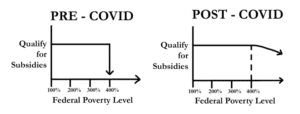
So before COVID, how the subsidy worked was if your income was between 100% and 400% of the federal poverty line, then you qualified for a subsidy. Now as a reference for a retired couple, so just a household of two, in the year 2022, 400% of the federal poverty level for a retired couple is about $73,000.

Now the catch here as you can kind of see in this depiction was if you made even just one dollar beyond that 400% level then you lost that subsidy completely. It was just a straight drop, a straight cliff with about a 300-foot drop-off.

However, as part of the American Rescue Plan Act, the subsidies were extended to those with income beyond the 400% poverty level. And so from 2021 through 2025, that was just extended recently to get another three years on there.

Higher-income earners can still qualify for that subsidy. So you can see in this depiction here on this post-COVID, it’s just a lot more gradual of a decline instead of that hard cliff. So the higher earners again can qualify for a subsidy.

Reconciling Income Differences at Tax Time

Now one common question we always get is, well what happens if your income doesn’t end up being exactly what you projected it to be? Which if you can get your income to the dollar, I will be completely impressed.

The answer is that you will reconcile any differences when you file your taxes. So to give you an example here, if your income was less than what you projected it to be, you’re going to actually receive a credit on your taxes because you should have been qualifying for more of a subsidy.

Again, vice versa if your income was more than what you projected, then you’re going to have to pay some of that subsidy back when you file your taxes.

So I’m going to turn the time over to Chris to just talk about some of the companies and plan options that are available to you.

Companies and Plan Options Available to You (6:30)

Chris Cutler: Perfect, thanks Alek. So if you’re coming from a company-sponsored health insurance plan, there may be some differences going into the marketplace and looking at your options.

So it is important to consider a lot of different things when you’re trying to find a health plan that’s a good fit for you.

So if you look at this kind of left-hand column there, those are all the companies currently represented on the Marketplace.

And each company has, you know, different doctors and hospital networks to choose from. And even inside each health insurance company, they have different networks to choose from.

So it can get a little bit confusing and it’s important to kind of take your time. Make sure your doctors, prescriptions, and all your needs are met when you’re sifting through these different plans.

And that’s kind of where I can come in and help you out individually if you would like to make sure to find a health plan that’s kind of tailored to your needs.

There are no PPO options on the Marketplace. Meaning when you pick a company or a network, you need to stay within that within that network unless it’s an emergency.

Open enrollment, I want to mention open enrollment, that’s currently going on right now. It started November 1st and goes through January 15th. Open enrollments a great time to just reevaluate health insurance needs for the upcoming year. During that time, you can enroll and you can change plans or make any updates as needed.

Open enrollment is not the only time you can enroll into a health insurance plan. If you retire early and it’s in the middle of the year where your benefits end, you’ll get a 60-day window from the day you lost coverage to enroll into one of these plans through the Marketplace.

Just to kind of wrap your head around, and what you’re looking at as far as options, I wanted to highlight maybe a couple scenarios that I come across. If you just hit that next slide for me Alek that’d be awesome.

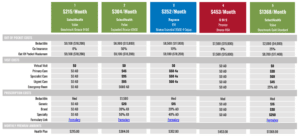
Perfect. So this may not be your exact situation. And again, I’m happy to run through your specific situation, but this is an example of a household size of two within Adjusted Gross Income of right around $100,000.

And as you can see, I picked through a few these bronze plans. The premiums are not too bad if that adjusted gross is going to be around that $100,000 mark per year. They start out, you know, right around $215, and then they go up from there.

There’s a lot more plans than this. I just wanted to grab a few of them, just so you can, just see you can see what options are and maybe you can kind of glance at these a little bit. Most of these come with, yeah, they’re going to cover your needs. And again, these plans might not be specifically what you’re looking for but should give you an idea.

If you could go to the next one Alek, that’d be awesome. Perfect, so this situation is just a household of one.

And I did an income estimate of like $20,000. I run across a scenario quite often where someone has a health insurance plan in place for their family. And then they moved to the Marketplace and they have like a 24-year-old child, maybe working part-time, going to school that was on their health insurance plan. And now they have to figure something out.

Well, this is a really good option because if that child isn’t working full-time making maybe around $20,000 a year, you can get a great insurance plan for them for next to nothing. As you can tell, it’s $9 a month. And we know in today’s world you can’t even buy a burrito for that cost. So it’s a pretty good option for a lot of people if it’s a good fit. So, again, I just wanted to reiterate that I am happy to kind of sit down with you or take a phone call and go over your unique needs and see if something like this would help. Go ahead Alek.

Daniel Ruske: And then Chris, just a quick question came up. If you go back to the last slide. What is the AD mean?

Chris Cutler: Yeah, that’s an abbreviation for After Deductible. So some of these plans won’t cover things until the deductible is met. Others will cover, you know hospital, doctor visits, specialist, or primary care visits before the deductible. It’ll just be a small co-pay.

Daniel Ruske: That’s perfect. Thank you.

Alek Johnson: And then Chris, one more question that I saw I just want to clarify right now since I think it’s a good time. The companies on here, someone just asked, are these only Utah companies? Are there more companies outside of Utah? If you want to just speak to that.

Chris Cutler: Yeah. That’s an awesome question. So these companies that are listed here in that left-hand column are the only companies represented in Utah on the Marketplace.

Now, if you live somewhere else full-time, then the Marketplace will have different companies for that state, or they have their own Marketplace platform to choose a plan.

But you know, kind of like I alluded to earlier, it’s hard to, if you have multiple addresses, it’s hard to find a plan that’s going to work across multiple states. Unless it’s like an emergency situation then you can use it anywhere in the world.

Alek Johnson: Right, thank you Chris so much for showing us that. I hope that provided some value to you to be able to see some of the numbers there. One thing I do want to highlight as well that maybe Chris is being bashful on.

It is actually no cost to you to use a health insurance agent. And so whether you do it yourself or whether you use a licensed professional, they will be compensated directly by the insurance company. And so if this is unfamiliar territory for you, please feel free to use a trusted health insurance agent that can help navigate those waters for you.

How the Marketplace Insurance can fit into your Financial Plan (13:46)

Perfect, so to wrap up I just briefly want to take a moment and explain just how the Marketplace insurance can fit into a financial plan. Healthcare is just such an important aspect of any financial plan that having a good understanding of it is absolutely critical.

Now the Marketplace is obviously a great option up until Medicare kicks in at age 65. But again, it’s important to be able to have a clear understanding of what your estimated income is going to be.

Again, because these subsidies are dependent upon your best guess of your income, having a sound financial plan in place, especially for retirees to know an idea of what your income will be, is extremely important so that you don’t have any tax surprises when you file your taxes.

Another important aspect of the Marketplace that I just want to highlight real quickly is that there may be ways, so we’ll have clients ask us, okay, I want a higher subsidy, but I don’t want to interrupt my cash flow.

And so there are definitely ways that we can report a lower modified Adjusted Gross Income while not affecting the desired cash flow that you have for retirement. Now this type of careful planning can again only be achieved by having a retirement income plan in place.

If that is something that you are interested, again we would love to sit down and discuss and see if that strategy makes sense in your situation.

Retirement Health Coverage Question and Answer (15:20)

So we’re going to turn the time to Daniel to ask us a couple of questions here. But before I do that, again I just want to thank you all for attending today. I hope you got something out of this.

Again, please feel free to reach out to Chris if you have any questions regarding getting on the Marketplace insurance or myself and more on the lines of if you have any questions regarding your financial plan and how this can be applied to it.

But we’re going to just open it up for three to five minutes here for some questions and then we’ll jump off. So Daniel any questions?

Daniel Ruske: Yeah, there’s been some awesome questions coming through the chat box here. I’ve tried to answer them, but there are a few I think that would be beneficial for you to answer for everyone.

Now I got a question here that says, the one time I looked online, I was basically bombarded with phone calls from insurance agents that continued for weeks. How do you start looking at these plans without putting all your information and getting bombarded with people trying to close business?

Chris Cutler: Want me to tackle that?

Alek Johnson: Yeah, go ahead.

Chris Cutler: Yeah, good question. And I’m not sure the exact platform that you’re putting your information on, but I will say I have a link that I can send out and I give you my word that I won’t bug you too much unless you want to approach me and have questions.

But I have a link that you’re able to put in your information and view the plans. And I believe if you go to the healthcare.gov site directly, there is a spot on the website where it will allow you to preview plans for 2023. And it does not require you to put in your email or phone number or anything like that. So you should be able to see the plans on that website without that type of hassle.

Daniel Ruske: Yeah, I can confirm that. I actually do that all the time for clients. You can go in there and instead of putting in your information, you just click a little lower down, it says view plans.

So thank you Chris. I got a couple other here, Chris do you offer, or let me just read the question exactly.

Does Chris offer to discuss options with us extended to those outside of Utah? Is he able to speak to options for those who live in other states?

Chris Cutler: I appreciate that. I’m happy to give any type of, I’m happy to talk through situations. But because I’m only licensed in Utah, I am limited as to what I can help out with. I would not be able to help someone enroll outside of Utah and I am not as familiar with the plans outside of Utah.

But if we’re looking for just general questions things like that about the Marketplace, I’m happy to try to help out where I can.

Daniel Ruske: Awesome, and we’ll do one last one here. What if I don’t know my income, what it will be throughout the year or if it’s variable?

Alek Johnson: Yeah, maybe I can start off on that one, and then Chris if you have any follow-up. So the best, obviously we want to get it as close as possible for obvious reasons, right. We want to try to just pinpoint it.

But if you can’t, anytime throughout the year, you can actually go back onto your application and adjust what it’s going to be. So let’s say you projected it was going to be $75,000, and then let’s just say you got a huge bonus at work, it bumped it up to $100,000. You can go back in and change that and that’ll adjust the subsidy that you are receiving throughout the rest of the year as well. Chris, any other thoughts on that?

Chris Cutler: Yeah, and I think you nailed it. Yeah, if you have some big income swings throughout the year, you can always adjust that. It’s important to keep in mind as well that like Alek mentioned, if you keep it as is you may need to pay some of this, the tax credit back when you file taxes if the actual reported income is higher than what the amount was estimated on the application.

Daniel Ruske: Awesome. Can I do one more Alek? I know we want to hurry and get to the survey. There’s a survey at the end that we’d appreciate all of your feedback. But if we can do one more.

Is it possible to modify a Marketplace plan/coverage if a child leaves for college or a mission or if you need to change it throughout the year? Can you change the plan?

Alek Johnson: Yeah, great question. Chris, you want to tackle that?

Chris Cutler: Yeah, I’ll go for that one. So just to clarify, and the question it was asking if you have a plan in place, the Marketplace, and then you have someone move out of the household and go to another state. You just want to change plans and make accommodations for your child that’s moving. Is that, am I getting that correct?

Alek Johnson: I think so yeah.

Chris Cutler: Okay, so in that situation, a move out of state does give you a special enrollment period. So it would probably make the most sense in that situation for that child that moved out of state to do a new application for whatever state he or she moves into because that would open a special enrollment period.

Daniel Ruske: Awesome, that is all of them. I’m going to answer a couple more here on the chat, but outside of that, that’s been most of them, so appreciate you guys.

Chris Cutler: Yeah, thank you.

Alek Johnson: Perfect, well again thank you everyone for taking the time to jump on. Again, as Daniel said there is going to be that quick survey after this. Any feedback that you have is great. Thank you for attending and we hope you have a good day.

Estate Planning Considerations for Retirees

Estate Planning Considerations for Retirees

Carson Johnson: Okay sounds good, we’ll get started here. So, first off, a little bit about myself, want to introduce me. As you probably already know, my name is Carson Johnson. I’m a Certified Financial Planner™ here at Peterson Wealth Advisors.

I grew up in a small town called Ephraim. For those of you that don’t know where that’s at, that’s in central Utah. If you’ve ever heard of Snow College, that’s where that college is located, where I attended school.

Later after Snow, I graduated from Utah Valley University’s Personal Financial Planning program, nationally ranked program, a really great program that I really enjoyed. And I’ve been in the industry now for seven years and absolutely love it.

I live in Spanish Fork, Utah with my lovely wife Shamri and our two kids. I have a three-year-old boy named Emmett and a little girl named Quinsley who just turned one on Monday and I’m super grateful for them.

Estate Planning Myths

So, what I want to talk about today is first, we’ll be going over and debunking certain estate planning myths and misconceptions that are out there. Estate planning has changed over the years and it’s important to see how estate planning applies to you today.

What is an Estate Plan

Second, we’ll talk about what is an estate plan.

Estate Planning Considerations for Retirees

Third, important estate planning considerations for retirees specifically. Things that you should be thinking about as you make that decision to retire.

And lastly, we’ll summarize what we’ve talked about and I’ll leave you a few questions and action items to help you get started before you meet with an attorney.

A quick disclaimer, the information provided in this webinar does not and is not intended to constitute legal advice. All the information shared, and all the slides is for general information purposes only.

So, let’s get started, shall we?

Estate Planning Myth #1 (1:52)

Myth number one, I am not wealthy enough to need an estate plan. Now one of the many reasons that people fail to create an estate plan or delay in creating one is because they feel that they don’t have the need for one because they don’t have the assets or the wealth to require one.

And in reality, even although the estate planning does talk about the distribution of your wealth, it also addresses other factors such as providing adequate provisions for surviving family members, mitigating family conflicts, helping beneficiaries avoid certain costs such as taxes, and for those that have large enough estates, inheritance, or estate taxes.

It helps you establish healthcare decisions that puts in your control. And if anything, regardless of the size of your estate, healthcare conditions can be one of the most important parts of an estate plan.

And lastly, providing for or supporting a dependent or other people in retirement.

Estate Planning Myth #2 (2:52)

Myth number two, I have a will, so I am covered. A will is a very important document and actually is foundational to an estate plan, but the planning shouldn’t stop there.

There are two main components of a will that I want to briefly talk about. First, a will appoints an executor or personal representative. This person has a huge responsibility. They’re in charge of overseeing your estate and handling everything that happens upon your passing.

Second, a will provides a set of instructions for the distribution of your property upon your death. Not all assets that pass through are covered by a will, and so it’s important to remember that not everything is covered by a will.

Now I briefly want to talk about the property that is not directed by a will.

Some of the property may include joint property where you own a property with another person. Property life insurance accounts, retirement accounts, payable on death designations, which typically deal with bank accounts that are paid to a specific beneficiary upon your passing, and then any property in trust are all categories that pass outside of the scope of the will.

And everything else does catch through the will and goes through what’s called the probate process, which I’ll talk about here momentarily.

So, what is probate? Many of you have either gone through probate or have heard about it and may be wondering, why do we try to avoid it?

Probate is a court-supervised process which transfers ownership of your assets from your heirs upon your death. Probate can be an expensive time-consuming and cumbersome process. And depending on your estate, it could be quite the hassle for your personal representative.

Probate is also very public. So, when your assets go through the probate process and is administered through the court, there’s often news and articles and advertisements describing your estate to the public.

And so, probate is a very, one of the reasons why we try to do estate planning and try to avoid it.

With the proper estate plan, it can reduce the cost and complexity of probate and sometimes even eliminate parts of it from your estate.

Estate Planning Myth #3 (5:17)

Myth number three, my spouse or significant other will immediately receive my assets. I love this question because this comes up quite often.

In connection to a will and talking about the probate process, just like I mentioned, when you die, when you pass away without a will, you are considered what’s called intestate, which just simply means you died without a will.

If this happens, essentially what happens is your will is provided for you through your state’s laws. Your state’s laws are common intestate laws, and the court process determines who inherits your belongings.

And additionally, with that, there might be family members that you want to inherit your belongings but are entirely left out because of the state laws, as this can be particularly important if you have non-traditional families or a mixed family. If you’ve had a divorce and remarried, these are all kinds of examples of where estate planning can be very important and apply.

Now it is fairly common for spouses, especially to have joint property. And like we mentioned before that does pass outside of the will and will bypass the probate process.

But like I mentioned, not all assets are titled as joint ownership. So, another important part of estate planning is understanding where your assets are and how they are owned and what that ownership looks like, whether you own it by yourself, with another person, or multiple people, so that you can understand how that specific property passes on.

What is Estate Planning? (7:02)

All right, now that we’ve debunked a few of the estate planning myths, I want to talk about what estate planning actually is.

Estate planning is a term that has changed over the years. At one point, a long time ago, estate planning was simply having a will, going through the probate process, and if there’s any property that can be owned jointly with your spouse or significant other, then to have an attorney help you do that.

Well over time due to changes to tax law, estate law, changes in finance, and the emerging non-traditional families or simply longevity and retirement has made estate planning far more interesting and frankly more compelling than ever before.

And especially where estate planning can cover many aspects of your life, things like your retirement plan, if you own any businesses, business interests, and planning for the estate planning process for your businesses.

Planning for incapacity, we’ll talk about this here in a moment. But one of the very real risks of retirement is becoming incapacitated, and so we’ll talk about that more in a moment. But it also includes charitable giving strategies and ultimately leaving behind a legacy that ensures that your wishes are being fulfilled.

So, to begin, what is an estate? This might be pretty obvious, but an estate is made up of everything that you own. That includes tangible assets such as your house, automobiles, jewelry, household items, etc. as well as intangible assets: bank accounts, investment accounts, business interests, life insurance, and much more.

Once you have an idea of what your estate and your property looks like, then you can start clearly defining your estate plan in particularly the distribution of these assets, which I talked about a moment ago is just a part of your estate plan.

So, the golden question, what should an estate plan address? An estate plan will be unique to each individual depending on your family dynamics, the size of your assets, your ultimate goals upon your passing.

And so, it’s important to keep in mind some of the clear objectives that estate planning accomplishes.

First is it fulfills your wishes about how property is to be managed or distributed. This might be obvious to everyone, but if you don’t have a proper estate plan, that control over how your property is distributed and passed on is given to the court and you’re putting that into somebody else’s hands rather than your own.

Second is providing liquidity. This is a concept that actually gets overseen quite often. If you think about it, once you pass away and you have considerable expenses that are passed on to your executor, the person that’s in charge of your estate, you might have somebody have them hire a CPA to prepare your final tax return.

You might have final medical bills or even just regular income taxes as well as the traditional funeral expenses that are significant costs. And so having enough liquidity, or funds, to cover those costs is important.

Addressing Healthcare Decisions

Next is fulfilling your health care decisions. Like I mentioned before, regardless of your estate, this can be one of the most important aspects. And healthcare decisions typically pertain to two things.

One, naming somebody to make general medical decisions on your behalf if you become unable. And two, specifically providing instructions for end-of-life care. So, things like life support can be a great example of end-of-life care needs.

Next is planning for incapacity. Now, this is actually different than the previous bullet point because this can actually be something where you enter in retirement and you become incapacitated, but there’s not necessarily medical decisions being made.

And so you need to make sure you have a plan so that somebody can make those decisions for you that might relate to your financial life or your legal affairs, and so having someone there and a plan in place for them.

Next is maximizing the net amount of assets that are passed on. A good way to think of it with this part is reducing costs. One of those costs is probate costs and hiring an attorney. It could be reducing income taxes. And for those that have large enough estates, it could be reducing estate tax or inheritance tax which can be up to 40% of whatever is passed on.

And so, planning for that, and this is where the creative strategies really come out to play and how it can apply to your property.

And lastly, reducing disagreements and family tensions. This is kind of the byproduct of an estate plan and one of the benefits of doing one.

All right. Now that we’ve talked about the myths, we’ve talked about what an estate plan is, and its common goals, I want to talk about the tools and documents that help us reach those goals.

Basic Estate Planning Documents (12:24)

So first, last will and testament we’ve already kind of gone over this, the new two main components are naming a personal representative, and two providing a set of instructions that describes how your assets are going to be passed on to your beneficiaries for any property that goes through that probate process.

Living Trust

Second is a living trust. A trust is a legal document that allows you to transfer assets into it while you are alive, and once you pass on, it gets passed on to your beneficiaries according to your instructions.

And the important part of a trust document is that it bypasses that probate process. It specifically explains the instructions that you want to leave behind to your future heirs.

Power of Attorney

Next is a power of attorney. There are lots of different types of powers of attorney, but the main two are a durable power of attorney and a medical power of attorney.

A durable power of attorney allows you to name somebody to make pretty general decisions on your behalf. This can be also very specific to financial decisions, but it allows you to make other decisions, be able to sell real estate if need be on your behalf.

Medical Power of Attorney

Second is a medical power of attorney as you can see from its name, it allows you to name somebody to make certain medical or health care decisions.

Living Will

Next is a living will. Living will is a legal document that specifies the instructions you want to leave for end-of-life care needs. So, whether that is having life support or having certain conditions in place to determine when those life decisions should be made, is accomplished through a living will.

Appointment of Guardian

And then lastly, appointment of guardian. This is typically a document used when you’re younger, but we occasionally see it in retirement where grandparents are taking care of grandkids, or legally adopting kids, or even taking care of their parents.

And so, having an appointment of guardian is a plan to make sure that your dependents are being cared for.

So, I like to put these documents into these three categories. A will and trust help you distribute the estate.

A power of attorney and living will helps you plan for incapacity. And then appointment of guardian helps you provide for a dependent or someone that you are supporting.

Estate Planning Considerations for Retirees (14:55)

Okay, my favorite part, estate planning considerations specifically for retirees. Estate planning changes as your family changes. This one also may be obvious, but as you go throughout your life your family dynamics change. Whether that be a divorce, or a falling out with a family member, or simply becoming a grandparent which is such an exciting experience.

Your estate planning needs might want to address these different scenarios and definitely needs to be updated, even if you already have an estate plan.

Two, cognitive decline is a very real risk in retirement. According to an article titled ‘Cognitive Impairment in the US’, it states that two out of three Americans experience some level of cognitive impairment by the age of 70.

And in my experience as a financial planner, I’ve seen this quite often and early in my career. And making sure you have a plan in place so that you have somebody to make those decisions, and not having to scramble last minute to try to get one is so important.

Third, retirees may be exposed to greater risk. For example, once you retire a lot of retirees have goals and ambitions to travel more and really have the time of their lives. Traveling presents a risk because you are taking on risk by visiting different countries or different places, or getting hurt. And so, having these documents in place for that can protect you.

Next, estate planning outcomes may vary depending on the state in which you live. We often see with retirees that they like to move. Moving closer to family or into a warmer climate so that they’re more comfortable. And because estate planning is based on your state laws, it’s important that you review how the state in which you live is going to impact your outcomes.

Next is a step up in basis for non-retirement assets. Let me briefly explain what this is. There can be considerable costs by gifting property to your heirs prior to your death.

And what happens once you pass away, non-retirement assets such as a home, or trust investment accounts, or other real estate are some examples, that once you pass away your heirs receive what’s called a step up in basis.

And what that simply means is let’s say you have a home and you bought it for $500,000. And over time it’s grown to $1,000,000 and you have $500,000 of growth.

Once your heirs inherit that and they have a step up in basis, that means they are able to inherit that property at $1,000,000 as the day that they receive it as you pass away. And then they aren’t responsible to having to pay the taxes if they were to sell the home and they are not responsible to pay those capital gains taxes.

And so an important conversation for retirees is looking at your non-retirement assets and seeing what property should be gifted and what property shouldn’t, especially if you have significant gains and in those assets.

And lastly, checking beneficiary designations, if you think about it, beneficiaries are chosen typically at the beginning once you open an account. And for retirees, if they have a 401k that was opened many years ago, 20, 30 years ago, likely your family has changed. Whether you have gotten a divorce or if a child has passed away. It’s so important to review those periodically to make sure that your assets are going to those that you wish to go to.

A quick note. There are other advanced estate planning strategies out there for individuals that have a net worth of right now, 12 million or 24 million for married couples. That’s where estate tax comes into play, and gift tax, and some of these other costs that can reduce the amount of assets that are passed on to your future generations.

If you’re an individual who has a desire to leave a significant amount of assets to a charity, there can be specialized trust strategies, charitable giving strategies that allows you to take tax benefits today and then leave the assets to a charity in the future.

And then caring for special needs children. One of the benefits that special needs children have is being eligible for federal benefits. And those federal benefits are based on income or assets and if these children receive a significant inheritance that could exclude them from these important benefits.

And so these are some examples of other advanced estate planning strategies that you should consider and talk about with an attorney or financial planner.

Summary of Estate Planning (19:52)

So in summary, estate planning is more than just the distribution of wealth, but a complete plan for end-of-life decisions and incapacity. A basic estate plan includes a will, trust, a power of attorney, medical power of attorney and a living will.

Three, as you enter retirement, estate planning needs change, and they evolve over time. As your family, as our society evolves laws and our views of finance.

And ultimately, an estate plan ensures that your wishes are being fulfilled. Now I mentioned that there were three myths, I’m gonna give you one more that I often hear which is, I created an estate plan years ago, so there’s nothing left to do.

This is something I hear quite often and it fascinates me because once you have these documents in place. And our lives are constantly changing, and so must our estate plan.

Attorneys, you may be asking how often should I update my estate documents. And attorneys will typically recommend three to five years to make sure that they’re up to date and to laws and fulfilling your wishes.

But if you’ve experienced the loss of a loved one or incapacity, or if you simply move to a new state, these can be excellent times to review your state and make sure it’s following your wishes.

So, what’s next? To help you start the conversation, I want to leave you three questions to start thinking about that will help you start planning this out and how it applies to you.

First, who will look after my financial legal affairs if I’m unable?

Two, who will be responsible to make healthcare decisions for me?

Three, who will be my executor, heirs, and how will my property be distributed, or how do I want my property to be distributed?

These are great questions to help you get started. Clients of Peterson Wealth, if you have questions about what we’ve talked about today, reach out to your advisor and ask them, how do these considerations apply to me?

And we can talk to you more about that or give you a recommendation to an attorney who can help you with estate planning. Anybody else that is interested in these strategies and considerations, feel free to reach out to our office. We’re happy to talk through how your different properties and assets might be passed on to your future generations.

Estate Planning Question and Answer (22:13)

Now, I’ll leave the time for some questions. If you have any Jeff, feel free to jump on if you have any questions that we haven’t got to during the presentation, and we’ll leave the last few minutes for you guys. Thank you.

Jeff Lindsay: Okay, so yeah, just go ahead and put your questions in the Q&A box and we’ll answer those.

One question that came in, what is the difference between a will and a living will?

Carson Johnson: Yeah, great question. So the basic difference between the two is a living will has to do with end-of-life care decisions. So if there’s anything that is going to essentially end your life or prolong your life, that’s what a living will encompasses.

A traditional will, or last will and testament, that has to deal with determining who’s going to be in charge of your estate. And if there’s any property that goes through probate, how will that property be distributed, to who’s your beneficiaries, and who’s going to get what property.

Jeff Lindsay: Okay, a couple questions about your slides came up. Can you show the summary slide? A couple back, and then also if you can go back at some point show the probate versus non-probate as well. While you’re kind of going through that, another question, how long will it really take to complete kind of the estate planning process?

Carson Johnson: Yeah, that’s a great question. So typically what these estate planning meetings look like with an attorney, as you meet with an attorney. They may charge you hourly or they may give you that consultation for free depending on the attorney. And you’ll kind of have a discovery meeting to look at where are all your assets, how are they owned, meaning are they owned in just your name or with the joint owner, etc., what property has beneficiary designations like those investment accounts, life insurance, to get a layout of your estate.

Then the attorney will go and draft the documents and recommend which documents apply to your case. And within, depending on the attorney, if the attorney’s very slammed, it could be a month or two or even longer before you get your documents. But it could be also as quick as two weeks or so for the attorney to get back to you with your legal documents. So, depends on how busy your attorney is.

Jeff Lindsay: Okay, and then can you go on the slides to the probate versus non-probate list? While you’re doing that, another question, what’s the difference between a trust and a living trust, or maybe a revocable versus irrevocable?

Carson Johnson: Yeah, good question. So a living trust just means that you created the trust while you are alive. There’s also what’s called the testamentary trust which is created once you have passed away. That’s your kind of last will and testament. But a living trust is when you’ve created one during your life.

And there’s also two types of trust. There’s what’s called the revocable trust and an irrevocable trust. And ultimately as you can see in the name, irrevocable trust means that once you’ve gifted property into it, you can’t take it back, irrevocable.

And there’s benefits in doing that for estate or inheritance taxes, for example. But ultimately it depends on whether you need an irrevocable trust or not. And it typically depends, it usually has to deal with how big your estate is and if estate tax applies.

And then oh, and on the other part of that revocable trust, revocable means you can take it away. So if you put property into it, you have control over the assets within the trust and you can take the property out of the trust if you want. So, it gives you more flexibility.

Jeff Lindsay: The other slide that somebody wanted you to show is goals of the estate of estate planning. And then a question, what is the typical cost to complete an estate plan?

Carson Johnson: Yeah, so generally if it’s a pretty straightforward estate where you have those main components, those main documents, a will, trust, power of attorneys, living well, and a trust, it generally ranges between $1,500 to $3,000, 3 or $4,000 depending on the complexity.

Now, if you’re one of those kind of situations where you have special needs children or more specialized charitable giving strategies that can definitely be more than that. But I would say a good range is between that $1,500 to $3,000 range.

Jeff Lindsay: Okay, then if somebody already has an estate plan kind of already set up, they’ve already got their trust, how do they make a change in the trust document? Do they have to go to an attorney or can they just attach a notarized document stating the change?

Carson Johnson: Yeah, great question, you’ll definitely want to consult an attorney. So an attorney, what they’ll typically do is they’ll do what’s called, they’ll add a codicil, which is just an amendment to your trust or legal documents. So they’ll still keep what you have, but whatever amendments or changes you want to make, it does need to be done in a legal format. And so that’s done through a codicil and an attorney can help you with that.

Jeff Lindsay: And also, I’ll just add in depending on the state, it might be possible to do it this other way where you’re attaching a notarized document. But if we tell you to do that, then we’re giving legal advice and we’re not attorneys. So, just you would have to either research that out or go to an attorney to double check on that.

Carson Johnson: Yeah, that’s great. Thank you.

Jeff Lindsay: Okay, so another question for those who have underage children, when would it be appropriate not to have your assets and trust to care for your children and instead just leave your trust via a will?

Carson Johnson: Good question, that might be something that is state-related, meaning depending on your state laws where that might matter because the state laws are different in each state. And it could be good in some cases if the probate process and your state laws are, you know, fairly easy and straightforward and that there’s not a huge time or a risk in going through that probate process where a will can be sufficient, but I would talk to an attorney to see if it does make sense to just do a will and kind of not these other estate planning documents.

Jeff Lindsay: So we’re just about a minute over, do you want to keep on Q&A or we can answer these also direct to people?

Carson Johnson: Yeah, let’s take two more questions, and then let me go to the last slide here. And if you still have quite a few questions that you want us to talk about again, you can schedule a consultation or you can send an email to this info@petersonwealth.com email and we’ll get back to you within the next day or two with some responses.

But let’s take the last two questions here.

Jeff Lindsay: So maybe a quick question here, if I plan to sell my home soon in a year or so, is it worthwhile to put it into a trust?

Carson Johnson: Yeah, I would say generally yes. Trusts do, a lot of cases make sense. Especially if you, for example here in Utah, there’s some things that can be taken care of if you have assets less than $100,000. But if you have more than that, then a trust definitely makes sense, especially if you have a home to be able to put your home and other non-retirement assets in the name of a trust, just to avoid that probate process.

Jeff Lindsay: So the point is you might have a plan to sell it in a year, but you pass away in nine months and then you wish your heirs wish you had it in trust right?

And then maybe the last quick question, typical cost for probate versus cost for setting up a trust, and all that kind of comparing the two.

Carson Johnson: Yeah, so if you don’t go through the probate process with an attorney, depending on the state, it could be pretty inexpensive actually. And we kind of made some general terms today of how it might cost, and that probate can be expensive.

And it can be depending on the state, but there are some states, it’s actually a pretty quick and easy process, but if you have to hire an attorney that might cost you between 2 to $4,000 which is about the amount you’re paying for an estate plan anyways.

But if your specific estate is a fairly easy probate process, then you may have some court fees that they have to pay, but that’s pretty nominal in a lot of cases.

Jeff Lindsay: One thing I’ll just mention on, that I’ve had attorneys kind of talk to me about is you can either take care of this before your death and you pay a fairly similar cost to what your kids might pay an attorney after your death.

So it’s just kind of saving them the hassle and the expense of that point too. They might be a pretty similar cost actually.

So I think we’ve kind of come to the end of our time here, but if there are questions that we weren’t able to get to, we’ll reach back out to people and make sure all your questions are answered.

Carson Johnson: Yeah, thanks Jeff. Thanks for everyone for joining, great questions, happy to talk more with everybody, and thanks for your time. Have a great day.

How do Rising Rates Impact My Lump-Sum Pension

How do Rising Rates Impact My Lump-Sum Pension

Mark Whitaker: Well, I think we’re here on the hour. So, we’ll just go ahead and get started. Today, we’re having this Lunch and Learn webinar at Peterson Wealth Advisors. And what I’m hoping today, everyone who’s attending can get a lot of good information. If you are close to retirement and you have a pension or maybe your spouse has a pension, and you’re trying to decide how can I make the best decisions in regards to my pension as I’m preparing for retirement? I’m hoping that from this webinar, you’ll get some good ideas and kind of some high-level thoughts about things that you should consider.

With today’s presentation, I’m thinking that it’ll take maybe 10, 15 minutes for us to get through some of the content that we’ve prepared. And then what I’m really hoping is that we can spend the remainder of, you know for another 15 or 20 minutes or so going over some of your questions.

So, as far as answering and asking questions, within Zoom you can use the Q&A feature. And as you put questions in there, what Carson and I will do is we’ll review those throughout the presentation and we’ll do our best to answer questions that we think are broadly applicable to those who are attending and that we think will have the most value for everybody overall.

If there’s a question that’s maybe a little too specific and we can’t give it a, you know, maybe the answer that it deserves, then what I would prefer to do is maybe you know put a pin in it and come back to that question, maybe follow up with you after the webinar to give you a really good answer to your question.

Also, today since we’re keeping the webinar a little bit shorter about 30 minutes, even if there’s a really good question, but maybe it kind of takes us off topic a little bit, we might have to maybe address that question another time.

So, a couple of housekeeping items that I like to go over. At the end of this webinar, you’ll receive an email with some helpful information. So, if you’d like to contact us to get more information about figuring out what’s the right decision to do with your pension, you can use the link there to schedule a consultation with one of our Certified Financial Planners™.

If you haven’t had a chance to read Scott Peterson’s book, ‘Plan on Living’, the revised edition that recently came out, there’s a link there as well that you can order one or forward to a friend.

In chapter 5 of that book, Scott goes into detail about how to maximize your pension. And so, if you haven’t had a chance to read that, or you know someone that would be helpful for, I encourage you to go ahead and go ahead and request a complimentary copy of that book.

As well, I’d like to let you know that in the upcoming weeks, we’ll have an additional webinar. So in the survey that will also be in that email, if you have any suggestions for us as the topics that you’d like to hear in the future, we love to hear your feedback.

As far as these webinars go, we really want to share information that’s most helpful. So, your feedback is very appreciated.

Jumping into today’s webinar, maybe a quick introduction, my name is Mark Whitaker, a Certified Financial Planner™, and we really specialize in helping retirees maximize their retirement from an income tax saving standpoint so that they can focus on what matters most in retirement.

Joining me today is one of our lead advisors Carson Johnson. He’s also a Certified Financial Planner™ and he’s been with us for a number of years. Before joining Peterson Wealth Advisors, Carson worked for the high-net-worth retirement group of Fidelity Investments. And in that role gained a lot of experience with dealing with retirement plans from companies, pension plans, 401k plans. So, he brings us some additional experience that’s relevant to today’s conversation.

So with that, a quick overview of what we will be addressing. Really quickly, we’re going to touch on just an overview of pension plans and then we’re going to jump right into how do inflation and rising interest rates impact the value of your pension or lump-sum pension option.

And then aside from that, you know, we want to talk about some of the benefits to choosing a lump-sum pension over just a level monthly payment. But then also, really just take a very honest look at you know, maybe are there situations where that doesn’t make sense? And you know, how would you evaluate what’s the best option for yourself?

And then like I said, from there we’ll open it up to questions and hopefully have a good conversation.

Impact of Inflation and Interest Rates on Pensions

So with that, let’s go over pension options. So for today’s discussion as we talk about pensions, we’re going to be, I would say, most of what we’ve prepared today is most relevant to people who have a pension from a company.

So some of the information will be relevant if you have a government pension from your state, or from a school district, or from the federal government. But mostly I think this information will be most helpful if you have a pension from a company.

And to talk about pensions, I’m going to use the example here of our couple. And they’re going to, this is what we’re going to, we’ll use their, this kind of a backdrop to talk about, you know, how pensions work.

So for today’s webinar, we’ve got Sarah and Tom. And Sarah’s retired and she has the option, she can get a monthly payment of $2,000 a month for the rest of her life. It’s guaranteed, and with her pension, there’s no cost-of-living adjustments.

So she’s not getting, you know, like an annual adjustment for inflation like you might get while you’re working, or like you get with Social Security for example.

So what are some of the benefits and what are some of the things you should consider with a guaranteed monthly payment?

Well frankly, I think the number one benefit is that they’re guaranteed. Regardless of what’s happening in the economy or whatever’s happening in the market, you really don’t have to worry about that so much.

There are some little minor caveats there, but your income is guaranteed for the rest of your life no matter how long you live. And frankly, as far as longevity is concerned, I mean, I think that’s probably the biggest benefit.

Another, I’d say significant benefit of a guaranteed monthly pension is it protects. It can protect the retiree from making poor financial decisions from not having an investment plan and maybe squandering their retirement benefit through poor investment decisions. So, that’s another benefit of a guaranteed monthly pension.

Some of the downsides, if you have a pension that does not come with a cost-of-living adjustment, inflation has a significant impact on your pension and you really don’t have a way of keeping up with inflation.

If you’re interested in leaving money to your heirs, leaving money to your children, a monthly pension ends when you pass away. There’s other payment options that can extend for a period of time or for a spouse that often you can choose payment options with a survivor benefit, but you’re not really able to leave a legacy.

So if that’s something that’s important to you, whether it’s to help your children or grandchildren or to give to your church or to other charities, you really don’t have that option. I would say as well, if you choose a monthly pension, another downside here, not only are you unable to leave a legacy, but if you don’t live that long in retirement you may have worked for decades to earn a pension benefit.

And if you were to pass away, maybe five years into retirement, then you know that benefits gone, right? So that’s another potential downside to monthly payments.

And lastly, the loss of tax planning opportunities. It’s another significant thing to consider if you’re looking to choose a monthly payment.

So we’re going to jump right into what are the impacts of inflation on your monthly pension. And Carson, I’m going to go ahead and turn it over to you.

How Does Inflation Impact My Pension? (8:02)

Carson Johnson: Great, thanks Mark. So as we know when you enter retirement, there’s two main risks that retirees face, which one is related to investments which has to deal with more volatility or ups and downs in the market, but the other huge risk is inflation, which also applies to pensions.

As you can see from this chart, you can see if we have, for example, a pension that you start off with $1,520. And if you had the historical average inflation rate of 3% over a 25-year period of time, it decreases the purchasing power or the value of your pension to about $962, which is about a 34% haircut off of the original $1,520 the original pension that you started with.

So inflation is absolutely an important thing to consider when choosing a pension or even a lump-sum option, which we’ll talk about later today.

How do Rising Interest Rates Impact Lump-Sum Pensions? (9:06)

Mark Whitaker: Yeah absolutely, thank you Carson. And I think that’s pretty straightforward, it’s very intuitive. If I have a guaranteed monthly pension and every single year, you know even month to month like we’re experiencing right now, it costs more to buy something than every single year. That pension that I’m getting can buy less and less of the stuff that I want to get.

I had a bit of a surprise. My wife does most of the grocery shopping in our household and I went down to the grocery store to pick up some eggs. And on the way home we wanted to make some chocolate chip cookies and my wife said, “oh, but can you stop by and get some eggs?” Went to the grocery store and had some serious sticker shock remembering being able to get five dozen eggs before what that cost, maybe four or five six dollars and now looking and seeing it above $10 for eggs.

And so, you know with my young family we go through a lot of eggs. So with inflation, you can see that can have a significant impact on your quality of life if you don’t have a plan for that.

Understanding Rising Interest Rates and Lump-Sum Pensions

Now, let’s talk about rising interest rates. So with lump-sum pensions, or I should say with pension plans, you often have, I’m going to say kind of categorically two main kind of payment options.

One is to receive some guaranteed monthly income, and the second is you can trade in that guaranteed paycheck for the rest of your life, for a bucket of money, a lump-sum. Okay, so what’s interesting with pensions is that they guarantee the monthly income amount, but that lump-sum amount is actually variable, it can change and interest rates play a part in that.

So, the way that this is calculated is the company that you worked for will look at interest rates that are available in the market. And actually, the IRS determines what these rates are. They loosely approximate to the yield on a corporate bond.

And so, what happens is as interest rates go up, then the value of your lump-sum pension actually goes down. So for example, let’s say with Tom and Sarah, they have their guaranteed monthly income of $2,000 and they have the choice between retiring, let’s call it the end of 2022.

What we did is we went and looked at the IRS tables for the interest rates that are used to calculate lump-sum pensions. And based off of this number and some other factors, the lump-sum that they’d be entitled to would be about $424,000.

Now let’s say they waited to retire in 2023 and claimed the lump-sum pension at that time. Well because of the change in interest rates that have happened over the last year, the value of their lump-sum pension would have dropped by about $1,000,000, $99,000 and change actually. The reason for this, is that a retiree retiring in 2022, the interest rate that’s used to calculate that lump-sum pension is an interest rate from the previous year.

Usually, it’s an interest rate from 12 months ago or an average interest rate over the last 24 months. And because interest rates were so low in 2021 and 2020, that interest rate that’s used to calculate the lump-sum pension for a retiree today is a lower rate, meaning a larger lump-sum value.

Now, let’s say we fast forward to next year. If you were to retire next year, then those interest rates that are used are going to be based on interest rates that are happening right now. And as we’re all aware interest rates are much higher now than they were last year which would result in a smaller or lower value for your lump-sum pension.

This is essentially how an interest rate impacts your lump-sum pension value.

So, aside from inflation, or I should say aside from interest rate consideration, we want to just kind of briefly cover some of the advantages of lump-sum pensions in general.

Carson Johnson: Yeah, thank you Mark. So lump-sum pension, the decision to make or choose that lump-sum option is very important. There’s a lot of factors to think about when making that decision.

The first advantage of doing a lump-sum option is giving you the flexibility control over that money.

Like Mark said, I think he explained that perfectly, you know, if especially if in your situation you’re aware of that, of a health concern and where you might expect to pass away sooner than what an average of life expectancy. Then it allows you to roll that money over and you have those assets and it gives you the control and flexibility with those assets, what you want to do with them.

The second is the ability to keep up with inflation. Now, there are some pensions that do have a cost-of-living adjustment, and that does help with the inflation, that inflation concern. However, there are a lot of corporate pensions that don’t have those costs of living adjustments.

It doesn’t keep up with inflation and so by doing the lump-sum option you’re able to roll that money over and invest it in inflation, beating investments which we can talk about in more detail. Typically stocks have been the best investment that has been able to do that. And so it allows you to be able to control how inflation impacts you in retirement.

Tax Savings Opportunities with Lump-Sum Pensions

The third thing is saving in taxes. Now, this is a, there’s actually quite a few different ways this can impact you. But just some similar, some examples that you may want to think about.

Taxes, once you’ve chosen, let’s say you decide to go with the guaranteed monthly payment option, pension option. One of the things to keep in mind is once you select that option, there’s really for the most part no going back. You can’t change your pension in the future. Once you’ve selected it, that’s the option you’ve chosen.

And so you receive that monthly income, but what we’ve seen a lot of times in retirement is especially, and down the road where retirees may not be spending as much depending on the situation.

Now, there are health care costs that do tend to go up later on in retirement. But by choosing that lot, the monthly payment option, that is automatic income that shows up on your taxes whether you need that income or not.

And so if your situation changes where you want to maybe not take as much income, that’s not an option when you’re taking it as a monthly income stream.

Other tax strategies to consider, maybe doing Roth conversions where if you have the ability to take some of your IRA money, convert it which is just taxable to you, that might be limited too because you’re choosing a monthly income stream from your pension. Because you have that income, it’s going to be coming no matter what it might limit you to being able to do Roth conversions.

And then one last strategy to think about also is that once you turn age 70 and ½, there’s a strategy that you can do called Qualified Charitable Distributions, which allows you to pull money from an IRA and donate it to a qualified charity tax-free when it normally would have been a taxable event.

And so, you know by taking that monthly income from your pension that shows up on your taxes, that might limit the ability or the value ad that you get from doing those charitable donations as well, because you have this extra income that’s showing up on your taxes.

Any other thoughts there on taxes Mark, that you wanted to mention?

Mark Whitaker: No, I think you hit on the big ones and maybe I’ll just add one extra detail with, you mentioned making charitable contributions with your distributions from a, take a lump-sum pension, you can take money out of your retirement account without recognizing it as income.

There’s an additional tax benefit there where by doing a Qualified Charitable Distribution, it can also reduce the taxes that you pay on your Social Security benefit.

It can also impact your Medicare Part B premiums because it’s reducing the income number that’s used to calculate those other taxes you pay on those other benefits.

And so there’s this very high-level discussion about tax savings. But you’ll just have to take our word for it that the tax savings are significant with some of these strategies. So, you know, that’s all I would add to what you said Carson.

Carson Johnson: Perfect, and then the last thing which we’ve already hit on this is leaving a legacy. You know, there is some power to being able to have that control. Again kind of related to the first point, that control, that ability to control what your ultimate legacy that you leave behind for future heirs that follow you.

Should I Choose a Lump-Sum Pension? (18:37)

Mark Whitaker: Very good, well Carson, maybe we can jump now to just kind of generally, how do you know, maybe you can think of some of the reasons or some of the questions that a retiree might ask themselves whether or not they, let’s say if they have both options. They have a pension-guaranteed monthly income and they have a lump-sum option as well. What are some things that they can consider?

I’ve got some things that I want to talk about as far as having a clear retirement plan, but is there anything else that maybe you’d like to address?

Carson Johnson: Yeah, just I think there’s quite a few factors, but I think health status. Where are you with your current health or is there a history of family health concerns that runs in your family because that can be a determining factor whether you take the lump-sum option or not.

I think taxes, where are you going to fit in a tax bracket? Do you feel like you’ll need all the income from the pension to be able to manage your tax situation?

And then obviously, the current interest rate environment.

Mark Whitaker: Yeah, absolutely, thank you Carson. So, going off of what Carson talked about a minute ago with generally the potential benefits that you can have as a retiree by choosing a lump-sum pension.

There’s what’s implied in that, is that you have a plan. Okay, so we’re talking about potentially saving, you know, using tax planning strategies. We’re talking about leaving a legacy. The potential to earn a rate of return and in order to have an inflation-adjusted income, an income that increases over time.

The benefit potentially of having control and flexibility to decide when and how much income you take as your circumstances change over the course of your retirement.

What’s implied in that is that you actually have a plan, right?

And so, I guess I could just say if you don’t have a plan then taking a lump-sum is probably not a good idea, right? One of the benefits of a guaranteed monthly pension is it can protect you from making a poor decision like we talked about earlier.

So, without a plan, those potential benefits really go away.

So what I’ll go over here briefly is the framework that we use for retirees to help them really capture those benefits that we’ve discussed as they relate to a lump-sum pension.

And if this is a new concept or this is something that doesn’t look familiar to you, again I’ll reference you to our website. We’ve got some videos, other helpful information and you can of course schedule a consultation with a financial planner or request a copy of Scott Peterson’s book where he goes over this, our methodology in detail.

On the screen here what we have, this is what we call the Perennial Income Model. And really what this shows is how we manage investments to make sure that you have an income stream that adjusts for inflation over time that provides predictable and stable income that gives you the ability to have a legacy for your family or for your church or for other charities.

And also provides a framework so that we can do proper tax planning. You can map out your income over time and start looking at strategies that might make sense for your situation.

Investment Strategy

So, for this income plan here, what we’re showing is we have a retired couple let’s say they have a retirement portfolio of $1,000,000 and we’ll say that part of that is made up from, they were able to take the lump-sum pension.

So really what the objective here is to invest this to provide inflation-adjusted income over time. So the way that we do that is we look at various investment portfolios, each one of them designated for five years of a retiree’s lifetime. Each one of these portfolios is invested differently with a different planned rate of return. Income that’s going to be used or taken out early in retirement we use very conservative rates of return.

You can see here that 1% certainly isn’t keeping up with inflation, but that’s what we have to do to protect income that’s coming out in the next couple of months when someone’s about to retire.

But money that won’t be used for decades, we can take advantage of investing in equities, investing in the market, investing in real estate, and get that growth that’s needed in order to provide inflation-adjusted income and have the ability or the potential to leave a legacy for your family.

So, you can see that each month we’re sending out income and every fifth year you can see there’s an increase here in the amount of monthly income.

Now, you’d think that by sending in all this monthly income that the portfolio would be dropping significantly over time. But you can see that because the latter segments are invested in more growth-oriented investments. The portfolio has the potential and the ability to maintain its value over time and it’s really the objective.

So you can see that investing the initial portfolio of $1,000,000, the objective here is at the end of that 30 year, 25 year, that’s what this plan is, to still have $1,000,000.

But then also to have taken out about $1,500,000 in income over time. So maybe just to summarize this, in order to capture the benefits of a lump-sum pension, you really have to have a plan. You have to have a structure and a methodology that’s not just based on using your gut to decide how to invest. It really has to have a structure.

So just maybe, just to sum up, we’ve talked about pensions. We’ve talked about the impact of inflation and interest rates and some of the potential advantages of taking a lump-sum. But really, the key to capturing those benefits is to have a plan. Because without a plan, it frankly would be better to just take that guaranteed monthly income to avoid really making a poor financial decision with your with your lump-sum.

So that’s our presentation in a nutshell. We’ll open it up here for the next five or 10 minutes. We’ll go over some questions and we’ve had a few that have come in. But if you have a question about anything we’ve discussed today, feel free to use the question-and-answer feature and we’ll go from there.

Lump-Sum Pension Question and Answer (25:20)

Carson Johnson: Yeah, and maybe to get us started Mark while it looks like some are typing their questions out, I had a really great question from somebody, that if Mark, if you want to give your thoughts on this especially.

There’s some pension options that do partial lump-sums rather than a full lump-sum especially here in Utah. I know that Utah Retirement Systems is a common one that has the partial lump-sum option. So how does the interest rate environment affect the partial lump-sum option? And maybe you can, if you have any thoughts there Mark.

Mark Whitaker: I do, yeah great question. So, specifically where I’ve seen this, it’s actually a feature of some corporate plans as well. Well, you’re right, I see it a lot here in the state of Utah with the Utah Retirement Systems pension plan.

And with that plan, you can take a 12-month partial lump-sum or a 24-month partial lump-sum. And in short, the way that I’d say is that rising interest rates, my thought would be that yes, it would impact that lump-sum amount. It wouldn’t impact the payment amount.

But for example, if you were to estimate your retirement based on interest rates over the last year, then you could have your monthly income and a partial lump-sum that would be larger. And then the same given, all else being equal, that same retirement the next year that monthly income number would be the same. But that partial lump-sum would be lower because prevailing interest rates would have gone up by then. So those are my thoughts there.

Carson Johnson: Perfect, another question that came in was if I pass away does my pension pass on to my heirs? And if I may Mark, I’ll take that one.

So pensions have a variety of different payment options that you can choose from. The standard, typically what they call is the standard benefit, is a benefit that will last through your, you as the pension, the participant that is receiving the pension, will receive through the course of their lifetime.

But there are also other payment options that are available. So survivor payment options, which you can, sometimes they give you the option to have 100% of your benefit to continue on to your spouse or to another person.

And what it essentially does to your payment, or your benefit pension, is that it reduces your initial starting value of your pension because the pension plan knows that eventually, 100% of that will go to a spouse or an heir.

There’s also other payment options where 50% will pass on to your spouse or heir, 75%. So reviewing your different payment options is absolutely important when to start choosing your pension.

Mark Whitaker: Absolutely, yeah, I think that’s maybe the number one consideration is thinking about your family circumstances.

I have a good question that came in here from one of our attendees about, I think going over to the, I’m going to go back on the slide and we’re going to look at this income plan chart.

So, the question generally is, okay, so at the end of this retirement plan, it’s assumed you would have money invested aggressively. So what happens with a retirement income plan and when you go through a year like we’re experiencing right now in 2022 with the stock market being down, plus or minus 20% over the first half of the year, how would that affect somebody’s lump-sum pension?

And maybe I’ll just jump in and then Carson if you have any thoughts to add here, but you know, it’s almost cliche the saying but there’s no free lunch in investing right?

There’s nothing, you can’t just, if anybody promises you can make higher returns without any risk, then you should probably run away because that’s just how it works.

So, how does that work according to this plan? So, retirees kind of have these two competing needs, investment needs and retirement stability of cash flow for monthly income.

But also, the need to grow your portfolio over time so you can have ever greater monthly income to account for inflation. So, the way that we do this with investing is money that is set aside for the early years of retirement is invested very conservatively, right?

So, for example in the year like this, we have the stock market dropping down 20%. Well, you know, so what’s happening is, clients that have money invested in these latter segments.

It’s getting hit, it’s down 20%, 30% or you know, let’s take the financial crisis, you know down 30%, 40%. These portfolios are invested in the market and they’re down.

But that is the price that has to be paid in order to have those high returns over time that have the chance of overcoming inflation.

It doesn’t impact monthly cash flow because the money that’s invested that’s paying out today is invested conservatively. So, it’s a great question and really, I guess that’s the point of having a plan is you have to be invested in order to overcome inflation, but you have to have a plan to make sure that by so doing you don’t disrupt your current cash flow and retirement. Good question.

Carson Johnson: Perfect.

Mark Whitaker: This is a good follow-up question with this is a great question. So by year 21, now all of your money is invested aggressively. I’ll just put a pin in this, in the book we talk about in detail our process of managing this through time, and in Plan on Living, we discuss the principle of harvesting. So adjusting that risk over time through once you’ve hit your goals for a particular segment.

And in this explanation, this answer doesn’t do the question justice, but I’d encourage you to go to our website. There’s some videos, or request a copy of Plan on Living and that’ll give you a very detailed answer. Great questions.

Carson Johnson: Perfect, another great question Mark here, is the lump-sum amount essentially the net present value of monthly payments based on some actuarial estimate of life expectancy?

Mark Whitaker: I love it, the short answer is yes. And that’s why, so NPV, Net Present Value, you’re saying okay, what is the lump-sum that I would need today to provide a cash flow over time based on some variables. You know a certain duration of time that would be an important variable. The interest rates an important variable.

And so what companies do is, the IRS publishes these monthly interest rates. And so what your company does then is they look at those stated interest rates published by the IRS and then they calculate the life expectancy of the plan participant and so depending then on your gender, man or woman, that has an impact, how old you are when you retire, that has an impact.

And that overlaid with your monthly benefit guaranteed amount and the interest rate that’s available based on the IRS publications, that will determine that Net Present Value or that lump-sum amount. Yep, great question, a little more technical, but those are fun too.

Carson Johnson: Perfect, and then this one’s a little more related to Roth contributions, but the question is, I haven’t retired yet, but my tax person says I should put about $7,000 a year into a Roth IRA. Do you know why they might be saying that?

And if it’s okay Mark, I’ll hop on there and then you can jump in. So one of the biggest things with Roth IRAs is by contributing now and allowing that money to grow over time is tax-free.

And so time is your best friend. And so one of the things I could see your tax person saying is let’s get money into that now so that it grows tax-free over the course of your retirement.

Now, I think there’s other factors to consider there. One may be are you maxing out your current retirement plan contributions, whether to a 401k where you’re getting a match.

Some other consideration may be where are you at in the tax bracket because there might be some benefits and in doing pre-tax dollar contributions, depending on where you fall in the tax bracket rather than contributing to a Roth IRA.

And so there’s a few different factors to consider. We’d happy to go over your options with you, but that’s one big reason why Roth IRAs are advantageous.

Mark Whitaker: Yeah, great answer there. Maybe just touching on some other tax strategies as they relate to Roth accounts. Roth accounts are, they’re very powerful and a great thing to have when you’re in retirement.

One of the benefits, or I should say your tax person saying, should I or should I not make contributions to a Roth IRA, really to do that question justice, if you want the mathematical correct answer, really what has to be done is to look at your income today to calculate your taxes and then to map out your retirement income and compare where your tax brackets will be here, you know at the current state, and in the future.

And then that’s how you can get maybe a more precise answer as to whether or not you should make a Roth contribution or make pre-tax contributions.

And there’s a little more nuance to that because in retirement. You have things like Social Security income that’s taxed a little bit differently. You also have, and it’s not just black and white, if you have other portfolio sources, then that can determine what your actual taxable income is.

And so really to do a good job knowing whether or not you make a Roth contribution or not, you really have to lay that out and have that retirement plan. I guess I’ll say one of the things regarding Roth accounts as they relate to lump-sum pensions.

With a lump-sum pension, you have the ability to do what Carson mentioned earlier, which is doing a Roth conversion. And so let’s say that while you’re working, you’re in a very high tax bracket. Well in that case it would make sense to make contributions to your retirement plan on a pre-tax basis and get that tax deduction.

And then let’s say you shift into retirement and you can live off of other savings for a time.

We have a lot of clients that serve, that do missionary service in their retirement, and maybe don’t need as much income during that time. And those can be times when you can strategically do Roth conversion, meaning taking money out of pre-tax accounts and moving them into Roth accounts.

And because you need less income, you can do that at a lower tax rate. So there’s a lot of planning that can happen here and good stuff.

We’ve got maybe, let’s do one more question and we’ll call it quits for today and go from there.

Carson Johnson: Perfect, last question here, I think it’s really great too.

If I take a lump-sum option, what happens at that point? Does it go into a tax-deferred plan, the Roth IRA? How does that all work?

Mark Whitaker: Yeah, maybe I’ll just answer this briefly. When you take a lump-sum pension option, the standard answer is that the lump-sum amount will go from your defined benefit pension plan over into a traditional IRA account.

The reason for that is that it’s going from kind of a tax-sheltered pre-tax environment into another pre-tax-sheltered environment. So with that lump-sum transfer or that lump-sum rollover, there’s no taxes due at that time.

Now, if you wanted, you know from there you can convert to Roth and that sort of thing. But that’s not the default answer.

So, Carson, I think we’ll leave it there. We’re coming up on about 12, almost on 12:40. There will be a recording available for this webinar and that’ll come out in an email after today.

Like I said, there will be links to request a copy of Plan on Living or to schedule a time with us if you have questions and would like to continue the conversation.

We appreciate your feedback. It’s been a lot of fun to have this webinar with you all today. Let us know if there’s anything else that would be helpful you’d like to have us discuss in the future and have a great day.