Many of you throughout your working career have contributed to a tax deferred retirement account, whether that be a 401k, 403b, 457, or even an IRA account. Once you hit a certain age, you’ll be required to take what’s called Required Minimum Distributions that forces you to take money out each and every year and that you have to pay taxes on that distribution.Now, with that responsibility of withdrawing money from your retirement account comes a lot of mistakes that we often see.
So today I want to talk about some of those mistakes that are often overlooked and how you can avoid them. But first, let’s talk about some of the important changes that were made to Required Minimum Distributions back in December of 2022 in The SECURE Act 2.0.
Really, the biggest change was the age at which you begin taking these Required Minimum Distributions. For those that are already taking Required Minimum Distributions or were born before 1950, you will continue to take those Required Minimum Distributions as normal. For those that were born in 1951 to 1959, you will begin taking your Required Minimum Distribution at age 73. And those that were born in 1960 or later, you will begin at age 75.
Common Required Minimum Distribution Mistakes
Now, one of the biggest mistakes with Required Minimum Distributions is simply failing to take your Required Minimum Distribution. Now that may seem simple, but this can result in one of the largest tax penalties in the IRS code, which is 50% of the Required Minimum Distribution amount. Plus all of that distribution is still fully taxable to you on the federal and state level, depending on the state where you live.
Now, the second mistake is understanding how Required Minimum Distributions can impact the amount of tax to pay throughout retirement. So, here’s an example.
Let’s say you’re a young retiree that’s age 60 with $1,000,000 retirement account. Assuming a 4% growth rate, that Required Minimum Distribution will be approximately $60,769. Now, if you’re a retiree that is relying on that income and using all that income for their income plan, then this may not be as relevant. But, let’s say you aren’t needing that income. That could be an additional $60,769 of additional income that you have to pay tax on.
So, without a plan, this can make big impacts on your overall retirement. Now, the IRS calculates the Required Minimum Distribution based on two things, your age and your account balance. So, as you can see on the chart, as you continue to get older and your account continues to get bigger, your Required Minimum Distribution also continues to grow.
Now, let’s say this retiree has other taxable income, things like Social Security and pension, that equals to about $130,000. And that additional Required Minimum Distribution of a taxable income of $60,769, that jumps this retiree from the 22% bracket to the 24% bracket. And since the Required Minimum Distribution continues to get bigger, that means that this retiree will likely be in that higher tax bracket throughout the rest of their retirement.
Now, it may not seem like a big difference from the 22% to 24% bracket, but if you look at all the rest of the tax brackets, there are some significant jumps in the tax brackets. For example, from the 12% to the 22%, is a 10% jump. So, it’s so important to be aware of how your Required Minimum Distribution will impact your tax bracket.
The last mistake is how Required Minimum Distributions will also impact your Medicare premiums. This is an important planning item and oftentimes overlooked by retirees. An increase to Medicare premiums is called IRMAA, which stands for Income Related Monthly Adjustment Amount. Just as the name says, Medicare will adjust your Medicare premiums for Part B and D depending on your amount of total income that you report on your tax return.
How this works is Medicare looks at your income from two years prior, and if your income falls within certain thresholds, that will determine the amount of your monthly Medicare premium. It kind of works like tax brackets, depending on how much income you make, it may be in the 10%, 12%, 22%, 24% bracket, etc..
Now, I’ve listed a couple of common tax filing statuses to show you the different thresholds and brackets for Medicare. For example, let’s say you’re a married couple filing a joint return. If your total income, or in other words, your Modified Adjusted Gross Income falls between $194,000 and $246,000, your Medicare premiums will increase from $164.70 to $230.80 per person, plus your Medicare Part D premiums will also go up by about $12.20.
Now, these brackets do adjust for inflation and may change over time, but this will give you a general idea of where your Medicare premiums will be based on your income. Now, every retiree should be able to have an answer on how they’re going to address Required Minimum Distributions.
Like I mentioned before, some may be relying on all their Required Minimum Distribution for their income, so this may not be as relevant. However, time and time again I have seen so many retirees who have failed to plan for their Required Minimum Distribution and how it will impact them.
Conclusion
There are a lot of different ways you can manage the impact of your Required Minimum Distribution, whether that be through Roth conversions, Qualified Charitable Distributions using a Donor Advised Fund, but simply having a plan allows you to take your Required Minimum Distribution in the most tax efficient way possible.
Peterson Wealth Advisors is a registered investment adviser. This video is for educational purposes only and should not be considered individualized investment, tax, or legal advice. Investing involves risk, including the possible loss of principal. Past performance does not guarantee future results.
For many couples approaching retirement, reaching $2 million in savings feels like crossing a finish line.
After years of contributing to retirement accounts, watching investments grow, and making smart financial decisions, seeing a portfolio reach $2.2 million is an incredible accomplishment.
But once that milestone is reached, a different question often replaces it. Instead of asking, “Have we saved enough?”, people begin asking, “What kind of retirement will this actually allow us to enjoy?”
It’s one of the most common conversations we have with couples in their late 50s. They’re still working, but retirement is beginning to feel real.
They’re imagining more travel, more time with family, maybe serving a mission, helping with grandchildren, pursuing hobbies that have waited for years, or giving more generously. They’re no longer wondering whether retirement is possible.
They’re wondering what retirement can look like.
At Peterson Wealth Advisors, we love that conversation because we’ve learned something important after helping retirees transition from accumulating wealth to living on it. The quality of your retirement isn’t determined simply by the size of your investment portfolio. It’s determined by how effectively that portfolio is transformed into dependable retirement income.
Let’s look at how we’d approach a hypothetical couple in their late 50s with approximately $2.2 million saved who want to understand what kind of retirement lifestyle their savings may be able to support.
Step 1: Define What “Comfortable” Means to You
Everyone wants a comfortable retirement, but very few people define what that actually means.
For one couple, comfort may mean traveling internationally every year. For another, it means spending summers at the family cabin. Some hope to purchase a second home. Others dream of serving missions, volunteering, or spending more time with grandchildren.
All of those goals influence how retirement income should be planned. And it’s why we don’t begin by talking about investments. We begin by talking about your life.
What experiences matter most?
How much monthly income will allow you to enjoy them?
Which goals are non-negotiable?
Where do you want flexibility?
Only after those questions are answered can we begin designing a retirement income strategy that’s aligned with the lifestyle you’re trying to create. After all, retirement isn’t simply about replacing your paycheck, but about creating the freedom to live intentionally.
Step 2: A Larger Portfolio Creates More Choices
Many people assume that once they’ve accumulated $2 million or more, retirement planning becomes easy. In reality, the opposite is often true.
Greater financial resources usually create greater flexibility, and with that comes more decisions.
Should you retire at 60?
Or continue working until 65?
Should you begin Social Security early, or delay benefits?
Would Roth conversions reduce future taxes?
Should you spend more freely during the early years of retirement while you’re healthiest?
How much should you reserve for future healthcare expenses?
How should charitable giving fit into your overall retirement plan?
Should your children inherit retirement accounts, Roth assets, or taxable investments?
None of these questions are answered simply by knowing your portfolio balance, but through thoughtful planning. The goal is to use your wealth intentionally, making choices on purpose that serve your retirement life goals.
Step 3: Coordinate Every Source of Retirement Income
Even with $2.2 million in retirement savings, your retirement savings needs to be thoughtful withdrawn from different types of accounts, and coordinated with other income sources like Social Security. Traditional IRAs, 401(k)s, Roth IRAs, taxable brokerage accounts, and pension income all have different rules and tax implications that require careful orchestration.
Rather than treating each account as a separate investment, we integrate every income source into one coordinated strategy.
The timing and order of withdrawals matters. So does tax planning and Social Security decisions. When all of those pieces work together, retirees often gain more than efficiency. They gain confidence that every part of their financial life is working to provide dependable income throughout retirement.
Step 4: Why Time Matters More Than Risk
Most investment firms organize retirement portfolios around one central question:
“How much investment risk are you comfortable taking?”
At Peterson Wealth Advisors, we believe there’s a more practical question.
“When will you actually need this money?”
The answer changes everything.
Money you’ll likely spend during the first few years of retirement shouldn’t necessarily be invested the same way as money you may not touch until your eighties. That’s the foundation of our proprietary Perennial Income Model™.
Rather than viewing your entire $2.2 million as one investment portfolio, the Perennial Income Model™ organizes retirement assets into a series of five-year income segments.
The first segment is designed to provide dependable income during the early years of retirement. Later segments have much longer investment horizons. That additional time allows those investments the opportunity to pursue long-term growth before they’re eventually needed to provide retirement income.
Every dollar has a purpose. Every segment has a timeline.
Instead of asking one portfolio to accomplish every objective simultaneously, each portion of your retirement savings is assigned a specific role within your overall income strategy. That structure can help create something gives retirees the confidence that the money they need will be there when they need it, no matter how long their retirement stretches. And that confidence is priceless.
Step 5: Plan for the Retirement You Want to Live—Today and Decades From Now
One of the biggest misconceptions about retirement is that it’s a single phase of life. In reality, retirement often unfolds in stages.
The first decade may be filled with travel, hobbies, volunteer work, and making memories with children and grandchildren.
Later years may bring different priorities. Travel may slow, but healthcare expenses often increase. Time spent with family may become even more meaningful. Charitable giving, estate planning, and leaving a legacy may take on greater importance.
A successful retirement income strategy recognizes that your needs—and your priorities—will evolve over time. That’s one of the reasons we don’t simply ask how much income you need this year. We ask how your retirement may change over the next thirty or forty years.
Inflation is part of that conversation as well. The income that provides a comfortable lifestyle at age 60 likely won’t have the same purchasing power when you’re 80 or 90.
That’s why the Perennial Income Model™ isn’t designed simply to generate income today. It’s designed to organize your retirement assets so that money intended for later decades has the opportunity to remain invested longer before it’s needed, helping support your future purchasing power while earlier income segments provide dependable cash flow during the first years of retirement.
It’s a strategy built around time, and how your spending will change, not just today’s expenses.
Step 6: Retirement Confidence Isn’t About Never Worrying—It’s About Having a Plan
Even couples with substantial retirement savings can experience uncertainty. Questions like these are surprisingly common:
“Can we spend more freely?”
“Should we buy the vacation home?”
“Can we help our children financially?”
“Will we still be okay if the market drops?”
“How much should we leave to our family?”
These aren’t investment questions, they’re confidence questions. Without a written retirement income plan, every major financial decision can feel like a guess. Many retirees end up spending less than they comfortably could because they’re afraid of making a mistake. Ironically, after working for decades to build financial security, they struggle to enjoy the very retirement they worked so hard to create!
We’ve found that confidence comes from understanding how your retirement income is expected to work.
When you know where your monthly income is expected to come from, how your investments are organized, and how your long-term goals fit into the overall plan, it becomes much easier to make financial decisions with confidence.
No investment strategy can eliminate uncertainty. But a thoughtful retirement income plan can provide clarity during periods of market volatility and help reduce the emotional decision-making that often hurts long-term investment success.
What Could Retirement Look Like for a Couple with $2.2 Million?
Every retirement is unique, but here’s how we might begin evaluating a couple in their late 50s with approximately $2.2 million in retirement savings.
The first conversation wouldn’t be about investment returns. It would be about the retirement they envision.
Do they hope to retire in the next few years?
How much travel do they anticipate during the first decade?
Would they like to purchase a second home, serve a mission, or spend more time with family?
How important is charitable giving?
What kind of legacy do they hope to leave?
Once those goals are clearly defined, we’d coordinate every source of retirement income into one comprehensive strategy. We’d evaluate the timing of Social Security benefits to help maximize lifetime income where appropriate and identify opportunities to improve long-term tax efficiency by coordinating withdrawals from traditional retirement accounts, Roth IRAs, and taxable investments.
Rather than treating the entire portfolio as one investment account, we’d organize it using the Perennial Income Model™, assigning each portion of the portfolio a specific role based on when that money is expected to provide retirement income.
The result is a written retirement income plan designed to provide dependable monthly income today while helping preserve purchasing power and flexibility for decades to come.
Instead of wondering whether they can afford the retirement they imagine, they’d have a strategy designed to support it.
So…How Comfortable Can Retirement Be with $2.2 Million in Savings?
For many couples, very comfortable.
A thoughtfully managed portfolio of $2.2 million, combined with Social Security and a coordinated retirement income strategy, can provide tremendous flexibility and opportunities throughout retirement.
But comfort isn’t measured solely by the size of your portfolio. It’s measured by your confidence in using it.
At Peterson Wealth Advisors, we’ve found that retirees experience the greatest peace of mind when they stop asking, “Is $2.2 million enough?” and begin asking a different question:
“How can we use what we’ve built to create the retirement we’ve always imagined?”
That’s exactly what the Perennial Income Model™ was designed to help accomplish.
Retirement isn’t simply about accumulating wealth. It’s about transforming that wealth into dependable lifetime income that gives you the freedom to live generously, confidently, and intentionally.
After all, the goal isn’t just to retire with a large portfolio. It’s to enjoy the life that portfolio was meant to provide.
Let’s Talk About Turning Your Retirement Savings Into Income That Lasts a Lifetime
At Peterson Wealth Advisors, we focus 100% of our energy and expertise on helping retirees and those nearing retirement transform their savings into dependable retirement income that can last throughout retirement while empowering them to leave a meaningful legacy.
If you’re wondering what kind of retirement your savings can support, or simply want greater confidence in your retirement income strategy, we’d love to have a conversation.
Schedule your complimentary Retirement Income Strategy Session or call 801-225-0000 to learn how the Perennial Income Model™ can help you build an organized, dependable income plan designed around the retirement you’ve worked so hard to achieve.
Disclosure
Peterson Wealth Advisors is a registered investment adviser. This article is provided for educational purposes only and should not be considered individualized investment, tax, or legal advice. Every retirement situation is unique, and investment decisions should be based on your personal goals, financial circumstances, and risk tolerance. Investing involves risk, including the possible loss of principal. Past performance does not guarantee future results.
Almost every homeowner in America understands the bond market better than they realize.
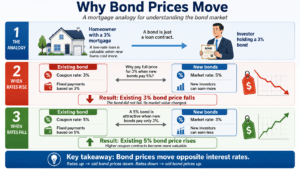
A bond is a loan you make. You hand your money to a company or a government; they agree to pay you a set rate of interest for a set number of years, and they promise to return your money at the end. That agreement is a contract—and like any contract, it has value. Most people never think about how the contract’s value changes long before it comes due.
Think about the homeowner who locked in a 3% mortgage a few years ago and now feels stuck because moving would mean giving it up. That loan is worth a fortune to them. But flip the transaction around and look at it from the other side of the table. Assume you’re the person who made that 3% mortgage loan. If you can issue new loans and get a 5% return, you’ll have to pay extra to someone to take that loan off your hands.
That is the entire bond market in one sentence.
When you own a bond paying 3% and newly issued bonds pay 5%, investors have little reason to pay full price for yours. To compete, your bond’s market value must fall. The bond has not defaulted or missed a payment; it is still doing exactly what it promised. Only the price someone is willing to pay for it today has changed.
The opposite is equally true. If you own a 5% bond in a world where new bonds pay 3%, then yours becomes more valuable. This seesaw has always been how bonds work. Most investors simply never had to think about it during the decade when rates went nowhere but down.
Educational illustration created by OpenAI
What the Federal Reserve Actually Controls
When people hear that the Fed “held rates steady,” they reasonably assume bond prices should have held steady too.
The Federal Reserve sets a target range for the federal funds rate. That is one rate: a short-term rate that banks charge each other overnight. It is enormously influential, but it does not determine what your bond fund is worth.
Long-term yields, by contrast, are set in the open market by investors weighing inflation expectations, economic growth, government borrowing (and the total supply of new Treasury debt), and their best guess about what the Fed does next. Now you see where shaky outcomes occur: bond rates and prices ride on investors’ best guesses. The Fed influences that conversation, but it does not control it.
This brings us to 2026. The Federal Reserve has now held its target range at 3.50% to 3.75% for five consecutive meetings, and at the most recent one, three members dissented because they wanted to raise rates. Meanwhile, inflation has stayed above the Fed’s 2% goal, the economy has kept expanding, and oil prices have been volatile due to Middle East tensions.
Investors who began this year expecting two rate cuts are now talking about a possible rate hike. That repricing pushed the 10-year Treasury above 4.7% and drove the 30-year past 5.3%, its highest level in nineteen years. Long-term yields rose without the Fed lifting a finger (remember our conversation above about investor sentiment affecting long-term yields?), and bond prices fell accordingly.
“Conservative” Does Not Mean “Never Declines”
Somewhere along the way, the word conservative came to mean guaranteed not to go down, but it never meant that.
A conservative portfolio is built to fluctuate less than an aggressive one. It is not built to eliminate volatility, and it never was. Every finance professional will tell you that bonds carry real risks: interest-rate risk, inflation risk, credit risk, and liquidity risk. Interest-rate risk is the one every bondholder has felt firsthand these past several months.
How far a bond’s price falls depends mostly on how long you have to wait to get your money back. A bond maturing in thirty years commits a buyer to below-market interest payments for three decades, so its price has to drop substantially to make up the difference. A bond maturing in two years commits them for only two, and at the end of those two years the issuer repays the full face amount regardless of what rates did in the meantime. That short wait is what limits the decline, and it is why the money you plan to spend soonest belongs in the bonds that move the least.
Higher Rates Are Not All Bad News
Here is the part that gets lost in the frustration: rising yields are a gift to a patient bond investor.
Every bond that matures inside your portfolio can get reinvested at today’s higher rates. Every new dollar you invest buys more income than it would have bought two years ago. That interest income does not erase a decline in market value overnight, but it can steadily rebuild it. It raises the income your portfolio produces going forward. Higher starting yields also provide a thicker cushion the next time rates move against us.
The same rate increase that hurts bond prices today is what improves bond returns tomorrow. But retirees capture only the second half of that trade if they still have money to invest when higher rates arrive.
Why We Use Conservative Projections
No investment climbs in a straight line. Stocks have bear markets. Bonds have years like this one. Real estate corrects. Cash quietly loses to inflation.
These difficult elements are why we choose not to build a retirement income plan on the assumption that every investment earns its historical average every year. When we construct a Perennial Income Model™, we assume future investment returns far below historical averages in every projection we run.
We are not trying to forecast the market. Nobody can. We are building a margin for error into a plan that has to survive thirty years of reality.
If a retirement plan only works when every investment cooperates, it is not much of a plan.
Every Investment Has a Job
At Peterson Wealth Advisors, we do not evaluate any investment in isolation. We evaluate it against the job it was hired to do.
Money that funds your grocery bill three years from now and money that will likely be spent by your grandchildren twenty years from now should never be measured by the same yardstick, held in the same investments, or worried about on the same timeline. Bonds in a retirement portfolio are there to produce income, provide stability, add diversification, and—most importantly—make certain you are never forced to sell stocks at a discount to pay next month’s bills.
So, the question worth asking is not, “Did my bonds go down?”
The question is, “Are my investments still positioned to deliver the income I need, when I need it?”
For our clients, the answer has not changed.
Interest rates will keep moving. Bond prices will keep adjusting. The Federal Reserve will keep making decisions we cannot predict in advance. Temporary market movements are unavoidable, but letting them derail a carefully constructed retirement plan is entirely avoidable.
The goal was never to avoid every disappointing quarter. The goal is dependable retirement income throughout the unpredictable future.
Frequently Asked Questions
1. Why are my bonds losing value when the Fed hasn’t raised interest rates?
Bond prices can fall even when the Federal Reserve holds its short-term policy rate steady. Long-term bond yields are influenced by inflation expectations, economic growth, government borrowing, and investor expectations about future interest rates. When long-term yields rise, existing bonds with lower yields generally become less valuable in the market.
2. Why do bond prices fall when interest rates rise?
Bond prices and interest rates generally move in opposite directions. When new bonds are issued with higher yields, existing bonds with lower yields become less attractive to investors. Their market prices typically fall until their yields become competitive with newly issued bonds.
3. Does the Federal Reserve control bond prices?
No. The Federal Reserve directly controls the federal funds rate, a short-term interest rate. Bond prices, particularly for longer-term bonds, are determined by the broader bond market and can be affected by inflation expectations, economic conditions, government borrowing, and expectations for future Fed policy.
4. Can long-term bond yields rise even if the Fed doesn’t raise rates?
Yes. Long-term Treasury yields can rise independently of changes to the federal funds rate. Investors may demand higher yields because they expect higher inflation, stronger economic growth, greater government borrowing, or higher interest rates in the future.
5. Are bonds still safe if their prices go down?
A decline in a bond’s market price does not necessarily mean the bond has defaulted or that you will lose the full amount invested if you hold it to maturity. Assuming the issuer makes the required payments, an individual bond generally pays its stated interest and principal at maturity. However, bonds still carry risks, including interest-rate, inflation, credit, and liquidity risk.
6. Do higher interest rates eventually help bond investors?
Generally, yes. Higher yields mean that maturing bonds and new contributions can be reinvested at more attractive rates. Over time, those higher yields can increase the income generated by a bond portfolio and help offset the impact of earlier price declines.
7. Should retirees be worried when their bond portfolio goes down?
Not necessarily. A temporary decline in bond prices does not automatically mean a retirement plan is in trouble. The more important question is whether the portfolio is structured to provide the income and liquidity needed throughout retirement without forcing unnecessary sales of investments at unfavorable times.
8. Should I sell my bonds when interest rates rise?
Not necessarily. Selling bonds simply because their market value has declined can undermine the role they play in a diversified retirement portfolio. Whether you should change your bond allocation depends on your time horizon, income needs, risk tolerance, and overall retirement plan.
Peterson Wealth Advisors is a registered investment adviser. This video is for educational purposes only and should not be considered individualized investment, tax, or legal advice. Investing involves risk, including the possible loss of principal. Past performance does not guarantee future results.
One of the most common questions we hear is:
“Can I retire at age 65 with $1.2 million?”
After years of helping retirees transition from saving for retirement to living off their savings, I know the answer is YES…but only if you structure your retirement income the right way.
I’ve found that the size of your nest egg tells only part of the story. Two couples can retire with exactly the same $1.2 million, yet one enjoys decades of financial confidence while the other spends retirement worrying about every market headline.
The difference isn’t simply how much they’ve saved, it’s whether they have a retirement income plan.
At Peterson Wealth Advisors, we believe the most important retirement question isn’t “How much money do I have?” It’s “Will I outlive my money, or will my money outlive me?”
Let’s look at how we’d approach a hypothetical couple who plans to retire at age 65 with $1.2 million split between traditional 401(k)s and Roth IRAs.
Step 1: Determine the Income Retirement Needs to Provide
Before discussing investments, we first determine what retirement actually needs to look like. How much monthly income will you need?
Will you travel extensively? Help grandchildren? Serve a mission? Purchase a second home? Delay Social Security? How much flexibility do you want if healthcare costs increase later in retirement?
We start with income, not investments. Once we understand the lifestyle you want, we can build a plan that supports it.
Step 2: Coordinate Every Source of Retirement Income
A $1.2 million portfolio rarely works alone. For most retirees, retirement income also includes:
Social Security
Retirement accounts
Roth IRA assets
Cash reserves
Tax-efficient withdrawals
The order in which these income sources are used matters.
For example, delaying Social Security may significantly increase lifetime benefits for many couples, while thoughtful coordination between traditional retirement accounts and Roth assets can help reduce taxes throughout retirement.
Rather than viewing each account independently, we integrate every income source into one coordinated retirement income strategy.
Step 3: Organize the Portfolio Around Time Instead of Risk
This is where Peterson Wealth’s proprietary Perennial Income Model™ becomes different from traditional retirement investing. Most investment firms ask one question:
“How much risk are you comfortable taking?”
We ask a different question:
“When will you actually need this money?”
Money needed over the next few years shouldn’t be invested the same way as money that won’t be spent for twenty or thirty years. Instead of treating the entire $1.2 million as one portfolio, the Perennial Income Model™ organizes assets into a series of five-year income segments.
Think of it like building a series of income “buckets.”
The first segment contains money expected to provide income during the early years of retirement. Because that money will be spent soon, it emphasizes stability.
Later segments, which may not be needed for ten, fifteen, or even twenty-five years, have significantly longer time horizons. That additional time allows those assets to remain invested for long-term growth, helping combat one of retirement’s greatest challenges: inflation.
This time-segmented approach creates purpose behind every investment dollar. Each segment has a specific job to do over the course of your retirement.
Step 4: Build Around Inflation, Not Just Today’s Income
Many retirees focus only on replacing their current paycheck. But retirement often lasts thirty years or longer. A couple retiring at age 65 has a meaningful chance that one spouse will live well into their 90s.
Over three decades, inflation quietly reduces purchasing power.
The groceries, healthcare, travel, and charitable giving that seem affordable today may cost substantially more twenty years from now.
That’s why the Perennial Income Model™ isn’t designed merely to generate income today. It’s designed to create an income stream that can increase over time by allowing longer-term investments the opportunity to grow before they’re eventually used for future retirement income.
Step 5: Reduce Emotional Investing
One of retirement’s biggest risks isn’t market volatility. It’s investor behavior.
When markets decline, many retirees feel tempted to sell investments because they fear running out of money. Unfortunately, selling growth investments during market downturns can permanently damage a retirement plan.
The Perennial Income Model™ helps reduce this emotional pressure.
Because early retirement income has already been planned through dedicated income segments, clients aren’t forced to sell long-term investments simply because the market experiences short-term volatility.
Having years of planned retirement income already in place gives many retirees something priceless: Confidence.
What Could Retirement Look Like for a 63-Year-Old Couple Retiring at 65 with $1.2 Million?
Every retirement plan is unique, but here’s how we might begin thinking about a couple retiring at age 65 with $1.2 million.
Social Security strategy would be carefully evaluated to maximize total retirement income, not just Social Security benefits.
Their traditional 401(k) assets would be coordinated with Roth IRA withdrawals to improve long-term tax efficiency.
Their investments would be organized according to when each dollar will be needed—not simply assigned one overall risk level.
Finally, we’d develop a retirement income plan designed to provide predictable monthly income while helping preserve future purchasing power through disciplined long-term investing.
Instead of wondering each year how much they can safely withdraw, they would have a written plan showing where future income is expected to come from and how each portion of their portfolio supports that income.
So…Can You Retire at 65 with $1.2 Million?
The answer is: Yes, if you do it right and want to live comfortably, not extravagantly.
For many couples, $1.2 million combined with Social Security and a well-designed retirement income strategy can provide an excellent retirement.
For others, spending goals, taxes, healthcare costs, pensions, charitable objectives, and family circumstances may require additional planning.
Remember: The number itself isn’t what determines retirement success. The plan does.
At Peterson Wealth Advisors, we’ve found that retirees gain the greatest confidence when they stop asking, “Is $1.2 million enough?” and start asking, “How can my retirement assets provide income that lasts the rest of my life?”
That’s exactly what the Perennial Income Model™ was designed to accomplish. Retirement isn’t about accumulating the biggest portfolio possible. It’s about creating an organized, thoughtful income strategy that allows you to spend less time worrying about your investments and more time living the retirement you’ve worked so hard to achieve.
Let’s Talk About Turning Your Retirement Savings Into Income That Lasts a Lifetime
At Peterson Wealth Advisors, we focus 100% of our energy and expertise on helping retirees like you make their savings last their whole retirement and empower them to leave a meaningful legacy. If you’re ready to talk about how to make that possible for you, set an appointment here or call 801-225-0000.
Disclosure
Peterson Wealth Advisors is a registered investment adviser. This article is provided for educational purposes only and should not be considered individualized investment, tax, or legal advice. Every retirement situation is unique, and investment decisions should be based on your personal goals, financial circumstances, and risk tolerance. Investing involves risk, including the possible loss of principal. Past performance does not guarantee future results.
 801.225.0000
 info@petersonwealth.com
 Orem, UT 84057
 Client Login
 Schedule a Free Consultation