Carson Johnson is a Certified Financial Planner™ professional at Peterson Wealth Advisors. Carson is also a National Social Security Advisor certificate holder, a Chartered Retirement Planning Counselor™, and holds a bachelor’s degree in Personal Financial Planning and a minor in Finance.
Capital gains can be one of the most overlooked investment tax traps in retirement. This is something that I have seen, we have seen, many times throughout working with retirees and really just understanding what are capital gains, how they are taxed, and how can they work in retirement.
What is a Capital Gain?
So first, let’s talk about what is a capital gain. Capital gain simply put is when you buy an investment and it grows over time and then you sell it. So that profit that you make on an investment is the capital gains income. Now, there are only certain assets that are considered capital gains. So things like an investment property, selling of a stock or a mutual fund within a non-retirement account, or even the sale of a business can count as a capital gain.
So understanding what type of investment you have, if it does qualify for capital gains, is an important part. But let’s say you buy an investment like a stock, like Apple, for example, for $100 and it grows over time and it is now $300. The difference between those two, the $200, it would be considered the capital gain if you were to sell that investment. Then that $200 is reported on your taxes and then it’s taxed from there.
But, another part of capital gains that is important to note is that capital gains are broken down into two categories. They can be either short-term capital gains or long-term capital gains. And what really determines that is simply how long you’ve held the investment.
So, for example, let’s say you buy an investment and sell it within a year. That will be considered a short-term capital gain. If you have held it and sold it for longer than 12 months, longer than a year, then that would be considered long-term capital gains. So, understanding not only what type of investment you have and how long you’ve held it, actually creates a lot of planning opportunities when it comes to taxes.
How are Capital Gains Taxes?
Which leads me to kind of the last part of this, which is how are capital gains taxed? So as you can see, short-term capital gains are taxed as ordinary income, which just simply means it’s taxed like your other income that you get from either a job or pensions sometimes. It’s just taxes, ordinary income. So depending on how much income you have, you can see it will determine at what tax rate that is taxed at, which is typically higher than what long-term capital gains tax rates are.
So how are long-term capital gains taxed? Compared to the ordinary income tax rates, they are pretty simple. They’re either taxed 0%, 15%, or 20%. But they are dependent on your other combined income, things like your Social Security, your pensions, or even W-2 wages as well. That’s what determines which rate they’re taxed at.
So, for example, let’s say you’re a single filer. If you have income less than $40,400 combined between your Social Security, your wages, and all of that, then your long-term capital gains are taxed at 0%. Which you can see can present a huge opportunity to sell investments with zero tax impact. If that single individuals combined income is between $40,400 and $445,850, long-term capital gains are taxed at 15%. And if their combined income is greater than $445,850, then long-term capital gains are taxed at 20%. The same principle applies if you are married filing a joint return, but the numbers may be a little bit different. So if your combined income is less than $80,800, long-term capital gains are taxed 0%. Between $80,800 and $501,600, that’s taxed at 15%. And combined income above $501,601 is taxed at 20%.
Conclusion
So as you can see, understanding how capital gains work, what they are, and how they are taxed is so important. It’s essential in maximizing a retiree’s investment portfolio and creating a better retirement outcome for them over the course of their retirement.
Step-up in basis is an important planning tool that can make taxable capital gains disappear when leaving property to your heirs. I want to talk about step-up in basis because it’s an important part as part of a retirement plan. For those that have taxable assets things like a non-retirement account stocks, bonds, mutual funds, and investment property, this can all be applied for a step-up in basis.
So, when you have an investment or an asset that grows in value, investors should be aware that if they sell it then they would owe capital gains taxes on the profit, or the difference between what they sold it for and what they bought it for. But when you are thinking of an inheritance to heirs, a step up in basis makes such an important and tax efficient transfer to your heirs.
What step up of basis is, is that it allows you to pass on non-retirement assets like an investment or an asset to an heir, and wipes away that capital gains impact to the heir.
Example
For example, let’s say we have Jack and James, and Jack is a retiree and father to James. Jack purchased, let’s say, Apple stock at $20,000 10 years ago and now it’s worth $100,000 today. If he were to sell that, the stock, he would have a capital gains income that he would have to report on his taxes of about $80,000, which if we assume a capital gains rate of 15%, that would equal $12,000 in additional taxes that Jack would have to pay. If the goal is for Jack to donate, give that stock to his son, there’s a more tax efficient way to doing so, which is through the step-up in basis. If Jack simply allows that stock to pass on to James, James is able to inherit that stock at the $100,000 amount and completely avoid the capital gains responsibility.
Essentially, what happens is Jack’s cost basis of $20,000 that he originally purchased the stock for gets stepped up to the current value of the stock, which is worth $100,000. As soon as James owns that stock, at that point in time, any profit is then taxable to him. But, it’s a great way to pass down assets to future heirs in generations tax free so that they don’t have to deal with the capital gains impact.
One of the mistakes that we see retirees make is they want to give their assets or investments to their heirs prior to their passing, but with the correct knowledge of the step-up in basis, there is a lot more tax efficient way to pass on those assets to their heirs in future generations.
There’s one example that I had with a client that I was working with where it was siblings, two brothers. One brother had given an investment property to his other brother. And by doing so, when he passed away, the client that I was working with ultimately is now responsible for those capital gains. Because if you gift that property during one’s life, you get to essentially keep the same cost basis or what the original owner purchased it for.
So, it’s important to consider, especially later in retirement, if there’s any investment assets that you’re looking to pass on to future heirs to have a conversation about how the step-up in basis can apply.
Important Takeaways
Now there are a few takeaways and important rules to remember about this. Step up in basis can apply to stocks, bonds, mutual funds, real estate, and much more. Really, any type of asset that’s considered a capital asset, according to the IRS’ definitions, which it can be found IRS.gov.
The other important takeaway is that step up in basis works differently for spouses. Instead of being able to receive a full step-up in basis, a surviving spouse is only eligible to receive a step, a half step-up in basis if they own the property jointly, meaning if both husband and wife or both spouses own it together. If only one spouse owns it, then the other spouse could potentially get a full step-up in basis as well.
The other aspect of this is depending on where you live. There are certain states that are considered what’s called community property states such as California, Idaho, Louisiana, Nevada, New Mexico, Texas, and Washington, where the step up in basis rules may be different.
Conclusion
So for anybody that wants to learn more about this, should consult with their financial advisor or tax advisor to specifically know how this may apply to their situation.
When it comes to your investment assets, it’s important that investors are aware of step-up in basis and have a plan on how those assets should be distributed to their heirs in the most tax efficient way.
A Qualified Charitable Distribution is one of the best tax planning and charitable giving strategies available to retirees. For those that give regularly in retirement, they should consider this as part of their retirement plan. A Qualified Charitable Distribution is a provision in the tax code that allows you to withdraw your money from your IRA tax free as long as it goes directly to a qualified charity.
When you normally withdraw money from your IRA or 401K, every dollar you pull out is taxable to you. But, if it’s done as QCD, that is completely tax free. Ultimately, a QCD gives you three tax benefits. If you think about it, you put money into your IRA or 401K that you’re not taxed on. Then you’re also not taxed on any of the growth that you’ve had on your investments over a 20 or 30 year career.
And then lastly, you’re able to pull that same money out tax free as long as it goes to a qualified charity. So, this has huge tax savings if done properly. But despite these benefits, there’s also many downfalls or mistakes that investors make.
Who is eligible for a Qualified Charitable Distribution?
So I wanted to talk about a few of them and how to avoid them. First, is that this strategy is only available to those that are at least 70.5 years old. The maximum amount that you can do is $100,000 per year. That is adjusted for inflation, so that will go up over time.
Second, is that this is only available within IRA accounts. So, many retirees have 401Ks or 403Bs and may wonder if it’s available within their plans. However, it is not. QCDs are only available within an IRA account. So one way that you can get around that is by simply rolling over a part or all of your funds into an IRA account to be able to do this strategy.
Third, a QCD must be a direct transfer from your IRA to the qualified charity. I have a client of mine who had the ability or a feature on his IRA to write a check from time to time, and that’s how he was doing his QCDs.
However, this is not eligible for a QCD. After we talked to him, we explained that this is not a direct transfer and it has to come directly from the custodian like TD Ameritrade, Fidelity, Vanguard, etc., in order for him to qualify.
Fourth, a QCD is not an itemized deduction. This is important because the IRS doesn’t want investors to double dip in their tax savings. So, I like to remind everyone that a QCD allows you to avoid the tax so it’s a tax free income, but it is not considered a tax deduction.
Lastly, is the reporting and reporting is such an important part in order to get a benefit from this strategy. The IRS has a lot of different codes on how money is distributed from an IRA, but they don’t have a specific code for a QCD. However, the IRS has issued some guidance on this and there’s some instructions on the IRS.gov website for that. But if it’s not reported correctly, it’s as if it never happened. So you need to make sure it’s done, correctly.
Conclusion
Qualified Charitable Distributions ultimately gives retirees the opportunity to save taxes and accomplish their charitable giving goals. Every retiree that regularly gives to charity, is over age 70.5, and has an IRA should consider how QCDs can better help and enhance their retirement.
A Donor-Advised Fund is an excellent tool to maximize your charitable giving while minimizing your tax burden. I like to think of these accounts as a charitable giving account. How these accounts work is you donate cash or other assets such as stocks, bonds, mutual funds, etc. and the amount that you contribute gives you a tax deduction.
Whatever you choose to donate, your contributions are irrevocable and completely dedicated for charitable giving. But once you make the contributions to these accounts, those funds sit in the account until you’re ready to grant or transfer those funds.
Now, you can choose from a list of thousands of different qualified charities, whether that’s your alma mater, religious organization or local food bank. There are a variety of practical applications on how you can use a Donor Advised Fund. Oftentimes, the savviest thing is to donate long-term appreciated assets like a stock, bond or mutual fund.
This allows you to potentially eliminate the capital gains for tax that you would otherwise face, while also receiving an income tax deduction. Another application is if you’re anticipating the sale of a business or expecting a large tax year. This can come in the form of receiving a severance or selling an investment property. Because of the extra taxable income that you would have to report, that may cause a bigger tax year for you.
So by contributing, making these contributions, you can essentially reduce your taxable income by making these contributions.
A Donor-Advised Fund Helps Reduce Taxes
Now, there are ways that the Donor Advised Fund can be helpful to reduce the tax impact of these big tax years. But, if done improperly, it can reduce the benefit that you actually receive from this strategy. I wanted to go over a few of those mistakes that we see and how to avoid them.
First, some people may invest the money in their Donor Advised Fund too aggressively. But, by investing too aggressively in those funds, in any given time, the market could go down and have less money there to be able to use for you charitable giving goals.
Another common mistake is contributing too much to a Donor Advised Fund. Now, there’s a lot of people that get carried away with these strategies and think that they should just contribute as much as they can. However, they should be aware of how this plays in with other tax planning strategies that they may need to consider like a Qualified Charitable Distribution or a Roth conversion, etc..
And by overlapping these strategies, they may reduce the benefit of one tax strategy or the other.
Lastly, if you’re planning on gifting the funds directly to a charity, then there’s no reason to set up a Donor Advised Fund there. There are a lot of qualified charities that accept stocks, bonds, mutual funds, and you can transfer those directly to the charity without having to set up an account like this. These accounts are particularly suited for those who regularly give to charities, and planning on making a large contribution for tax purposes, but don’t plan on sending all of that money to the charity right away.
Conclusion
A Donor Advised Fund can be a huge tax planning tool for those who are anticipating a large tax year and can be an excellent tool to maximize your charitable giving efforts in a tax efficient way.
One of the most common questions that we get is, should I do a Roth conversion? And if so, how much?
What is a Roth conversion?
Now, for those that don’t know what a Roth conversion is, all it is is simply taking money from your IRA or 401K retirement accounts and converting them to an after-tax Roth 401K or a Roth IRA. Now, there are significant tax benefits for having these accounts, but there are many factors that should be considered before you make that decision to doing a Roth conversion.
Factors that may include where am I in the tax bracket today? What is my tax bracket projected to be in retirement? How do Required Minimum Distributions fit into all this? And what happens if my spouse passes away early during my retirement?
Today, I’d like to talk about a few of those costly mistakes that many people make when considering a Roth conversion in their retirement.
Many people get carried away with Roth conversions
First, many people get carried away with Roth conversions. There’s a lot of content and information about Roth conversions in the news, media, and nearly every financial institution has an article or content about it. But, often retirees get carried away and think I needed to be doing as much as I can into a Roth IRA or a Roth 401K, but they may not be seeing the tax impact of that during their retirement.
You take a look at the tax brackets, you’ll notice that it starts off with the 10% bracket, 12% bracket, but then it jumps, significantly jumps, to the 22% bracket. There’s more significant jumps throughout the tax brackets as well. But, what we see is when people come into our office, they say they have been doing Roth conversions and they end up making these big jumps in their taxes. But in reality, their tax bracket may not be as high in retirement as what they thought it was going to be.
People fail to plan for their Required Minimum Distribution
The second mistake is people fail to plan for their Required Minimum Distributions. All Required Minimum Distributions are is that you are forced to withdraw a certain amount out of your IRA or 401K account as soon as you reach age 73. Now, if you’re a retiree that is relying on your investment income then this may not be as big of a deal for you because you are relying on that income throughout your retirement.
But for most retirees, that income is not their only source of income. They may have pensions, Social Security, rental income, and more. And so what we see is retirees will get into retirement, start their Required Minimum Distributions, and then they’re not using all of their investment income, which is just ultimately going to be withdrawn from their retirement accounts and taxed.
Every retiree should have a plan on how their Required Minimum Distributions are going to impact them during and throughout their retirement.
The next mistake is how Roth conversions can potentially impact your Medicare premiums. Many may not realize that Medicare premiums is based on your combined income. And so the more income you have, the higher your potential Medicare premiums will be. The base Medicare premium cost for Part B is $164.90.
For those that are married and file a joint return, that will stay the same if their income stays below $194,000. If you’re a single filer and your income stays below $97,000, it will also stay that same amount. But as soon as your income is a dollar over that threshold, it will jump to $230.80. Believe it or not, there are actually four other thresholds or for other increases to your Medicare premiums above that. So if you have substantial income coming in, your Medicare premiums could be as high as $560.50 per person per month.
So as you can see, Roth conversions can make a significant impact. You may be wanting to do Roth conversions to save taxes, but you may be adding additional expenses to your Medicare premiums along the way.
What non-financial aspects of Roth conversions should be considered?
Lastly, there are some non-financial aspects of Roth conversions that should also be considered. Things like moving from one state to another. If you live in a state that doesn’t currently have state income tax and moving to a state that does, that can be a big factor.
Or if you have a spouse that has a terminal illness and isn’t expected to live throughout a long retirement, knowing how Roth conversions can impact them. Or even potentially your heirs, how these Roth conversions could help your heirs for generation after generation.
With the new changes to secure Act 2.0, some of your heirs may be required to withdraw all of the money from IRA or retirement accounts within ten years. So having a plan to consider these other non-financial aspects is so important.
Now, there is an important disclaimer I have to share about Roth conversions and tax planning altogether is there are some things that are just simply out of our control. Whether that be market movements, or changes in legislation, tax laws, is always constantly evolving.
Conclusion
What I like to share with my clients is financial planning also evolves with the time and changes. We plan for the best and if there are any changes, we make adjustments along the way. Now, Roth conversions may seem straightforward, but it’s important that retirees carefully consider the factors that we’ve talked about today. Roth conversions may seem straightforward, but it’s important that retirees carefully think through these considerations that we’ve talked about today.
The best way to protect yourself from these costly mistakes is to simply have a plan. A plan that is dollar specific, goal specific, and that addresses other non-financial aspects of Roth conversions. As you do so, you’ll start to address these items and you’ll see that it’s going to help you maximize your retirement.
Many of you throughout your working career have contributed to a tax deferred retirement account, whether that be a 401k, 403b, 457, or even an IRA account. Once you hit a certain age, you’ll be required to take what’s called Required Minimum Distributions that forces you to take money out each and every year and that you have to pay taxes on that distribution.Now, with that responsibility of withdrawing money from your retirement account comes a lot of mistakes that we often see.
So today I want to talk about some of those mistakes that are often overlooked and how you can avoid them. But first, let’s talk about some of the important changes that were made to Required Minimum Distributions back in December of 2022 in The SECURE Act 2.0.
Really, the biggest change was the age at which you begin taking these Required Minimum Distributions. For those that are already taking Required Minimum Distributions or were born before 1950, you will continue to take those Required Minimum Distributions as normal. For those that were born in 1951 to 1959, you will begin taking your Required Minimum Distribution at age 73. And those that were born in 1960 or later, you will begin at age 75.
Common Required Minimum Distribution Mistakes
Now, one of the biggest mistakes with Required Minimum Distributions is simply failing to take your Required Minimum Distribution. Now that may seem simple, but this can result in one of the largest tax penalties in the IRS code, which is 50% of the Required Minimum Distribution amount. Plus all of that distribution is still fully taxable to you on the federal and state level, depending on the state where you live.
Now, the second mistake is understanding how Required Minimum Distributions can impact the amount of tax to pay throughout retirement. So, here’s an example.
Let’s say you’re a young retiree that’s age 60 with $1,000,000 retirement account. Assuming a 4% growth rate, that Required Minimum Distribution will be approximately $60,769. Now, if you’re a retiree that is relying on that income and using all that income for their income plan, then this may not be as relevant. But, let’s say you aren’t needing that income. That could be an additional $60,769 of additional income that you have to pay tax on.
So, without a plan, this can make big impacts on your overall retirement. Now, the IRS calculates the Required Minimum Distribution based on two things, your age and your account balance. So, as you can see on the chart, as you continue to get older and your account continues to get bigger, your Required Minimum Distribution also continues to grow.
Now, let’s say this retiree has other taxable income, things like Social Security and pension, that equals to about $130,000. And that additional Required Minimum Distribution of a taxable income of $60,769, that jumps this retiree from the 22% bracket to the 24% bracket. And since the Required Minimum Distribution continues to get bigger, that means that this retiree will likely be in that higher tax bracket throughout the rest of their retirement.
Now, it may not seem like a big difference from the 22% to 24% bracket, but if you look at all the rest of the tax brackets, there are some significant jumps in the tax brackets. For example, from the 12% to the 22%, is a 10% jump. So, it’s so important to be aware of how your Required Minimum Distribution will impact your tax bracket.
The last mistake is how Required Minimum Distributions will also impact your Medicare premiums. This is an important planning item and oftentimes overlooked by retirees. An increase to Medicare premiums is called IRMAA, which stands for Income Related Monthly Adjustment Amount. Just as the name says, Medicare will adjust your Medicare premiums for Part B and D depending on your amount of total income that you report on your tax return.
How this works is Medicare looks at your income from two years prior, and if your income falls within certain thresholds, that will determine the amount of your monthly Medicare premium. It kind of works like tax brackets, depending on how much income you make, it may be in the 10%, 12%, 22%, 24% bracket, etc..
Now, I’ve listed a couple of common tax filing statuses to show you the different thresholds and brackets for Medicare. For example, let’s say you’re a married couple filing a joint return. If your total income, or in other words, your Modified Adjusted Gross Income falls between $194,000 and $246,000, your Medicare premiums will increase from $164.70 to $230.80 per person, plus your Medicare Part D premiums will also go up by about $12.20.
Now, these brackets do adjust for inflation and may change over time, but this will give you a general idea of where your Medicare premiums will be based on your income. Now, every retiree should be able to have an answer on how they’re going to address Required Minimum Distributions.
Like I mentioned before, some may be relying on all their Required Minimum Distribution for their income, so this may not be as relevant. However, time and time again I have seen so many retirees who have failed to plan for their Required Minimum Distribution and how it will impact them.
Conclusion
There are a lot of different ways you can manage the impact of your Required Minimum Distribution, whether that be through Roth conversions, Qualified Charitable Distributions using a Donor Advised Fund, but simply having a plan allows you to take your Required Minimum Distribution in the most tax efficient way possible.
Peterson Wealth Advisors is a registered investment adviser. This video is for educational purposes only and should not be considered individualized investment, tax, or legal advice. Investing involves risk, including the possible loss of principal. Past performance does not guarantee future results.
For many couples approaching retirement, reaching $2 million in savings feels like crossing a finish line.
After years of contributing to retirement accounts, watching investments grow, and making smart financial decisions, seeing a portfolio reach $2.2 million is an incredible accomplishment.
But once that milestone is reached, a different question often replaces it. Instead of asking, “Have we saved enough?”, people begin asking, “What kind of retirement will this actually allow us to enjoy?”
It’s one of the most common conversations we have with couples in their late 50s. They’re still working, but retirement is beginning to feel real.
They’re imagining more travel, more time with family, maybe serving a mission, helping with grandchildren, pursuing hobbies that have waited for years, or giving more generously. They’re no longer wondering whether retirement is possible.
They’re wondering what retirement can look like.
At Peterson Wealth Advisors, we love that conversation because we’ve learned something important after helping retirees transition from accumulating wealth to living on it. The quality of your retirement isn’t determined simply by the size of your investment portfolio. It’s determined by how effectively that portfolio is transformed into dependable retirement income.
Let’s look at how we’d approach a hypothetical couple in their late 50s with approximately $2.2 million saved who want to understand what kind of retirement lifestyle their savings may be able to support.
Step 1: Define What “Comfortable” Means to You
Everyone wants a comfortable retirement, but very few people define what that actually means.
For one couple, comfort may mean traveling internationally every year. For another, it means spending summers at the family cabin. Some hope to purchase a second home. Others dream of serving missions, volunteering, or spending more time with grandchildren.
All of those goals influence how retirement income should be planned. And it’s why we don’t begin by talking about investments. We begin by talking about your life.
What experiences matter most?
How much monthly income will allow you to enjoy them?
Which goals are non-negotiable?
Where do you want flexibility?
Only after those questions are answered can we begin designing a retirement income strategy that’s aligned with the lifestyle you’re trying to create. After all, retirement isn’t simply about replacing your paycheck, but about creating the freedom to live intentionally.
Step 2: A Larger Portfolio Creates More Choices
Many people assume that once they’ve accumulated $2 million or more, retirement planning becomes easy. In reality, the opposite is often true.
Greater financial resources usually create greater flexibility, and with that comes more decisions.
Should you retire at 60?
Or continue working until 65?
Should you begin Social Security early, or delay benefits?
Would Roth conversions reduce future taxes?
Should you spend more freely during the early years of retirement while you’re healthiest?
How much should you reserve for future healthcare expenses?
How should charitable giving fit into your overall retirement plan?
Should your children inherit retirement accounts, Roth assets, or taxable investments?
None of these questions are answered simply by knowing your portfolio balance, but through thoughtful planning. The goal is to use your wealth intentionally, making choices on purpose that serve your retirement life goals.
Step 3: Coordinate Every Source of Retirement Income
Even with $2.2 million in retirement savings, your retirement savings needs to be thoughtful withdrawn from different types of accounts, and coordinated with other income sources like Social Security. Traditional IRAs, 401(k)s, Roth IRAs, taxable brokerage accounts, and pension income all have different rules and tax implications that require careful orchestration.
Rather than treating each account as a separate investment, we integrate every income source into one coordinated strategy.
The timing and order of withdrawals matters. So does tax planning and Social Security decisions. When all of those pieces work together, retirees often gain more than efficiency. They gain confidence that every part of their financial life is working to provide dependable income throughout retirement.
Step 4: Why Time Matters More Than Risk
Most investment firms organize retirement portfolios around one central question:
“How much investment risk are you comfortable taking?”
At Peterson Wealth Advisors, we believe there’s a more practical question.
“When will you actually need this money?”
The answer changes everything.
Money you’ll likely spend during the first few years of retirement shouldn’t necessarily be invested the same way as money you may not touch until your eighties. That’s the foundation of our proprietary Perennial Income Model™.
Rather than viewing your entire $2.2 million as one investment portfolio, the Perennial Income Model™ organizes retirement assets into a series of five-year income segments.
The first segment is designed to provide dependable income during the early years of retirement. Later segments have much longer investment horizons. That additional time allows those investments the opportunity to pursue long-term growth before they’re eventually needed to provide retirement income.
Every dollar has a purpose. Every segment has a timeline.
Instead of asking one portfolio to accomplish every objective simultaneously, each portion of your retirement savings is assigned a specific role within your overall income strategy. That structure can help create something gives retirees the confidence that the money they need will be there when they need it, no matter how long their retirement stretches. And that confidence is priceless.
Step 5: Plan for the Retirement You Want to Live—Today and Decades From Now
One of the biggest misconceptions about retirement is that it’s a single phase of life. In reality, retirement often unfolds in stages.
The first decade may be filled with travel, hobbies, volunteer work, and making memories with children and grandchildren.
Later years may bring different priorities. Travel may slow, but healthcare expenses often increase. Time spent with family may become even more meaningful. Charitable giving, estate planning, and leaving a legacy may take on greater importance.
A successful retirement income strategy recognizes that your needs—and your priorities—will evolve over time. That’s one of the reasons we don’t simply ask how much income you need this year. We ask how your retirement may change over the next thirty or forty years.
Inflation is part of that conversation as well. The income that provides a comfortable lifestyle at age 60 likely won’t have the same purchasing power when you’re 80 or 90.
That’s why the Perennial Income Model™ isn’t designed simply to generate income today. It’s designed to organize your retirement assets so that money intended for later decades has the opportunity to remain invested longer before it’s needed, helping support your future purchasing power while earlier income segments provide dependable cash flow during the first years of retirement.
It’s a strategy built around time, and how your spending will change, not just today’s expenses.
Step 6: Retirement Confidence Isn’t About Never Worrying—It’s About Having a Plan
Even couples with substantial retirement savings can experience uncertainty. Questions like these are surprisingly common:
“Can we spend more freely?”
“Should we buy the vacation home?”
“Can we help our children financially?”
“Will we still be okay if the market drops?”
“How much should we leave to our family?”
These aren’t investment questions, they’re confidence questions. Without a written retirement income plan, every major financial decision can feel like a guess. Many retirees end up spending less than they comfortably could because they’re afraid of making a mistake. Ironically, after working for decades to build financial security, they struggle to enjoy the very retirement they worked so hard to create!
We’ve found that confidence comes from understanding how your retirement income is expected to work.
When you know where your monthly income is expected to come from, how your investments are organized, and how your long-term goals fit into the overall plan, it becomes much easier to make financial decisions with confidence.
No investment strategy can eliminate uncertainty. But a thoughtful retirement income plan can provide clarity during periods of market volatility and help reduce the emotional decision-making that often hurts long-term investment success.
What Could Retirement Look Like for a Couple with $2.2 Million?
Every retirement is unique, but here’s how we might begin evaluating a couple in their late 50s with approximately $2.2 million in retirement savings.
The first conversation wouldn’t be about investment returns. It would be about the retirement they envision.
Do they hope to retire in the next few years?
How much travel do they anticipate during the first decade?
Would they like to purchase a second home, serve a mission, or spend more time with family?
How important is charitable giving?
What kind of legacy do they hope to leave?
Once those goals are clearly defined, we’d coordinate every source of retirement income into one comprehensive strategy. We’d evaluate the timing of Social Security benefits to help maximize lifetime income where appropriate and identify opportunities to improve long-term tax efficiency by coordinating withdrawals from traditional retirement accounts, Roth IRAs, and taxable investments.
Rather than treating the entire portfolio as one investment account, we’d organize it using the Perennial Income Model™, assigning each portion of the portfolio a specific role based on when that money is expected to provide retirement income.
The result is a written retirement income plan designed to provide dependable monthly income today while helping preserve purchasing power and flexibility for decades to come.
Instead of wondering whether they can afford the retirement they imagine, they’d have a strategy designed to support it.
So…How Comfortable Can Retirement Be with $2.2 Million in Savings?
For many couples, very comfortable.
A thoughtfully managed portfolio of $2.2 million, combined with Social Security and a coordinated retirement income strategy, can provide tremendous flexibility and opportunities throughout retirement.
But comfort isn’t measured solely by the size of your portfolio. It’s measured by your confidence in using it.
At Peterson Wealth Advisors, we’ve found that retirees experience the greatest peace of mind when they stop asking, “Is $2.2 million enough?” and begin asking a different question:
“How can we use what we’ve built to create the retirement we’ve always imagined?”
That’s exactly what the Perennial Income Model™ was designed to help accomplish.
Retirement isn’t simply about accumulating wealth. It’s about transforming that wealth into dependable lifetime income that gives you the freedom to live generously, confidently, and intentionally.
After all, the goal isn’t just to retire with a large portfolio. It’s to enjoy the life that portfolio was meant to provide.
Let’s Talk About Turning Your Retirement Savings Into Income That Lasts a Lifetime
At Peterson Wealth Advisors, we focus 100% of our energy and expertise on helping retirees and those nearing retirement transform their savings into dependable retirement income that can last throughout retirement while empowering them to leave a meaningful legacy.
If you’re wondering what kind of retirement your savings can support, or simply want greater confidence in your retirement income strategy, we’d love to have a conversation.
Schedule your complimentary Retirement Income Strategy Session or call 801-225-0000 to learn how the Perennial Income Model™ can help you build an organized, dependable income plan designed around the retirement you’ve worked so hard to achieve.
Disclosure
Peterson Wealth Advisors is a registered investment adviser. This article is provided for educational purposes only and should not be considered individualized investment, tax, or legal advice. Every retirement situation is unique, and investment decisions should be based on your personal goals, financial circumstances, and risk tolerance. Investing involves risk, including the possible loss of principal. Past performance does not guarantee future results.
Once you’ve decided what to do with your Intermountain Health pension — lump sum or monthly payments — the next question becomes just as important:
When should you act?
Timing can meaningfully impact the size of your benefit, your tax situation, and the long-term success of your retirement income plan. Let’s walk through the key considerations.
Understanding the 5% Rule
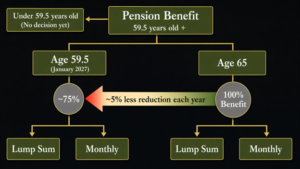
For caregivers between the ages 59½ and 65, your pension benefit is adjusted by roughly 5% per year. If you claim early, your lump sum or monthly benefit is reduced by about 5% for each year before age 65. For example:
Claiming at 65 = full value
Claiming at 62 = roughly 15% reduction
Claiming at 59½ = roughly 25% reduction
On the surface, that makes waiting look like the obvious choice. But timing is rarely that simple.
The Core Question: Can You Beat 5%?
If you’re considering taking the lump sum before age 65, the real financial question becomes:
Can you reasonably earn more than 5% annually by investing that money?
If you believe (and can structure your portfolio) to achieve returns above 5% over time, taking the lump sum earlier may make sense. That way, instead of accepting the guaranteed 5% annual increase by waiting, you’re putting that capital to work immediately.
If retirement is still a few years away, time is still on your side. That lump sum can potentially grow within a 401(k) or IRA while you’re still working. But this requires:
Discipline
Proper asset allocation
Long-term perspective
Thoughtful tax planning
Without a clear strategy, chasing returns simply to “beat 5%” can backfire.
The Case for Waiting Until 65
There’s also a strong argument for patience. If you wait until 65:
You receive the maximum pension value
You avoid the early-claim reduction
You lock in guaranteed growth
For someone who prefers certainty or who is nearing retirement and doesn’t want market exposure, waiting can provide peace of mind.
The guaranteed 5% annual increase until 65 is difficult to ignore, especially in a low-risk context. If you know you’ll need the income soon, maximizing the base benefit may be the wiser move.
Timing Monthly Payments: A Tax Consideration
Now let’s talk about monthly payments. Intermountain allows you to start receiving pension income while still working. That flexibility is unique — but it doesn’t automatically mean it’s wise.
Here’s a rule of thumb:
If you don’t need the income, don’t take the income.
Why?
Because if you’re still earning wages, pension payments stack on top of your salary. That can push you into higher tax brackets and reduce overall efficiency. You’re essentially accelerating taxable income you may not yet need. Waiting until retirement (when your earned income drops) often creates more tax flexibility.
The Bigger Picture: This Decision Is Not Isolated
Timing should never be evaluated in a vacuum. You must consider:
Your planned retirement age
Your other retirement savings
Social Security timing
Medicare eligibility
Current and future tax brackets
Your overall income needs
For example, if you plan to work until 67 and have other conservative assets, taking the lump sum early and investing it may allow it to grow more efficiently than waiting. But if retirement is just around the corner and you’ll rely heavily on the pension, maximizing the guaranteed amount may be the better fit.
This is not simply a math problem. It’s a coordination problem.
A Practical Framework
Here’s a helpful way to think about it:
If you can earn more than 5% annually, don’t need the income now, and are comfortable with market volatility — taking the lump sum earlier may make sense.
If you prefer guaranteed growth, will need income soon, or value simplicity — waiting until 65 maximizes the pension benefit.
Both paths can be appropriate. The key is aligning the timing decision with your broader retirement income plan.
Ultimately, timing your pension decision is one of the most financially impactful choices you’ll make in the coming years. Early action offers growth potential and flexibility. Waiting offers certainty and maximum guaranteed value.
But the right answer depends on your full financial picture, not just the 5% rule. Before making a decision, it’s worth modeling both scenarios within a comprehensive retirement income strategy.
Peterson Wealth Advisors is a registered investment adviser. Information presented is for educational purposes only. Please consult a qualified financial advisor before implementing any strategy.
Should I take the pension as a lump sum — or as monthly payments?
It’s a simple question on the surface. But underneath it are issues of inflation, taxes, flexibility, legacy planning, and personal responsibility. Let’s walk through both options carefully.
The Case for Monthly Payments
Taking your pension as a monthly income stream (annuitizing) provides something many retirees value highly:
Stability.
You receive a steady payment every month for the rest of your life. There are no market swings to monitor. No allocation decisions to make. No concern about running out of money tied specifically to that pension.
For some caregivers, that simplicity brings peace of mind. That monthly pension payment can feel like a safe harbor if you:
Strongly dislike market volatility
Don’t want to manage investments
Prefer predictability over flexibility
Or don’t have trusted guidance to help navigate downturns
But that stability comes with trade-offs.
The Limitations of Monthly Payments
The most significant challenge retirees face today is inflation. Your pension payment is fixed.
If you retire with a $3,000 monthly benefit, you’ll still receive $3,000 twenty years later. But if inflation averages 3% per year, the groceries, travel, healthcare, and everyday expenses that cost $3,000 today could cost roughly $5,400 per month in twenty years. In other words, the fixed payment stays the same, but it certainly loses purchasing power over time.
There’s also limited flexibility:
You receive the same amount whether you need it or not.
It restricts certain tax planning strategies.
You cannot adjust withdrawals based on changing circumstances.
When you and potentially your spouse pass away, the payments stop.
There is generally no remaining asset to pass to children or charities. That’s not necessarily wrong, but it’s important to understand what you’re giving up.
The Case for the Lump Sum
With the lump sum option, instead of receiving a monthly pension check for the rest of your life, you receive a one up-front payment that represents the estimated value of those future monthly payments.
Importantly, this does not necessarily mean the entire lump sum becomes taxable income to you immediately. If handled properly, the lump sum can typically be rolled into your 401(k) or IRA, allowing the money to remain tax-deferred until you begin taking withdrawals.
Taking the lump sum shifts you into the driver’s seat. You can roll it into your 401(k) or IRA and integrate it into your broader retirement income plan. This provides:
Investment control
Tax planning flexibility
Inflation-fighting growth potential
Legacy planning opportunities
The tax planning flexibility is often overlooked. By rolling the lump sum into an IRA or 401(k), you may have more control over when the money becomes taxable. That can open the door to more thoughtful tax planning around withdrawals, Roth conversions, Medicare premiums, and charitable giving. For caregivers who regularly give to charity or to their Church, this flexibility can be especially meaningful and allow you to withdraw from your IRA tax-free later in retirement.
Properly managed, a lump sum can be invested in a way that allows part of the portfolio to grow over time. That growth can help offset inflation and give you the ability to increase your income over the years as expenses rise. It also gives you more control over how much income you take, when you take it, and which accounts to draw from.
And if something happens to you or your spouse, the remaining assets don’t disappear. They pass on to heirs. For caregivers who value flexibility and legacy impact, that can be meaningful.
The Responsibility That Comes with Control
Here’s the honest truth: A lump sum is powerful, but it requires discipline. When you take control of that pension value, you are responsible for:
Investment allocation
Managing volatility
Withdrawal strategy
Tax efficiency
Ensuring the funds last throughout retirement
Without a plan, flexibility can turn into pressure. The pressure of making investment decisions, managing withdrawals, and wondering whether your money will last. With a structured retirement income plan, flexibility becomes strength. The key isn’t just taking the lump sum, but knowing how it fits into your broader retirement architecture.
Can You Create Stability Without the Pension?
Some caregivers assume the pension is the only way to create stable income. That’s not necessarily true.
A properly structured retirement income plan can generate a “paycheck” style income stream — while still maintaining flexibility and long-term growth potential.
And unlike a fixed pension, that income strategy can adjust if life changes. If:
Healthcare needs shift
Travel plans expand
Markets fluctuate
Family circumstances change
A dynamic plan can evolve. A pension cannot.
So… Which Is Better?
The answer depends on you. Your:
Comfort with volatility
Health and longevity expectations
Other income sources (Social Security, spouse’s benefits, 401(k))
Tax situation
Desire to leave a legacy
Willingness to engage in planning
There is no universal right answer.
But there is a right answer for your situation.
Final Thoughts
The pension freeze has forced caregivers into an important decision.
Monthly payments offer simplicity and predictability.
A lump sum offers flexibility and long-term potential.
The key is not simply choosing one or the other — but understanding how that decision supports your ability to create an inflation-adjusted stream of income that lasts throughout retirement.
Peterson Wealth Advisors is a registered investment adviser. Information presented is for educational purposes only. Please consult a qualified financial advisor before implementing any strategy.
When most people think about retirement, they focus on one question:
“Do I have enough?”
But there’s another question that can be just as important—if not more so:
“How much of what I have will I actually keep after taxes?”
Because the reality is, for many retirees, taxes become one of the largest expenses they’ll face throughout retirement.
And without a clear plan, those taxes can quietly erode the income you worked so hard to build.
Why Taxes Matter More in Retirement Than You Think
One of the biggest surprises for retirees is this:
You don’t stop dealing with taxes when you stop working.
In fact, in many ways, you become more responsible for how and when you pay them.
During your working years, taxes are relatively straightforward. Income comes in, taxes are withheld, and the system runs in the background.
But in retirement?
You’re in control.
You decide:
How much income to take
Where to take it from
And when to recognize that income
And each of those decisions carries different tax consequences.
Without a plan, it’s easy to make withdrawals that unintentionally push you into higher tax brackets, increase Medicare premiums, or reduce the efficiency of your income.
The Foundation: Know Your Future Income
Before you can make smart tax decisions, you need clarity on one thing:
What will your income actually look like in retirement?
This is where many retirees fall short.
They attempt to make tax decisions in isolation—without first projecting their income over time.
But without that projection, it’s nearly impossible to answer key questions like:
Which accounts should I withdraw from first?
How much can I take without increasing my tax burden?
How do I coordinate withdrawals with Social Security and other income sources?
A well-structured retirement income plan answers these questions upfront—so your tax strategy becomes intentional, not reactive.
Not All Income Is Taxed the Same
Here’s where things start to get more nuanced—and more powerful.
Social Security may be partially taxable depending on your income
Pension income is typically fully taxable
Investment withdrawals can vary widely based on the type of account you have
This creates both a challenge and an opportunity.
Because if you understand how each income source is taxed, you can begin to coordinate withdrawals in a way that minimizes your overall tax burden.
The Three Tax Buckets Every Retiree Should Understand
One of the simplest and most effective ways to think about taxes in retirement is through what I call the three tax buckets.
Each bucket represents a different type of account—and each is taxed differently.
Understanding how to use these buckets strategically is key to creating a tax-efficient retirement income plan.
1. Tax-Deferred Accounts
This includes accounts like:
Traditional IRAs
401(k)s, 403(b)s, and other types of retirement accounts
These are often called pre-tax accounts because the money went in without being taxed.
But there’s a catch:
Every dollar you withdraw in retirement is taxed as ordinary income at your tax rate.
And later in retirement, Required Minimum Distributions (RMDs) force you to take money out—whether you need it or not.
Without planning, this can create:
Large, unexpected tax bills
Higher Medicare premiums
And reduced flexibility
2. Tax-Free (Roth) Accounts
This includes:
Roth IRAs
Roth 401(k)s
With these accounts, you’ve already paid taxes on the money going in.
The benefit?
Qualified withdrawals are completely tax-free.
That makes Roth accounts incredibly valuable in retirement, because they give you:
Flexibility in managing your taxable income
A way to avoid pushing yourself into higher tax brackets
And a powerful tool for long-term tax planning
3. Taxable Brokerage Accounts
These are your standard investment accounts.
They’re called “taxable” because:
Interest and dividends are taxed along the way whereas retirement accounts are not taxed on the investment earnings
Capital gains are taxed when investments are sold
While that might sound less appealing, these accounts play an important role—especially in early retirement.
They can provide income before Social Security begins, helping you:
Control your taxable income
Potentially reduce healthcare costs
And delay withdrawals from tax-deferred accounts, allowing you to take advantage of other tax strategies such as Roth conversions
Turning Tax Complexity Into a Strategic Advantage
At first glance, having multiple account types with different tax rules might seem complicated.
But with the right plan, it becomes an advantage.
Because instead of being at the mercy of the tax code…
You can orchestrate your withdrawals across these buckets to:
Stay within favorable tax brackets
Reduce lifetime tax liability
And create a more efficient, sustainable income stream
This is exactly the kind of coordination that a structured retirement income plan is designed to provide.
How the Perennial Income Model™ Supports Tax Efficiency
At Peterson Wealth Advisors, we incorporate tax planning directly into the retirement income strategy through the Perennial Income Model.
This approach doesn’t treat taxes as an afterthought.
Instead, it:
Projects your income over time
Aligns withdrawals with your tax situation
Coordinates income sources to minimize unnecessary taxes
And adapts as tax laws and your situation evolve
The goal is simple:
Create an income stream that not only lasts—but does so as efficiently as possible.
Because it’s not just about how much you earn in retirement…
It’s about how much you keep.
I’m working with a client right now where this type of planning has made a big difference. On the surface, they had plenty of savings for retirement to cover their needs. But the real question was how to turn those savings into income without unnecessarily increasing their tax bill. After projecting their retirement income through the Perennial Income Model and carefully evaluating which accounts to draw from, we found that the best approach was to take roughly 60% of their income from IRA and other tax-deferred accounts and 40% from Roth IRA accounts. That mix allowed them to stay in the 12% tax bracket rather than moving into the 22% bracket, while also preserving valuable tax deductions made available under the recent One Big Beautiful Bill that could have been reduced or lost at higher income levels. In their case, that planning is expected to save nearly $8,000 per year in taxes in addition to the other tax and charitable giving strategies we will continue to implement throughout their retirement. It is a good example of how retirement tax planning is not just about reducing taxes in a single year, but about creating a smarter income strategy over time.
The Bigger Picture: Income, Taxes, and Legacy
When you manage taxes effectively in retirement, the benefits extend beyond your monthly income.
You also gain more control over:
How your assets are preserved
How they’re passed on to future generations
And how you support the people and causes you care about
Tax-efficient planning can help reduce the burden on your heirs and increase the impact of your legacy—turning smart decisions today into meaningful outcomes or future generations to come.
Ready to Take Control of Your Retirement Taxes?
If you’ve spent years building your retirement savings, it’s worth taking the next step to protect them from unnecessary taxes.
A thoughtful, coordinated plan can make a significant difference in:
Your lifetime tax liability
Your retirement income
And your overall peace of mind
If you’d like help building a tax-efficient retirement income strategy, we’re here to help.
Schedule a free consultation today and see how the Perennial Income Model can help you keep more of what you’ve earned—and use it to live the retirement you’ve been planning for.
 801.225.0000
 info@petersonwealth.com
 Orem, UT 84057
 Client Login
 Schedule a Free Consultation