801.225.0000
 info@petersonwealth.com
 Orem, UT 84057
 Client Login
 Schedule a Free Consultation
Almost every homeowner in America understands the bond market better than they realize.
A bond is a loan you make. You hand your money to a company or a government; they agree to pay you a set rate of interest for a set number of years, and they promise to return your money at the end. That agreement is a contract—and like any contract, it has value. Most people never think about how the contract’s value changes long before it comes due.
Think about the homeowner who locked in a 3% mortgage a few years ago and now feels stuck because moving would mean giving it up. That loan is worth a fortune to them. But flip the transaction around and look at it from the other side of the table. Assume you’re the person who made that 3% mortgage loan. If you can issue new loans and get a 5% return, you’ll have to pay extra to someone to take that loan off your hands.
That is the entire bond market in one sentence.
When you own a bond paying 3% and newly issued bonds pay 5%, investors have little reason to pay full price for yours. To compete, your bond’s market value must fall. The bond has not defaulted or missed a payment; it is still doing exactly what it promised. Only the price someone is willing to pay for it today has changed.
The opposite is equally true. If you own a 5% bond in a world where new bonds pay 3%, then yours becomes more valuable. This seesaw has always been how bonds work. Most investors simply never had to think about it during the decade when rates went nowhere but down.
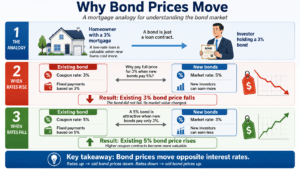
Educational illustration created by OpenAI
What the Federal Reserve Actually Controls
When people hear that the Fed “held rates steady,” they reasonably assume bond prices should have held steady too.
The Federal Reserve sets a target range for the federal funds rate. That is one rate: a short-term rate that banks charge each other overnight. It is enormously influential, but it does not determine what your bond fund is worth.
Long-term yields, by contrast, are set in the open market by investors weighing inflation expectations, economic growth, government borrowing (and the total supply of new Treasury debt), and their best guess about what the Fed does next. Now you see where shaky outcomes occur: bond rates and prices ride on investors’ best guesses. The Fed influences that conversation, but it does not control it.
This brings us to 2026. The Federal Reserve has now held its target range at 3.50% to 3.75% for five consecutive meetings, and at the most recent one, three members dissented because they wanted to raise rates. Meanwhile, inflation has stayed above the Fed’s 2% goal, the economy has kept expanding, and oil prices have been volatile due to Middle East tensions.
Investors who began this year expecting two rate cuts are now talking about a possible rate hike. That repricing pushed the 10-year Treasury above 4.7% and drove the 30-year past 5.3%, its highest level in nineteen years. Long-term yields rose without the Fed lifting a finger (remember our conversation above about investor sentiment affecting long-term yields?), and bond prices fell accordingly.
“Conservative” Does Not Mean “Never Declines”
Somewhere along the way, the word conservative came to mean guaranteed not to go down, but it never meant that.
A conservative portfolio is built to fluctuate less than an aggressive one. It is not built to eliminate volatility, and it never was. Every finance professional will tell you that bonds carry real risks: interest-rate risk, inflation risk, credit risk, and liquidity risk. Interest-rate risk is the one every bondholder has felt firsthand these past several months.
How far a bond’s price falls depends mostly on how long you have to wait to get your money back. A bond maturing in thirty years commits a buyer to below-market interest payments for three decades, so its price has to drop substantially to make up the difference. A bond maturing in two years commits them for only two, and at the end of those two years the issuer repays the full face amount regardless of what rates did in the meantime. That short wait is what limits the decline, and it is why the money you plan to spend soonest belongs in the bonds that move the least.
Higher Rates Are Not All Bad News
Here is the part that gets lost in the frustration: rising yields are a gift to a patient bond investor.
Every bond that matures inside your portfolio can get reinvested at today’s higher rates. Every new dollar you invest buys more income than it would have bought two years ago. That interest income does not erase a decline in market value overnight, but it can steadily rebuild it. It raises the income your portfolio produces going forward. Higher starting yields also provide a thicker cushion the next time rates move against us.
The same rate increase that hurts bond prices today is what improves bond returns tomorrow. But retirees capture only the second half of that trade if they still have money to invest when higher rates arrive.
Why We Use Conservative Projections
No investment climbs in a straight line. Stocks have bear markets. Bonds have years like this one. Real estate corrects. Cash quietly loses to inflation.
These difficult elements are why we choose not to build a retirement income plan on the assumption that every investment earns its historical average every year. When we construct a Perennial Income Model™, we assume future investment returns far below historical averages in every projection we run.
We are not trying to forecast the market. Nobody can. We are building a margin for error into a plan that has to survive thirty years of reality.
If a retirement plan only works when every investment cooperates, it is not much of a plan.
Every Investment Has a Job
At Peterson Wealth Advisors, we do not evaluate any investment in isolation. We evaluate it against the job it was hired to do.
Money that funds your grocery bill three years from now and money that will likely be spent by your grandchildren twenty years from now should never be measured by the same yardstick, held in the same investments, or worried about on the same timeline. Bonds in a retirement portfolio are there to produce income, provide stability, add diversification, and—most importantly—make certain you are never forced to sell stocks at a discount to pay next month’s bills.
So, the question worth asking is not, “Did my bonds go down?”
The question is, “Are my investments still positioned to deliver the income I need, when I need it?”
For our clients, the answer has not changed.
Interest rates will keep moving. Bond prices will keep adjusting. The Federal Reserve will keep making decisions we cannot predict in advance. Temporary market movements are unavoidable, but letting them derail a carefully constructed retirement plan is entirely avoidable.
The goal was never to avoid every disappointing quarter. The goal is dependable retirement income throughout the unpredictable future.
Frequently Asked Questions
1. Why are my bonds losing value when the Fed hasn’t raised interest rates?
Bond prices can fall even when the Federal Reserve holds its short-term policy rate steady. Long-term bond yields are influenced by inflation expectations, economic growth, government borrowing, and investor expectations about future interest rates. When long-term yields rise, existing bonds with lower yields generally become less valuable in the market.
2. Why do bond prices fall when interest rates rise?
Bond prices and interest rates generally move in opposite directions. When new bonds are issued with higher yields, existing bonds with lower yields become less attractive to investors. Their market prices typically fall until their yields become competitive with newly issued bonds.
3. Does the Federal Reserve control bond prices?
No. The Federal Reserve directly controls the federal funds rate, a short-term interest rate. Bond prices, particularly for longer-term bonds, are determined by the broader bond market and can be affected by inflation expectations, economic conditions, government borrowing, and expectations for future Fed policy.
4. Can long-term bond yields rise even if the Fed doesn’t raise rates?
Yes. Long-term Treasury yields can rise independently of changes to the federal funds rate. Investors may demand higher yields because they expect higher inflation, stronger economic growth, greater government borrowing, or higher interest rates in the future.
5. Are bonds still safe if their prices go down?
A decline in a bond’s market price does not necessarily mean the bond has defaulted or that you will lose the full amount invested if you hold it to maturity. Assuming the issuer makes the required payments, an individual bond generally pays its stated interest and principal at maturity. However, bonds still carry risks, including interest-rate, inflation, credit, and liquidity risk.
6. Do higher interest rates eventually help bond investors?
Generally, yes. Higher yields mean that maturing bonds and new contributions can be reinvested at more attractive rates. Over time, those higher yields can increase the income generated by a bond portfolio and help offset the impact of earlier price declines.
7. Should retirees be worried when their bond portfolio goes down?
Not necessarily. A temporary decline in bond prices does not automatically mean a retirement plan is in trouble. The more important question is whether the portfolio is structured to provide the income and liquidity needed throughout retirement without forcing unnecessary sales of investments at unfavorable times.
8. Should I sell my bonds when interest rates rise?
Not necessarily. Selling bonds simply because their market value has declined can undermine the role they play in a diversified retirement portfolio. Whether you should change your bond allocation depends on your time horizon, income needs, risk tolerance, and overall retirement plan.