Smart Year-End Tax Moves for Retirees

Smart Year-End Tax Moves for Retirees – (0:00)

Alek Johnson: Welcome, everyone. Excited to be here with you today.

Tax planning is always one of those topics that everyone wants to know more about, because understanding it directly results in more money in your own pocket. But over time, I have found that the interest level in the topic can vary dramatically.

For example, I really eat this stuff up, but when I told my wife that I was doing a webinar on fun tax topics, she said, “Well, that will probably be a very short webinar then, won’t it?”

So, whether you love tax planning or you are just here to get the job done and get out, thank you for jumping on. For those of you who don’t know me, my name is Alek Johnson. I am one of the lead advisors here at Peterson Wealth Advisors. I’m a Certified Financial Planner™.

As always, I do have a couple of quick housekeeping items.

First, just so you all know, and I’m going to apologize in advance, this will be a little bit longer presentation today, probably around 45 minutes. I know, big red flag. Alek is your classic 20- to 30-minute presentation kind of guy. Believe me, I would love nothing more than to keep this one shorter, but in my experience when I’m dealing with tax planning, I’ve just come to find that people really want and need the details.

So we’re going to spend some time today to make sure you’re well-equipped to do your own end-of-year tax planning. And in the future, I promise a 20-minute webinar to compensate for this.

Next, if you have any questions during the presentation, please feel free to use the Q&A feature at the bottom of your screen. My colleague Jeff Sevy, who is another one of our great advisors here at the firm, is on with us right now and will be answering your questions the best that he can as we go throughout the presentation.

At the end of the webinar, I will take some time to answer just a few general questions, probably five minutes or so. As always, if you have a more individualized question, please feel free to reach out to your advisor here at the firm if you are one of our clients. If not, please feel free, you can always schedule a free consultation with us as well. We’d be happy to meet and answer any specific questions you may have.

And then last but not least, at the end of the webinar, there will be a survey sent out to give us some feedback as a team, and feedback for me as a presenter. Please utilize it. It’s very helpful to see what questions you have for future topics so that we can best help you out.

All right. And a quick disclaimer here before we do dive in, especially today, I think this one is important. I want to say that this is not tax advice. Clearly, I do not know all of your tax situations, so please use caution when determining if what we cover today makes sense for you and your particular situation.

If you are a client of ours, a lot of what we’ll be talking about today you’ve probably already heard at your end-of-year planning meeting with your advisor this year. But please feel free to reach out to them if you do have any questions that I don’t answer today.

All right, quick agenda for the day. I’ll just tell you, today is not about turning you all into tax experts by any means. It’s more about giving you a short checklist of moves to consider before December 31st, so less of your money goes to taxes and more goes to support your own goals, whether that be retirement income, family, charitable giving, or whatever it may be.

A big reason I want to talk about this today is that I have found, in my experience, many retirees are just unaware of the savings that could be created by utilizing these strategies, and I truly think that they are very underutilized in general. We want to make sure to get the word out to you, as sometimes this can create multiple thousands of dollars worth of tax savings, just depending on your situation.

Taxation 101 – (4:14)

Now, before we dive into year-end tax planning strategies that I want to discuss today, I think it’s important that we first discuss the taxation of different account types, as well as just how we’re taxed in the first place.

Knowing the different account types that you have is vitally important to manage your tax brackets, so I want to start there. And then at the end of this slide, just so you know, I’m going to have you take a picture of it, so if you want to have your phone handy, I’ll give you the cue on when to do it. I’m going to refer back to this slide quite a bit as we go throughout the day.

So, broadly speaking, you have three different account types, each of which is going to have its own unique tax advantages.

The first account type is your tax-deferred accounts. This will be things such as your 401(k)s, 403(b)s, traditional IRAs, thrift savings plans, whatever it may be. Generally, contributions to tax-deferred accounts will reduce your taxable income in the year that you make the contribution.

Once you make the contribution, those savings are going to grow tax-deferred, basically meaning that you’re not going to pay any taxes on any gains, any interest, or any dividends that you earn over the course of your working career.

Now, the catch here is that once money is distributed from these accounts, generally to your checking account so that you can spend it, it is 100% subject to income taxes.

Another thing to note is that you generally have to wait until age 59½ to pull any of these funds out of these accounts without incurring a 10% early withdrawal penalty.

Now, unfortunately, with these accounts, this first bucket here, you cannot just leave your money in there forever. The IRS requires you to take what’s called Required Minimum Distributions, or RMDs for short, from your tax-deferred accounts each year starting at either age 73 or 75, depending on the year that you were born.

The exception to that, just so you know, if you are still working beyond age 73 or 75, is if you have a 401(k) that you are actively contributing to.

Now, a Required Minimum Distribution is the minimum amount of money that must be withdrawn from a retirement account by the end of each year to comply with federal tax laws. We know how patient our federal government has been to get this tax revenue, so this is how they ensure that they get the money taken out of these accounts.

Second, we’re moving to tax-free accounts. So, unlike tax-deferred accounts, contributions to your Roth 401(k)s or Roth IRAs are made with after-tax dollars, so they won’t reduce your current taxable income.

That kind of begs the question: why would you want to do that if there’s no immediate tax benefit? Because as contributions go into these accounts, they grow completely tax-free.

And then the punchline here is that when you withdraw money from these accounts, you won’t owe any taxes on that income, which includes any appreciation or growth over the years that you were contributing and working. It’s all completely tax-free.

Now, some things to note on these accounts, like the tax-deferred accounts, is that you’re also subject to waiting until age 59½ to avoid the 10% early withdrawal penalty on any of the growth within these accounts.

But unlike that first bucket, Roth IRAs and Roth 401(k)s are not subject to Required Minimum Distributions. Your money can stay in those accounts until the day that you die, if you’d like.

All right, and lastly, our taxable accounts, otherwise known as brokerage accounts. If any of you have a bank account, a high-yield savings account, a CD, whatever it may be, the taxation is going to be the same as those accounts when it comes to these brokerage accounts. These accounts are funded with after-tax dollars, and the flexibility here is that they provide you the ability to take money out at any point, for any reason, at any time, without penalty. You can buy and sell, trade, and earn money, but you can take it out whenever you want. So you’re not subject to that age 59½ restriction when it comes to your brokerage accounts.

The bummer with these account types is that any income like interest, dividends, and capital gains that you earn year over year is taxable in the year that you earn it.

So, that being said, this is the time if you want to take out your phone and just take a quick picture of this slide, or refer back to it as we go throughout.

It’s important because each of these account types can play a very significant role when it comes to tax planning. We just want to make sure that you can clearly identify which account types you have as you enter or are in retirement.

Okay, moving on here. Now that we’ve covered the different accounts, I also want to make sure you have some understanding of the basics of how we are taxed in the first place, how your tax liability is calculated, as that will help lead into our tax strategy.

That being said, if any of you are CPAs or accountants online today, please do not hold it against me how simple I am going to try and make this.

So here’s a high-level view of the individual income tax formula. You’re going to start off by adding all of your income to get your gross income. This will be wages, salaries, rental income, dividends, interest. Everything will go into your gross income.

Once you’re here, you are allowed to subtract certain deductions called above-the-line deductions. Examples of these include things like IRA contributions, 401(k) contributions, HSA contributions, student loan interest, anything there goes above the line and brings you to your Adjusted Gross Income, or your AGI for short. Many of you are probably familiar with that number on your previous tax return.

Now, once you have your AGI, you get even more deductions called below-the-line deductions. The line, just so you know if you’re wondering, is the AGI. Above the line and below the line is AGI.

To determine what you’re going to deduct below the line, you will add together all of your itemized deductions and compare that with the standard deduction. You’re allowed to deduct whichever one is higher. I have this highlighted in red because I’m going to talk about it further in just a minute. We’ll dive into what those deductions are.

For now, just know you’re going to subtract the greater of the two, and that will get you to your taxable income. This is the number that you will actually pay taxes on. So when you see the brackets, this is the number that you’ll actually use.

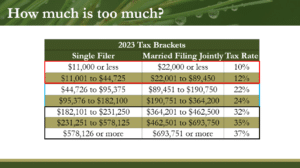
So that being said, you’re going to take that taxable income and multiply it by your ordinary income tax rate. Currently, there are seven brackets ranging from 10% to 37% federally.

Once you have multiplied it by those brackets, it will give you your tax liability. Now, that being said, we are still not done.

Next, you’re going to subtract any tax credits that you are entitled to, like the child tax credit, education credits, and previously there have been energy credits. Whatever those credits are, that’s going to go dollar for dollar against your tax liability, which finally brings you either to your taxes due or your tax refund, okay?

So what I want to focus on for just a minute, hopefully that was helpful to go through as a refresher, but I want to focus in on what I mentioned I have highlighted there in red, which is where we get those below-the-line deductions.

When it comes to these below-the-line deductions, as I mentioned, you get the greater of your itemized deductions or the standard deduction. The IRS has a list of things that we can count toward your itemized deductions, included on the screen here. So you have mortgage interest, state and local taxes, property taxes, medical expenses (kind of a funny one that it has to exceed 7.5% of your Adjusted Gross Income), and then the big one here is your charitable donations.

Included in this charitable donations deduction, if you are a member of The Church of Jesus Christ of Latter-day Saints, would be tithing, your fast offerings, humanitarian contributions, whatever else it may be, and then donations to any 501(c)(3) charity.

Now, if you add up all these deductions and they are not higher than the standard deduction, then you’ll just take the standard deduction. If the total is higher than the standard deduction, then you will itemize.

In 2017, the tax laws changed as part of the Tax Cuts and Jobs Act that President Trump signed into law. Part of what was changed, if you remember, was the standard deduction actually doubled. The One Big Beautiful Bill Act, which was just signed into law back in July, permanently extended these higher deductions.

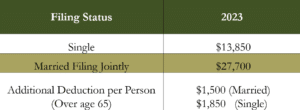
So you can see here on the screen: in 2025, the standard deduction for a single filer is $15,750, and for a married couple, it’s $31,500. You get some additional deductions if you’re blind or over the age of 65. But again, for a married couple, if your itemized deductions don’t add up to more than $31,500, you will just take the standard deduction.

What this essentially means is that with the larger standard deductions, most of us will forego itemizing our deductions and we’ll end up taking the standard deduction.

Now, previous to the law change in 2018, about 30% of Americans itemized. We don’t have the most recent data, but as of 2022, it was around 10% of Americans itemizing their deductions. I would be shocked if this hasn’t gone up just because interest rates have gone up on the mortgage interest side, but it knocked about 20% off the amount of people who were itemizing at the time.

So how did that impact, or how does that impact those who give to charity?

Well, although gifts to qualified charities are still available as an itemized deduction, most charitable donors will not receive any tax benefit for their donations because few will donate enough to take them over that standard deduction. So for the 90% of taxpayers who don’t itemize, they’re out of luck.

Now, the good news is that there are still actions we can take to reduce your taxes, and that’s going to lead us to our first strategy.

Charitable Giving Strategies – (15:28)

So, real quick, I’m going to let you know the next three strategies we’ll talk about are all charitable giving strategies. The first one I’m going to focus on is what we call bunching, and then the use of Donor-Advised Funds.

So, I want to start off with bunching first. Bunching is a strategy used to maximize your deductions, and you’re probably very familiar with it already, because it’s something we do in other areas of our lives.

For example, we bunch our medical expenses. Let’s say you have a $5,000 deductible on your health insurance policy, and you know that you’re going to have a knee replacement surgery coming up in the next year. Well, you’re probably going to wait until that year to do all of your other medical things that you need to take care of, because you’ll know you’ve already hit that $5,000 deductible with the surgery.

Another example is credit card reward points. Many of us will earn reward points when we’re spending, and we redeem them for airline tickets. We don’t usually redeem these points when we’re making shorter, less expensive flights. So, if we’re going from Salt Lake City to Las Vegas, for example, we’ll usually just pay the normal airfare. However, we save up or bunch these points so that when we go to Hawaii, we can get the help when we’re incurring the larger cost for that airfare. We’ll usually spend the points at that time.

So, just as we can reduce our medical costs and our travel costs through bunching, we can likewise minimize our taxes through a similar strategy.

The goal of bunching is to exceed that standard deduction. That’s what we want to do, by piling on all of your itemized deductions to get those greater tax savings.

In years that bunching does not occur, you’re just going to revert to taking that standard deduction. So, in the year that you do itemize, it is very important to pay every tax-deductible bill and every tax-deductible expense, incur everything you can there. And then the big thing is that you want to donate two, potentially even three, years’ worth of donations to your favorite charity all in one tax year, which will result in a higher itemized deduction.

Practically, to give you an idea of how this might work, during the year you are planning to itemize, if you’re donating to the Church, you might pay your regular tithing, donations, and other humanitarian contributions monthly or bi-weekly as you get paid throughout the year. Then, come December of that same year, you will prepay all of your next year’s donations through one big lump sum.

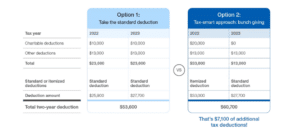
Let me give you a quick glimpse of how this would look. We’re going to take the Millers.

In option one, we can see the Millers year over year have $26,000 of total deductions. $14,000 of those deductions are from things like mortgage interest, potentially property taxes, state income taxes—things like that. And then they are giving $12,000 a year to charity.

So, in option one, if they just give the $12,000 a year over the two different calendar years—2024 and 2025—you’ll see they don’t have enough deductions to exceed the standard deduction those two years. And so they end up just taking the standard deduction in both years, which results in a two-year deduction of $60,700.

Option two is the tax-smart approach, where they’re going to bunch their giving in 2024. You can see they have $24,000 of donations now, plus the $14,000 of other deductions gets them to $38,000, which does exceed the standard deduction. So they’re able to itemize that year. In 2025, they’ll still have that same $14,000, but now they won’t have any charitable donations to deduct, and so they will revert to taking the higher standard deduction.

Now you can kind of see the difference. This results in an additional $8,800 of tax deductions, but it was not done by changing how much they donate. It’s simply by the timing of when they made those donations.

A common question we get is this: Is there a way to bunch deductions and still pay my charitable contributions on a more frequent basis? It’s that thought of, “I don’t love doing it annually—one big chunk up front all at once.”

And the answer to this question is yes. That is where a Donor-Advised Fund comes in.

Donor-Advised Funds, or DAFs for short, have been around for years, and there are a lot of them. They’ve become increasingly popular over the last decade, and you can open them up at really any major financial services company—Fidelity, Schwab, Vanguard, whatever it may be.

So what are they, and how do they work?

The best way to describe a DAF is that it is an account, just like your IRA account or just like your 401(k). It’s an account specifically designed to hold your charitable contributions until you decide when, and to what charity, you ultimately want to donate.

So how this works is that you, as the donor, will make a charitable donation to the Donor-Advised Fund. That can be made in cash. Better yet, it could be in the form of appreciated shares of stock, which we’ll talk about in just a minute. You, as the donor, are then going to get that tax deduction in the year that the contribution was made.

Your donation will then sit inside of that Donor-Advised Fund. You can invest it in there, and it can continue to grow until you decide to give it—whether it be to the Church or another charity—on your own schedule and on your own time.

So essentially, the timing of the donation from the DAF is up to you as the donor to decide.

Here are some practical applications that we have seen with Donor-Advised Funds. First and foremost, it just makes bunching easier to do and charitable giving a lot more flexible and easier to accomplish.

Second, it helps you get a deduction when it’s advantageous to you as the donor. One thing I want to point out here is that we often have clients who have higher income in the years before they retire, or they may be selling their business, or selling a second home, whatever it may be. Donating to a Donor-Advised Fund during those big income years can help you get a big deduction when you need it. And then you can essentially prepay for certain charitable endeavors.

I have plenty of clients who funded a Donor-Advised Fund before they served their senior mission, for example, and they paid for the housing portion of their mission with their Donor-Advised Fund.

Next, a Donor-Advised Fund can create a legacy for future generations. Many of our clients will use it for something like a missionary account for their grandchildren who will go and serve. Others pass it on even after they die for children and grandchildren to continue to donate from.

Donating Appreciated Assets to Charity – (23:09)

All right, our next strategy is donating appreciated assets to charity, appreciated meaning the investments have gone up in value.

This is a good one because, again, there are huge tax savings that can be realized by donating, and yet many taxpayers just fail to recognize it.

Now, one quick thing before we talk about it, if you think back to that image or pull out your phone and look at the picture, this is going to be pertinent to that third bucket, or the taxable accounts, such as brokerage accounts. This is not going to be utilizing 401(k)s or IRAs, Roth IRAs, anything like that.

This is only that third bucket.

Donations in kind are gifts of non-cash assets. You are giving the actual thing, not money. So think of a community food drive. Instead of writing a check, you’re donating canned goods, and then the charity immediately puts that to work.

Many charities, including The Church of Jesus Christ of Latter-day Saints, accept donations in kind. Charities accept almost all marketable securities such as stocks, mutual funds, and exchange-traded funds. Sometimes they’ll even accept more one-off things like gifts of real estate, life insurance policies, or potentially partnership interests. So it’s always good to check with the charity to see what they will and won’t accept before you donate. But this is a great strategy.

With investments, the “canned goods,” so to speak, are shares of investments that have gone up. If you sell those shares first, you may owe capital gains tax and the charity gets what’s left. If you donate the shares themselves, the charity can then sell them completely tax-free and keep the full value of the donation. And you typically get a deduction for the fair market value while you avoid paying that tax.

So let me give you another quick example here. We’re going to take the Andersons.

The Andersons have saved for retirement and now have a portfolio of individual stocks. One of the stocks that they own is Apple. So we’re going to assume they bought it for $10,000 ten years ago, and those same shares today are worth over $70,000.

If the Andersons were to sell $25,000 of Apple stock because they want to make a donation, and then donate that cash to the Church, for example, they would end up paying $5,000 in federal and state taxes, and the Church would end up getting $20,000.

As you can see in the right column, if the Andersons donate the $25,000 of stock, they won’t pay any tax whatsoever.

So here are the benefits that the Andersons get for donating their appreciated stock:

First, the Church that they donated to gets an additional $5,000, or a 20% greater donation.

Second, the Andersons don’t pay any tax on the gain of the stock.

Third, they also get to deduct $25,000 on their itemized deductions instead of $20,000, so they get that $5,000 bump.

And then any of the cash that they otherwise would have used to make a donation, they can buy right back into the market into a more diversified portfolio of stocks.

So before you write your next check to your favorite charity, you may just want to ask yourself: “Do I have any appreciated assets that I can donate to my charity that will be more beneficial than me writing this check?”

Now, this strategy by itself obviously saves you from paying capital gains tax and it’s great on its own. But when you couple this with bunching and with the use of Donor-Advised Funds, then we really start to pile on those tax savings.

The Use of the Qualified Charitable Distribution – (27:02)

All right, our next strategy is what’s called Qualified Charitable Distributions, or QCDs for short. I apologize for all the acronyms in the financial industry.

So again, if you refer back to the image of the three buckets that I showed you, we’re now just going to be looking at that first one, the tax-deferred bucket. Specifically, we’re going to be talking about IRAs. That’s the one we want to key in on here.

This is the most tax-effective strategy that I know to save you tax dollars. Unfortunately, there are some strict rules surrounding it, but when done correctly, it is amazing.

So what is it?

It is a provision of the tax code that allows a withdrawal from an IRA to be 100% tax-free, as long as that withdrawal is paid directly to a qualified charity, like the Church.

There are huge tax savings that can be realized, but these are not brought about by how much is paid to the charity, but by simply altering the way the contributions are made to the charity.

I always like to point this out:

First, you didn’t pay any income tax when you earned the money that you put into your IRA, your 401(k), your 403(b), whatever it may have been.

Second, you didn’t pay any taxes on the compound interest that your IRAs earned over 30 or 40 years of your working career.

And then last, any money paid directly to a charity through a QCD from your IRA will not be taxed. So this is one of those rare occurrences, similar to an HSA, where you get triple tax benefits.

So what other benefits are there?

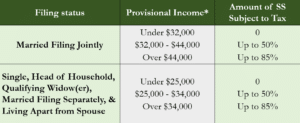
One, it can potentially reduce the amount of your Social Security benefit that’s going to be taxed.

Second, it will reduce the overall amount of income that is taxed.

Third, it will enable you to get a tax benefit by making a charitable contribution regardless of whether or not you itemize your deductions. This is a big one: you don’t have to itemize in order to get a benefit for doing QCDs.

And then lastly, these QCDs count toward satisfying your RMDs, or Required Minimum Distributions. So again, at age 73 or 75, when the government says, “Hey, we need you to take this money out,” you can just donate that instead. We have plenty of clients that, year over year, all they do is donate their Required Minimum Distribution so that there’s no tax due.

Now, as beneficial as QCDs are, they are unfortunately not available to all taxpayers, and the rules must be followed with exactness or the QCD will be considered a taxable event.

So here are the rules.

First and foremost, and probably the most unfortunate one, is that they are available only to people older than age 70½.

Now, why 70½? I do not know. (laughs) Talk to your local congressman. But it is specifically age 70½. What I mean by that is it can’t even be the year that you’re turning 70½, it has to be that you are 70½ years old.

Next, they are available only when distributions are from IRA accounts. So withdrawals from 401(k)s and 403(b)s are not QCD-eligible.

Now, that’s not that big of a deal, because you can always roll over your 401(k) or TSP, or whatever it may be, into an IRA, but it is something to be aware of. It can only come from the IRA.

Next, it must be a direct transfer from an IRA to a tax-qualified charity. Typically speaking, we don’t want the check to pass through your hands. If you were to deposit it by any means, that would become a taxable event.

There is a maximum of $108,000, this does adjust for inflation, of IRA money that is allowed to be transferred through a QCD.

So I know what you’re thinking: this is just a huge bummer. It’s capped at such a small amount, and we’re a big giving family here. I’m totally joking, hopefully that came across as a joke.

And then the last one here: the IRS has special reporting requirements for QCDs. You should check with your CPA to ensure that they report your donations correctly.

We have spent months and months in the past unwinding how a QCD was reported by someone’s CPA, so it’s important to know that it does have to be reported correctly. Otherwise, it could again be seen as a taxable event.

That being said, I believe that every person over the age of 70½ who has an IRA and who gives to charity regularly should absolutely investigate this strategy. You are your tax professional. You can run the numbers, do some comparisons, whatever it takes. I think that many of you, if not all of you, will find that the tax savings will be very significant.

Consider the Possible Benefits of a Roth Conversion – (32:14)

All right, so pivoting away from charitable donations brings us to our next tax strategy, which is considering the benefits of a Roth conversion.

Now, you may notice I did not say “do a Roth conversion,” but rather “consider the benefits of it,” and I am very intentional about that, because this may or may not be for everyone. A lot of people—whether it’s from the media, their friends, their family, their HR departments, whatever it may be hear that Roth is better, that Roth is king, but it isn’t always the case. So use caution with this strategy.

Now, if you are interested, I’ll just tell you too, I have done an entire presentation on Roth conversions specifically before. I’ll cover very similar content to what I did in that one, but if you ever want to really deep dive, just know that is available to you.

So, what is a Roth conversion?

Again, let’s refer back to the picture of the buckets on your phone here. As I mentioned earlier, virtually all retirement accounts are classified into one of two categories, meaning pre-tax or post-tax accounts, the first and the second bucket. For most retirees currently, it is much more common to have retirement accounts that are pre-tax money.

What a Roth conversion allows you to do is take a traditional IRA, or pre-tax retirement account, and convert it—either all of it or just a portion of it—to a post-tax Roth account. Essentially, you take it from bucket number one and put it into bucket number two. You are moving it from an account where you pay taxes into an account where it will grow completely tax-free.

So what’s the catch, then? Why not just convert everything and never pay taxes again?

Well, keep in mind that, just as the name suggests, any money in a pre-tax account has never been taxed before. That being said, any amount that you choose to convert becomes taxable to you in the year the conversion is performed. So as you take it out of that account, you are actually creating a tax liability.

For this reason, it is very uncommon to convert an entire account all at once, as it would likely push you into a higher tax bracket and make your tax bill unnecessarily large.

Quick example: if you have $1 million in a 401(k) or IRA, you can expect to pay 40% in taxes if you converted the whole thing over. So generally, the advice that we give clients is that we want to convert enough to get the future benefits of a Roth conversion, but not so much that it pushes you into a higher tax bracket.

Here are some quick key facts of Roth conversions.

First, there is no income limit. You can make a dollar a year, you can make a million a year, and you can still convert to a Roth.

Second, there are no age restrictions for conversions.

Third, there is no limit on how much you can convert. Again, I don’t usually say you want to convert everything, but there is no limit. You’re not capped. Sometimes it gets confused with contributions into IRAs, which are limited to usually $7,000 or $8,000 a year. You could convert the entire account if you really wanted to.

Fourth, the conversion must be completed within the tax year.

And then fifth, if you are 73 or 75 or older, you’re subject to those Required Minimum Distributions. You have to take the RMD first before converting any of the remaining funds. So the RMD itself cannot be converted to the Roth IRA.

So knowing it’s all taxable, it kind of begs the question: why would we do it? Why should we do a Roth conversion, or how do I know it’s beneficial for me? Well, despite the immediate tax liability, there are several potential benefits to doing a Roth conversion.

Number one is tax-free withdrawals. We already talked about this, but once it’s in there, it’s going to grow completely tax-free.

Second, there are no Required Minimum Distributions, so you’re not forced to take this money out as you continue to get older.

Third is what we call tax diversification. You’ve probably heard of investment diversification. Tax diversification provides a lot of flexibility in managing your tax brackets throughout retirement. You can strategically withdraw from each account to help minimize your overall tax burden.

Or if you needed a lump sum of money down the road, you wouldn’t have to pay a higher tax on that money if you took it from a Roth account.

Next is estate planning benefits. Roth IRAs can be really advantageous for estate planning. Your beneficiaries who inherit Roth IRAs will also have an additional 10 years of being eligible to keep it inside of those Roth IRAs for an extra decade of tax-free growth.

Now, in my experience, I will tell you there are not many children that are patient enough to inherit that lump sum of money and not take it out. But if they’re diligent, they absolutely can leave it in there for another 10 years.

A future tax rate hedge: if you expect tax rates to increase in the future, converting to a Roth IRA now can lock in the current tax rate. It’s particularly useful if you anticipate being in a higher tax bracket later on due to income increases, legislative changes, or whatever number of other factors.

And then the last one here: reduction of future RMDs. Again, by converting some of your traditional IRA now, you’re reducing what your account will be subject to in the future, which can help potentially lower your taxable income in coming years.

Now, a common misconception is that it is better to pay taxes now and let them grow tax-free than vice versa. The truth of the matter is that it does not matter when you pay the tax—now or later—if the tax rate is the same.

So often, deciding which one is more advantageous to your specific situation comes down to a variety of factors. Here are some of the things you do need to consider: How long are you planning on working? How long are you planning on living? What tax bracket are you currently in right now, and which one will you be in during retirement?

What types of income sources will you have—Social Security, pensions, rentals, anything else?

Whether the government changes tax rates, and in which direction they are going to change tax rates.

And the final one here is what state you live in, and when.

I’m going to give you some scenarios of both when you should and when you should not consider doing a Roth conversion. But again, let me reiterate: even though this may or may not make sense for someone else doesn’t mean it makes sense for you. So even with these examples, please be cautious about how you approach it.

First and foremost, if you have a year with unusually low income, potentially if you retire, you go serve a senior mission, during a job transition, early retirement, you get laid off, whatever it may be, converting to a Roth IRA can be advantageous. You’ll pay taxes at that lower rate on the converted amount.

Second is higher tax brackets in retirement. If you anticipate being in a higher tax bracket then than where you are now, paying taxes now at a lower rate can save you money in the long run.

Third, managing Required Minimum Distributions. Hand-in-hand with this one, if you can foresee that come age 73 or 75 you will be forced to take out massive amounts of money that will bump you into higher tax brackets, converting some of your assets to a Roth IRA can help lower your traditional IRA balance, thus reducing those required distributions.

Again, I kind of already mentioned this one, but if you expect your tax rate to be higher in the future due to changes in tax laws or just income, converting now means you’re locking it in.

And then that state example I mentioned earlier: if you live in a low-tax-rate state and plan to move in the future, it would be more advantageous to do it in the lower-tax state. For example, I come from the beautiful state of Wyoming, with no income tax. If you live there and you plan to move to Utah soon, you would be saving an additional five cents on the dollar by converting in Wyoming before you move to Utah. So state taxes also matter when it comes to this.

Likewise, here are some times you should likely not consider doing a Roth conversion.

If you are currently in a high tax bracket and, in the future, you’ll be in a lower tax bracket, it would not make sense to pay the taxes now. Generally speaking, most of the time when you are working, it does not make as much sense as when you’re retired.

Second, you have insufficient funds to pay the taxes. One of the key things with the Roth conversion is that whatever amount we decide to do—$30,000—we want that full $30,000 to go into the Roth to get the most benefit we can. But that means you need to have some funds on the outside to be able to pay that tax liability. If you don’t have those funds and you need to withhold from the $30,000, so only $25,000 ends up going in, then it may start to lose some of its appeal.

Third is if you have a near-term need for the funds. If you think you’re going to need to spend it for whatever reason, it may not be advantageous. It’s best when you can leave the money in there to grow tax-free for a long period of time.

Fourth is you’re close to your RMD age. Again, just because you have to take that Required Minimum Distribution first before you can convert, sometimes it makes less sense.

This one, though, use caution. I have several clients that are still above age 73 or 75 and we are doing Roth conversions.

Fifth is there’s a negative impact on financial aid. For some of you that may still have children in college and they’re basing aid on your income levels, this will increase your taxable income and it could have an impact there.

Next is tax credits and deductions, things like the child tax credit and education credits. Most have phase-outs, and so the higher your income is, you may phase yourself out of those credits or deductions. So keep that in mind.

Seven, you are very charitably inclined. Even if we can do Roth conversions at the lowest tax rate, 10% or 12%, QCDs are done at a 0% tax rate, as we already talked about. So just keep that in mind if you’re very charitably inclined, it may not make as much sense to do these conversions.

And then lastly here: Medicare and Social Security, and really the marketplace. Increasing your taxable income through a conversion can also make more of your Social Security taxable. It can also increase your Medicare premiums. If you’re on the marketplace and receiving a government subsidy to help cover your health insurance, it can affect that and you would owe taxes come tax filing time.

So really pay attention to all the extracurriculars going on outside of just your income, as it can affect even health insurance.

All right, so let’s just give you a quick example here.

I want to show you why, for example, a senior mission could be a really advantageous time to convert. We’re going to take the Parkers, age 63 and 62, and assume they are retired and going to serve a two-year mission in ’25 and ’26.

Before the Parkers leave on their mission, and then when they return home in ’27 (or ’28, I guess, in this example—I’m sorry, I should have updated those years), their income needs are going to be $12,000 a month before and after they serve.

Mr. Parker has a $7,000 monthly pension, and so he’s pulling $5,000 out of his IRA to sustain the Parkers’ lifestyle. At $12,000 a month, they will find themselves squarely in the 22% bracket. That means if they were to convert any money from a traditional IRA to a Roth IRA, it would cost them about 22% in federal tax.

When they go on their mission, they will only need $7,000 a month, essentially his pension. So at $7,000 a month, they will be squarely in the 12% federal tax bracket, which means they only pay the 12% tax if they do a conversion at this point.

So how much can they convert before they jump from the 12% to the 22% bracket? That’s about $44,000 to fill the 12% bracket, which would create a tax bill of $5,280.

If they were to convert that same $44,000 when they’re at home—before or after they leave—because they are still taking the extra $5,000 of income, now they have to pay it all at the 22%, which creates a $9,680 tax bill.

So that’s a $4,400 a year, $8,800 total, tax savings created from serving a mission if they served for those two years.

Now, just one quick reminder: if they had been in the same bracket before and during the mission, it really doesn’t matter. The Roth conversions start to lose their appeal at that point.

Tax Loss Harvesting – (46:37)

All right, final strategy I want to talk to you about today, and I apologize, I think we’re already at 45 minutes, so bear with me here. Hopefully it’s helpful. The last one is tax-loss harvesting.

Tax-loss harvesting is a strategy to help lower your tax bill by selling investments at a loss to offset capital gains, and then reinvesting those assets to maintain market exposure.

So again, back to your picture of those three buckets: we’re again just going to be talking about that third one. So this will not be for IRAs, Roth IRAs, or 401(k)s, but just those taxable accounts.

So let’s take a look at how this works.

First, you’re going to identify losses, find investments or stocks that have lost value in the account. At that point, you sell it. You sell the loss, and when you sell those losses, you can then use that to cancel out any gains from other profitable investments.

Now, if your losses exceed your gains, you can deduct an additional $3,000 a year against your ordinary income. What I mean by that: if you’re still working, your salary, your wages that you are continuing to earn.

After that, you can carry forward any losses. So if you hit that $3,000 and you still have some losses that you recognized, you can carry that forward indefinitely to offset future gains or income in coming years.

And then again, immediately, you’re going to buy into a similar investment to maintain your desired market exposure so that you don’t miss out on potential upturns in the market.

Let me give you a quick hypothetical example.

Let’s say you bought Coca-Cola stock two years ago for $50,000. Since you bought it, it’s gone down about $10,000 in value, and it’s now worth $40,000. If you sell it, you would be creating that $10,000 capital loss, which will now benefit you tax-wise. No one ever likes losses until it comes to tax time, then we’re all pretty big fans.

With that $40,000 of cash you now have, what do you do? Well, we want to stay invested, so generally you’re going to invest in a company or fund that you think will perform similarly to what Coca-Cola would do. So in this example, I’m just saying Pepsi.

Now, please note: this is 100% hypothetical. Coca-Cola has actually gone up the last two years. I’m also just comparing two companies based on the products they sell, not necessarily any other category. But hopefully you get the idea here.

Now, one big rule with this is called the wash sale rule. It simply states you cannot claim the tax loss if you buy the same or substantially identical security within 30 days before or after the sale. So you essentially have this 61-day window where you can’t buy or sell the exact same thing that you are selling. If you do that, you’ve triggered the wash sale and you no longer get to claim that tax loss.

Summary – (49:47)

All right, so wrap-up here—just a quick review.

Some questions that I would encourage you to ask before December 31st are:

  • Would bunching my deductions help me itemize this year?
  • Next, if I do bunch, should I consider using a donor-advised fund?
  • Do I have any appreciated assets that I can donate in kind?
  • Have I taken my Required Minimum Distribution, and am I eligible for a Qualified Charitable Distribution?
  • Should I consider a Roth conversion this year?
  • And are there any tax-loss harvesting opportunities in those taxable accounts?

I would strongly encourage you to meet with your tax advisor and see if any of these strategies could be beneficial in your situation.

Now, I also wanted to quickly go through a couple changes brought about by the One Big Beautiful Bill that was signed back in July. I know we’ve done a webinar on this, but I want to cover some of those high-level things again.

One, it expanded the Tax Cuts and Jobs Act. I think this is maybe the most undervalued or underrated piece of this that people kind of miss. 2026 would have been much worse had it not been extended for tax purposes. So that was a huge thing on the tax side of it.

Next, individuals over the age of 65 can receive an additional $6,000 deduction, so married couples can get $12,000 collectively. If you remember, this was kind of the middle ground they came to. They were trying to make Social Security not taxable at all. This is where they settled: an extra $6,000 for those over the age of 65.

Now, just so you know, that does have a phase-out. For single filers, once your income hits $75,000, you begin to phase out. For single filers, you’re completely phased out of that at $175,000 of your MAGI, your Adjusted Gross Income for most people. For couples, it starts to phase out at $150,000 and completely phases out at $250,000.

One thing here, just as a reminder: you do receive this in addition to either the standard deduction or your itemized deductions.

Next, you have your SALT cap, your State and Local Taxes. That did increase from $10,000 to $40,000. So this could help many of you this year potentially itemize, just because property taxes, income taxes, and all of that has a much higher cap now.

Two other quick things here, just starting in 2026:

If you do not itemize your deductions, they are kind of throwing you a bone here to say you get an extra $1,000 of a charitable donation deduction per person, $2,000 for a couple. So it just helps a little bit if you do end up taking the standard deduction.

And then also starting in 2026, just know that your charitable donation deductions only kick in to the extent that they are over half a percent of your Adjusted Gross Income. So if you make $100,000 for your AGI, the first $500 that you donate is not deductible. It would be only everything in excess of that.

Well, that wraps up the tax side of things.

So before I open it up to questions, I did just want to throw this out there: if you don’t have this book yet and you would like a copy, please request one. We’ll send it out to you for free.

When it comes to good tax planning, you really are only as good as your income plan. You’ve got to have a retirement plan first, in my opinion. Think about Roth conversions, how are you going to know what your income level will be now compared to then if you don’t have a plan?

Scott Peterson, the founder of our firm, in this book, details what that plan is like. So if you don’t have it, please feel free to request one. I think it would be very helpful for you.

Okay, and before I turn it to Jeff for any questions, first of all, thank you for bearing with me. I know we went almost 55 minutes, so it’ll probably be an hour-long webinar here. So thank you for attending today.

And then also, if I can, a quick plug for the survey: right after the meeting ends, if you wouldn’t mind filling that out, it’s very helpful for us to know what you want to hear about in coming webinars.

Question and Answer Session – (54:16)

That being said, Jeff, I will turn it to you. Any questions we want to go through?

Question: Awesome. Yeah, we just got three here. So, the first one: “If you donate stocks to a QCD”, I’m assuming they mean a DAF. “Does that change your above-the-line income at all, even though you get to deduct it?”

Answer: No. Donations in kind into a Donor-Advised Fund are a below-the-line deduction. So your AGI would not really change, but your taxable income would change.

Question: Awesome. Also, kind of going along with the DAF: “Are you limited to cash and stocks when donating to a DAF?”

Answer: No, you are not limited. It’s always important to check with the donor-advised fund as to what they can accept. But just outside of stocks and cash, you have bonds, mutual funds, and exchange-traded funds. They will also sometimes accept business interests. Sometimes we’ve had clients who, when they’re selling a business, donate a piece of it into the donor-advised fund. So there’s a lot of opportunity there, and it would be worth exploring.

Question: Awesome. Then last one here: “How do Roth conversions play into estate planning?”

Answer: Yeah, it’s a really good question. Oftentimes when someone has this goal of, “I want to leave a legacy,” when you think of the pre-tax accounts, any money in there generally is going to be taxed before it reaches your beneficiaries in one way or another. If you leave it to a trust, there’s the potential that it could be taxed there. If you leave it to them outright, they have a 10-year window of time, and whenever they take that money out, they have to pay taxes at their own tax rate.

So by you doing Roth conversions and leaving the Roth IRA, they can receive that money completely tax-free and not have to worry about the tax implications. So oftentimes, if your goal is focused on your children or your grandchildren receiving the best outcome for them, that’s when Roth conversions can really make a big impact on the estate planning side.

Awesome. And that’s it for us.

Okay. Awesome. Well, thank you again, everyone, for attending. I’m going to stop sharing my screen, and we look forward to working with you. If you have any questions, please feel free to reach out, and we will see you all again likely in January for our next webinar.

The One Big Beautiful Bill: What Retirees Need To Know

The One Big Beautiful Bill: What Retirees Need To Know – (0:00)

Daniel Ruske: My name is Daniel Ruske. I’m a Lead Advisor here at Peterson. I’ve been here for about five years. I’m loving it, and I know it sounds crazy, but today we’re going to talk a lot about taxes, and that gets us excited around here.

Before we jump into the One Big Beautiful Bill, I do want to go over a few housekeeping items. First, I’m hoping to keep this webinar to about 30 minutes. There will be a question-and-answer session afterward, and then we’ll spend about five or so minutes on a survey. If you don’t mind, at the end of the presentation, let me know what you liked, what you didn’t like, and also vote on the next webinar topic. If you are attending our webinars, you can vote on what we’re going to do next.

Also, our website is petersonwealth.com. All of our webinars are in a library—you can go to the ‘Learn’ tab and see all of our prior webinars. This one will be uploaded there as well.

For everyone who registered for today’s webinar, there will be a recording sent out after this presentation is over. I believe we’ll get it out today, maybe early tomorrow. That way, if you have to check out at any time or take off early, just know you’ll have access to see that.

Really quick, we’re going to go through this webinar fairly quickly. There’s a lot to tackle. If you’re a client and you have questions, contact your advisor. If you’re not yet a client, we will have a link posted in the chat. In that chat, you can set up a consultation with one of our advisors.

On the Zoom recording today, we’re going to have a question-and answer-feature. I’m going to have Jeff Sevy and also Zach Swens0n—they’re both Associate Advisors. They’re going to be able to answer your questions as we go.

If for some reason we don’t know the answer or if we need more specific information regarding your situation, we may ask you to email either myself at daniel@petersonwealth.com or info@petersonwealth.com, and we can get to your questions there.

Before we get started, I do have to go over this disclaimer: This webinar is for informational purposes only. It’s not intended to give any legal, tax, or financial advice. If you are looking for investment or tax advice, contact your CPA or talk to one of us. But we want to get to know you individually and talk about your situation before you apply any of the information you receive today.

Okay, let’s get started.

What is the One Big Beautiful Bill? – (2:43)

Today we’re talking about the One Big Beautiful Bill Act—also called the OBBBA or the BBB Act, or sometimes just the BBB.

Now, I’ve heard it called all of these things. And if that name isn’t confusing enough, wait until we dive into the over 800 pages included in this bill. Today, I’m going to refer to it either as the One Big Beautiful Bill or just the new bill.

This bill was signed into law by President Trump on July 4, 2025. A lot of the changes from this bill will take place in 2025, but many will go into effect in the coming months.

Let me just say once again, we will not be able to cover every change in this bill. We are going to focus on and do our best to cover the topics that are most applicable to retirees and soon-to-be retirees. But again, there is a lot in this bill that we will not cover.

This is also going to be a fairly high-level overview of the changes. So talk to your advisor if you’re a client—or schedule a consultation if you’re not yet a client—and we can go into more depth on the topics that most interest you.

Here are the changes we’re going to go over today:

  • The permanent extension of the tax brackets and the standard deduction
  • The new senior bonus deduction
  • How non-itemizing charitable donations have changed
  • A new charitable deduction
  • The increased State and Local Tax (SALT) deduction
  • Expanded access to Health Savings Accounts (HSAs)
  • And lastly, what was not included in the bill but is important, the Obamacare subsidies were not extended

Permanent Extension of Lower Tax Brackets – (4:29)

As a quick reminder, the Tax Cuts and Jobs Act (TCJA) was passed in 2017 during President Trump’s first term. It lowered income tax rates for most people and nearly doubled the standard deduction. The 2017 change also capped things like state and local taxes, which we’ll talk about later in this webinar.

For most Americans, this meant a simpler tax return and lower taxes. These changes were set to expire—or “sunset”—at the end of 2025 unless Congress stepped in. Well, they did. And now we have the new beautiful bill that makes these lower tax brackets permanent.

On the slide you’re looking at, you can see the tax rate progression—for example, 10%, 15%, 25%. The current rates, since 2018, have been 10%, 12%, 22%—and that is what it’s going to be going forward.

I want to give a quick example here of an individual making $150,000. I’m showing the federal tax bill if they didn’t have the new One Big Beautiful Bill, and then with the new bill. You can see their taxes are reduced from $29,000 to $25,000—just federally.

Now, same example, but this time the individual is making $250,000. You’ll see the tax bill with and without the new law. Hopefully that’s helpful, it gives you an idea of the tax savings in a hypothetical situation.

Now, before I get going and start talking about itemized and standard deductions, I do want to take a moment here to talk about the difference between the standard deduction and itemized deductions.

A standard deduction is a flat amount that the IRS lets you subtract from your income before you calculate how much tax you owe. It’s simple, automatic, and the amount depends on your filing status. Since the Tax Cuts and Jobs Act in 2017, over 90% of Americans are taking the standard deduction since it was doubled.

Now, for itemized deductions, these are a list of specific expenses like mortgage interest, state and local taxes, medical expenses, and charitable donations that you get to add up one by one. If your itemized deductions are higher than your standard, then you will take the higher itemized deduction.

The key here is you can only take one or the other. You obviously want to take the higher.

As we go through some of these changes in the bill, some of the changes are going to impact those of you who take the standard deduction, and some of the changes will impact those of you who itemize on your tax return. Some will also impact both groups. And then also there’s a change that might make you switch from taking the standard to itemized. I’ll try to highlight that as I go, and you can pay special attention based on whether you itemize or take the standard.

Permanent Increase to the Standard Deduction – (7:21)

This is obviously relevant to everyone. You want to make sure that you’re taking the higher of the two. This year, the standard deduction is $15,750 for single filers and $31,500 for married filing jointly.

As shown on the chart, the standard deduction doubled in 2018, and we’ve had cost-of-living adjustments every year from 2018 to 2025. So you can see the difference you’ve received if you’re taking the standard deduction. Thanks to the new tax bill, both the lower tax rates from 2017 and the increased standard deduction are now permanent.

Now, I’m going to put “permanent” in air quotes. What we mean by permanent is that there is no current sunset or expiration on them. That doesn’t mean they’re going to be permanent forever, it just means that Congress would have to pass a new law to change them.

Temporary Senior Bonus Deduction – (8:15)

Moving on, we’re going to talk now about this temporary senior bonus deduction. Now, I would say this is one of the most important slides for retirees because I think it’s going to impact a lot of our clients, and hopefully a lot of you as well. I feel like there’s been a lot of confusion around this deduction and the taxation of Social Security, so pay close attention here.

First, the temporary senior bonus deduction is available to taxpayers over 65 in 2025. I’m calling it a temporary deduction because it is only available from 2025 through 2028. This does have a built-in sunset. This is available whether you itemize or take the standard deduction.

Now, we talked earlier about how normally you can only take either the standard or itemized deduction. However, with this senior bonus deduction, it is added on whether you take the standard or you itemize. This amount is $6,000 for an individual or $12,000 if both you and your spouse are over the age of 65.

However, there are phaseouts. You begin phasing out when your income is over $75,000 as a single filer or $150,000 married filing jointly. Once you reach those respective phaseouts, as you see on the slide, you’ll fully phase out of this deduction.

Lastly, and a very important point here, this senior deduction was in exchange for Social Security becoming tax-free. There was a lot of discussion around whether Social Security would become taxable. I believe Trump even made some promises, but nothing regarding this senior bonus deduction impacts Social Security.

I’ll say it again: you do not need to be receiving Social Security benefits to receive this senior bonus deduction. Social Security will still be taxed the same as it was—none of that has changed. You simply receive this bonus deduction because lawmakers could not agree to let Social Security income be completely tax-free. Please, please, please do not claim Social Security purely because of this senior bonus deduction.

This next slide: I have an example of a 67-year-old and a 66-year-old couple who are filing jointly. I wanted to put this on the screen to highlight that whether you are taking the standard or whether you’re itemizing, you still receive the senior deduction—assuming that you haven’t phased out.

On the left-hand side (filing jointly), you’re going to get a $31,500 standard deduction. Plus, both husband and wife are over the age of 65. They’re going to get the normal $1,600 each deduction, so we add that $3,200. Then on top of that, they’re going to get the $12,000 senior deduction, once again, $6,000 each because both are over the age of 65. Quick note: that $3,200 is already in place. You get it because you’re over the age of 65.

Now, on the right-hand side, we have the same couple. But in this scenario, instead of taking the standard, they add up all their itemized deductions: $15,000 of charity, they add up the state and local tax, they add up their mortgage interest to get a total itemized deduction of $36,000. Then they also receive the $6,000 each, so we add the $12,000 to get a $48,000 deduction.

The whole point here is that whether you take the standard or whether you’re itemizing, you’re going to get that new senior deduction—if you’re 65+ and are not over those income phaseouts.

State and Local Tax (SALT) Cap Increased – (11:49)

Everyone should pay attention here because this is one of those changes that might cause you to itemize on your tax return when you might normally take the standard deduction. This can be a bit complex if you’re not the go-to tax person in your family, but try to hang with me. I’ll try to break it down.

One of the big questions during the negotiations of this new tax law was what would happen to the SALT (state and local tax) deduction cap.

Ever since the Tax Cuts and Jobs Act in 2017, it’s been capped at $10,000. This means that if your state tax, your property tax, and the other local taxes add up to over $10,000 in a year, you max out and can only include the $10,000 as part of your itemized deductions.

A lot of people, especially lawmakers from states with higher state tax, were not happy about this. Even Republicans from those states said they wouldn’t support the entire bill if this $10,000 cap was not raised. In the end, they got what they wanted. Starting in 2025, the One Big Beautiful Bill bumps the SALT (state and local tax) deduction limit up to $40,000.

This is great for those of you who pay a lot in state and property tax. However, there are income phaseouts that begin at $500,000. So if you’re itemizing and you have questions about this, let us know. This change will begin in 2025 and end in 2030.

To explain this further, here is a chart that helps explain the change. As I mentioned, the SALT deduction limit is set to drop back down to $10,000 in 2030. So chances are we’ll see another round of debate in Congress about what to do with it.

For now, though, there will be a steady increase of 1% each year for both the overall limit and the phaseout threshold. Feel free to take a picture of the slide if you’re one of those high state or local taxpayers. And once again, let us know if you have questions on that.

Charitable Donation Changes – (13:53)

Moving on, there were two notable charitable donation changes that I’ll go through.

First is for itemizers. Starting in 2026, the new bill introduces a hurdle for your itemized charitable deduction makers. This slightly hurts the charitable giver by implementing a new 0.5% AGI floor. Now what this means is that only a portion of your charitable contribution, the portion that exceeds 0.5% of your adjusted gross income (AGI), will be deductible.

Here’s an example: if your AGI is $150,000 and you donate $17,000 to your charity, the first 0.5% (or $750) will not count toward your itemized donation deductions. In the past, we didn’t have this floor—100% of it counted toward those itemized deductions.

Second is a change that actually helps a lot of charitable givers, and that is relevant to those who take the standard deduction.

In the past, taxpayers could only deduct charitable contributions if they itemized their deductions. But as we mentioned, with the standard deduction nearly doubling in 2018, far fewer households are itemizing. Mostly only those higher-income earners with large mortgage interest or state and local tax bills.

As a result, many of the middle- and lower-income households have not received any tax benefit for the charitable giving that they’ve done.

The CARES Act in 2021 briefly changed this, allowing just $300 for single filers and $600 for joint filers to be deducted, even if you didn’t itemize. That expired in 2021. But with the new One Big Beautiful Bill Act, it brings back this benefit and makes it permanent.

Starting in 2026, taxpayers who don’t itemize can deduct $1,000 if you’re filing single or $2,000 if you’re filing joint, regardless of income or other deductions. To add on top of this, the new deduction is not subject to the 0.5% AGI floor that we talked about on the last slide.

Now, I want to make a quick note here.

For those of you who are already making Qualified Charitable Distributions, or QCDs, I’m talking to you in a moment here. But if anybody is over the age of 70½ and is not making QCDs (paying their donations via QCD), please let us know. There’s a lot of tax savings there.

But for those of you who are, this will likely remain the most tax-efficient way to give.

However, this new deduction that I’m talking about is a great option for those smaller one-off donations that you might make throughout the year.

Often, we have clients who don’t want to go through the process of contacting their advisor to send a check directly from their IRA to their charity, and so they just give a few dollars here and there. With this, keep track of those smaller amounts and make sure to let your tax preparer know. You’ll receive a deduction for them.

More Marketplace Plans are now HSA-Eligible – (17:01)

Okay, let’s talk about health insurance. If you and everyone you know are already on Medicare, then you can tune me out for a minute or two. This is impactful for retirees or soon-to-be retirees aged 64 and below who need health insurance.

One of the helpful changes in this new law is that it expands the definition of what counts as a High Deductible Health Plan. This is the type of health plan that you need if you want to contribute to a Health Savings Account, or HSA.

Under the old rules, not every Bronze or Catastrophic plan on the Affordable Care Act exchange qualified. The IRS had specific guidelines for deductibles and out-of-pocket limits. But now, under this new law, every Bronze and Catastrophic plan offered through the federal or state Affordable Care Act marketplace automatically counts as an eligible plan.

This means that more people who choose these plans can also open and contribute to Health Savings Accounts. It’s a great tool for saving on taxes and for setting aside money for future healthcare costs. The reason, once again, this is important is primarily for retirees under the age of 65.

If you or a spouse is retiring before Medicare kicks in and you’re looking for private insurance on the Affordable Care Act marketplace, then this makes bridging that gap more flexible and tax-efficient.

Let me take a moment to explain how a Health Savings Account (HSA) works. You get to put your contributions into the health savings account tax-free. The money can be invested and grow. When you pull the money out, as long as it’s used for qualified medical expenses, it is completely tax-free.

So what’s nice is that you essentially never pay tax on the money you put in. You never pay tax on the growth either, as long as it’s used for those qualified medical expenses.

If your HSA is low, talk to us. We’ll maybe encourage you to put more in. If you’ve got a really large HSA, let’s talk and see if there’s a better place to put savings.

Affordable Care Act (ACA) – (19:02)

Staying on insurance, up to this point, everything we’ve talked about has been a change that did make it into the One Big Beautiful Bill. But this next point is actually worth mentioning because it did not change.

It’s one of the few things that people hoped would be updated but was left out, and that is: there is no extension of the Affordable Care Act (ACA) Obamacare credits. If you or someone you know gets health insurance through the Affordable Care Act or health exchange, this could have a huge impact.

Once again, we’re talking to the retirees and soon-to-be retirees who are 64 and under and need health insurance through the marketplace. Oftentimes, this insurance is used between retirement from full-time employment until you and your spouse both hop onto Medicare at 65.

Now, this topic could probably take an entire webinar by itself. And most likely, we’ll probably do one before the end of the year on this exact topic. I’m going to do my best to explain the entire thing in just a couple of slides.

In general, these Affordable Care Act or health marketplace plans are more expensive and have less coverage than what you might be used to through your employer. Individuals covered by an ACA insurance plan are eligible for a credit to help pay for them based on their income.

Now, the way these credits work is that the more income you have, the smaller the credits get. Once you make over a certain amount, you lose 100% of the credit. That limit is 400% of the poverty level.

To give you an idea, for a household of two, 400% of the poverty level is $84,600 in 2025. This means that if a couple on the ACA plan made $84,600 or less, they would qualify for approximately $18,000 in healthcare subsidies that would help pay for monthly premiums. But if they made even $1 more than that $84,600, they would lose the entire $18,000.

Here’s a quick history lesson: in March of 2021, the American Rescue Plan, one of the COVID acts, eliminated this “cliff.” That meant you wouldn’t lose the entire subsidy just for going over the income limit. Instead, the credit would taper off gradually until you fully phased out.

However, this change sunsets at the end of 2025. There was no update as part of the One Big Beautiful Bill.

That means that starting in 2026, if you are on an ACA plan, you need to pay a lot closer attention to your income to make sure you don’t exceed that 400% of the poverty level. If you do, you could lose thousands in healthcare subsidies.

This graph shows the annual subsidies you’d receive in 2025 versus 2026. On the vertical axis, you see the annual subsidies a 64-year-old couple would receive to help pay for their health insurance premiums. Along the horizontal axis, you see their hypothetical income.

As you can see, the higher the income, the lower the annual subsidy. The key difference between 2025 and 2026 is that big cliff you see in orange. When they cross that $84,600 threshold, they get close to $18,200 in subsidies. But if they go just $1 over, their subsidy drops to zero.

So please, pay close attention. If you have anyone you know on an ACA plan, let them know.

That is what we wanted to cover in today’s presentation.

However, as I mentioned, there is so much more that was in this bill that we’re not going to cover—less relevant to retirees and soon-to-be retirees.

That includes:

  • Deductions on tips and overtime
  • Trump Accounts and MAGA Accounts
  • The increased Child Tax Credit
  • Expanded 529 expenses
  • Clean energy credits and auto loan interest
  • Provisions affecting business owners
  • The estate and gift tax exemption being set to $15 million

If any of that applies to you or if you have additional questions, once again, we’ll have Jeff send that link in the chat. Sign up for a free consultation—or, obviously, if you’re a client, reach out to your advisor.

Before we open it up to questions, I want to remind everybody about the survey at the end. We really appreciate your feedback. Let us know what you liked, what we do well, and what we can do better. And, of course, vote for the topic of next month’s webinar.

We normally get a lot of questions about our book. This is Scott’s book, Plan on Living. It talks a lot about our approach to investments and our Perennial Income Model™. If you would like a book, email info@petersonwealth.com with your name and address, and we’ll send you one. If you know someone who might enjoy it, feel free to request the book or have it mailed directly to them.

Question and Answer Session – (24:48)

Q: If one partner is over 65 and the other is under 65, should taxes be filed separately to receive the bonus for the older partner, or does the filing status not matter for the temporary senior bonus deduction?
A: You can file jointly, but you’ll only receive the $6,000 deduction, not the full $12,000, because one spouse is too young. So, no need to change your filing status for that reason.

Q: If I have one person in our household on Medicare and one on an ACA plan, how do they determine the household size for ACA subsidies?
A: Great question. It’s based on total household size regardless of who is on the plan. So even if one of you is on Medicare, the household size is still two.

Q: Does this new tax bill make Roth conversions more or less favorable?
A: Good question. It depends on your situation. Initially, I’d say less favorable if you’re trying to stay under the income threshold for the senior bonus deduction, since a Roth conversion would push you over and reduce that benefit. However, once you’re already phased out, Roth conversions could actually become more attractive thanks to the lower tax rates. So, it really depends—we’d need to look at your individual case.

Q: You mentioned the maximum income a couple should not exceed for ACA tax credits. What’s the maximum for a single individual?
A: I don’t have the exact number off the top of my head, but you can Google “400% of the poverty level 2025.” You’ll see a table based on household size. For a single filer, it’s likely in the high $60,000s to low $70,000s range. The larger the household, the higher the income limit.

Q: Can you touch on the estate tax changes?
A: Yes. We didn’t get to estate tax earlier, but this is a separate tax from income or property tax. When someone passes away, if their estate is over a certain amount, it’s subject to estate tax—also called the “death tax.”

The exemption is now set to $15 million per person. So, for a married couple, that’s $30 million. If your estate is under that, you likely won’t owe estate tax. But if it’s over, definitely let’s talk and put together a plan to minimize or avoid it. The estate tax rate is significant.

That wraps up our webinar today. There is so much more in this bill that we didn’t cover—things like:

  • Deductions for tips and overtime
  • Trump Accounts and MAGA Accounts
  • Changes to the Child Tax Credit
  • Expanded 529 uses
  • Clean energy and auto loan interest deductions
  • Business owner-related provisions
  • And additional estate planning updates

If any of these apply to you, or if you want to dive deeper into what we did cover, please click the link in the chat to schedule a free consultation. Or, if you’re a client, just reach out to your advisor directly.

Before you go, please complete the short survey that will pop up. We truly appreciate your feedback. Let us know what you liked, what we can improve, and vote on our next webinar topic. Thanks, everyone!

Taxes In Retirement

Taxes In Retirement – Welcome to the Webinar (0:00)

Carson Johnson: Good afternoon. Welcome, everyone. Thank you all for joining me.

I’m so excited to be with you on this beautiful, technically still spring, afternoon to talk about the exciting topic of taxes.

I know you probably think I’m crazy for finding this a fun topic, but I actually do enjoy taxes. It’s interesting that when it comes to taxes, retirees always find it a big and important topic.

While we’re waiting for everyone to join, I’d like to quickly introduce myself. My name is Carson Johnson. I’m a Certified Financial Planner™ and one of the lead advisors here at Peterson Wealth Advisors. Joining us virtually today and manning the Q&A and chat is Josh Glenn, one of our Certified Financial Planners™. If you have any questions, feel free to use the Q&A feature at the bottom of your Zoom application, and Josh will get to your questions as they come up.

A couple of housekeeping items: We’ve received a lot of interest in today’s webinar, so I expect the presentation to be about 30 to 40 minutes, with a short Q&A afterwards. For anyone who can’t stay for the entire time, don’t worry. We are recording this webinar, and there will be an email sent out tomorrow with the link to the recording.

At the end of the presentation, there will be a survey. Thank you to those who have been filling these out; it’s super helpful for us to get feedback and improve our presentations. It also helps us understand the topics you want to hear about.

Another quick disclaimer: The information we discuss today is not considered tax, legal, or investment advice. All information discussed is for general informational purposes only. It’s important to remember that everyone’s situation is different, and you should discuss any ideas you glean from our conversation today with a qualified professional or tax advisor.

Let’s go ahead and jump right in. Today, my hope is to cover five main areas regarding taxes in retirement:

  1. How retirement impacts your taxes
  2. The taxation of different types of retirement income
  3. The taxation of different types of investment accounts
  4. What Roth conversions are and when you should consider them
  5. Other tax traps and planning strategies to consider in retirement

How does retirement impact your taxes? (3:10)

First, how does retirement actually impact your taxes? This is a big topic that is usually top of mind for retirees. For some, the impact may not be significant, but for others, it could be. Many studies say that taxes can be one of the largest expenses in retirement, so it’s a topic that shouldn’t be overlooked and should be carefully thought through.

Retirement Income Sources and Tax Implications

One of the major changes upon retirement is where your income comes from. Before retirement, income primarily consists of wages earned from working for an employer. In retirement, income usually comes from various sources, such as social security, pensions, rental income, or income from your portfolio, including IRAs, investment accounts, and Roth IRAs.

These different sources of income can present some challenging tax situations in retirement but also offer important planning opportunities. While all income sources eventually flow through to your tax return, not all are taxed in the same way or at the same rate. Retirees may be able to structure their income to minimize taxes and create a more tax-efficient income stream. However, without careful planning, they could end up with a less tax-efficient income stream or pay unnecessary taxes.

Today, we’ll discuss some of the rules to be aware of. By understanding some basics, you can significantly impact not only your retirement outcome but also how long your assets will last in retirement.

Changes in How Retirees Pay Taxes

Another major change upon retirement is how retirees pay their tax bills. Many retirees are used to having taxes withheld from their paychecks by their employers. In retirement, this responsibility falls squarely on your shoulders. It’s important to understand what taxes retirees are subject to and how they pay them.

Payroll Taxes and Retirement

One tax that goes away upon retirement is the FICA tax, which stands for Federal Insurance Contributions Act. This U.S. federal payroll tax consists of two parts: the Social Security tax, which is 6.2% of your gross wages up to a cap, and the Medicare tax, which is 1.45% of your gross wages with no cap. Upon retirement, you are no longer subject to these taxes because FICA tax pertains only to payroll taxes, leaving many retirees having to pay only federal and state income taxes. We’ll discuss one other category that retirees may be subject to in just a minute.

Also, as a quick note and an important distinction related to payroll taxes and deductions: once you’re retired, you’ll likely no longer be contributing to a 401(k) or an employer HSA, or have other deductions that you might have had during your working years. Even though these additional deductions aren’t taxes per se, they are expenses that will likely go down in retirement.

Methods for Paying Your Tax Bill in Retirement

So, if you’re no longer associated with an employer, how does a retiree pay their tax bill? Ultimately, there are two methods that retirees can use to pay their tax bills.

The first method is called tax withholding. Tax withholding is money that is withheld and sent directly to the IRS or state from one of your retirement income sources. This is similar to the elections you make on your paycheck, where you can specify a specific dollar amount or percentage to go towards taxes. This can be a great way to cover your tax bill, as it is fairly easy to set up and manage.

However, it’s key to be aware that you need to specify a certain dollar amount or percentage, so you’ll have to do some thinking and calculating to determine how much you should be withholding to cover your tax bill at the end of the year. Examples of where tax withholding might apply include pensions, IRA and 401(k) distributions, and Social Security. Note that Social Security only allows federal withholding, not state.

The other method to cover your tax bill is through estimated payments. This method is generally used by self-employed individuals who don’t have the other sources of income listed above. They typically have a non-retirement account and are probably already used to paying taxes this way. With this method, you pay taxes to the IRS throughout the year on a quarterly basis. This method can be more cumbersome than having tax withholding, as you have to send money in either by mailing a check or setting up a direct deposit on the IRS.gov website.

Importance of Timely Tax Payments

As a general suggestion, tax withholding is generally easier to manage. Although this may seem like a small adjustment for many of you, for some retirees it is a big change. You have to think about how much to withhold because some might think they can just wait until the end of the year to pay their taxes and figure it out then. Unfortunately, our tax system works differently; it’s a pay-as-you-go system, meaning it’s important to pay your tax bill in a timely manner throughout the year to avoid underpayment penalties.

These penalties are essentially an interest rate that the IRS charges on the amount you underpaid. Currently, with higher interest rates, this penalty is about 7-8% and can be substantial. The goal of withholding is to withhold enough to avoid underpayment penalties, but not so much that you end up with a big tax refund. A major misconception is that a tax refund is a gift from the government, but it’s actually just a refund of your own dollars that you overpaid. There’s no reason to give the IRS an interest-free loan when you could be using those funds for something else.

Ordinary Income Tax for Retirees

Moving on to the next topic, I want to discuss the two categories of taxes that retirees are generally subject to. The first is taxation on ordinary income. When I refer to ordinary income, I mean income sources such as wages, taxable withdrawals from retirement accounts, taxable Social Security benefits, annuity distributions, pensions, and more.

Each of these income sources is taxed as ordinary income, meaning they are taxed based on your tax rate or federal tax brackets. We have the tax brackets for single filers and married filing jointly, showing based on your income what the tax brackets are. Our tax system is progressive, meaning not all of your dollars are taxed at one rate.

For example, if you’re a married couple with a combined ordinary income of $180,000, the first $23,200 is taxed at 10%, the next $71,000 is taxed at 12%, and the remaining portion of that $180,000 is taxed at 22%. It’s important to figure out your tax rate and the average or effective tax rate among these blended rates to make informed decisions. This could be for determining how much to withhold on your pensions and Social Security to cover your tax bill or for making other decisions such as whether to do a Roth conversion or other tax planning strategies.

There are calculators online that you can use to figure out your effective tax rate, or you can work with a CPA or financial advisor who can project this out for you.

Capital Gains Tax in Retirement

Now, the second category of taxes a retiree may pay is called capital gains tax. This tax only applies if you’re selling an investment or an asset in a non-retirement account, or if you’re selling other assets such as a business interest or investment properties other than your primary residence. So, if you only have a 401(k) or an IRA account, this won’t apply to you. However, some retirees do have non-retirement money, and I think it’s important to go over this.

So, what is a capital gain? Simply put, a capital gain is when you sell an asset or property for more than what you originally paid for it. For example, let’s say you buy Apple stock for $50,000, and over time it grows to $120,000. If you then decide to sell it, you would report the difference of $70,000 as capital gains income on your tax return.

Capital gains are taxed at different rates depending on how long you’ve held or owned that investment. There are two categories to be aware of:

Short-term capital gains

These are gains realized on investments or assets sold after holding them for less than a year. The tax rate for short-term capital gains is the same as your ordinary income tax rate.

Long-term capital gains

These are gains realized on investments or assets sold after holding them for more than a year. Long-term capital gains are taxed at preferred rates of either 0%, 15%, or 20%, depending on your income level.

It’s important to understand a couple of key rules. First, short-term and long-term capital gains must be reported on your tax return in the year that you sell the investment. Second, capital gains only occur when you sell an investment for a profit. For example, if you hold Apple stock in your brokerage account and it appreciates in value, you won’t pay taxes on that growth until you actually sell the investment.

Short-term capital gains are taxed at your ordinary income tax rate. So, wherever you fall in the tax brackets we discussed earlier, that rate will apply to your short-term capital gains. Long-term capital gains, on the other hand, get preferred treatment and are taxed at lower rates.

Tax Strategies for Short-Term and Long-Term Gains

A common issue with short-term capital gains is that some retirees or investors may own investments that generate significant short-term gains, leading to higher taxes. For instance, mutual funds managed by fund managers who buy and sell investments frequently can result in substantial short-term capital gains being passed down to shareholders, causing unnecessary tax burdens.

One strategy to mitigate this is to be cautious of mutual funds and other investments that generate short-term capital gains. Holding investments long enough to qualify for long-term capital gains rates can significantly reduce your tax liability.

Understanding Tax Loss Harvesting

Another related tax strategy is tax loss harvesting, which can be very beneficial. Tax loss harvesting allows you to sell an investment in a non-retirement account at a loss and use that loss to offset other taxable income on your tax return.

For example, let’s say you bought Apple stock for $50,000, and the stock market drops, reducing the value to $40,000. You could sell the stock, report the $10,000 loss, and use that loss to offset other capital gains or income, potentially reducing your overall tax bill.

Some might think that selling an investment at a loss is not a good idea, which is true to an extent. However, the goal of tax loss harvesting is to strategically use losses to your advantage by offsetting gains or income and lowering your tax liability. This strategy can be especially useful in volatile markets where some investments may experience temporary declines.

Reinvesting After Tax Loss Harvesting

Remember, the key to successful tax planning in retirement is understanding how different types of income are taxed and using strategies like tax loss harvesting to manage your tax liability effectively.

So the other part of tax loss harvesting is not to just stay out of the market, but to take those proceeds from what you just sold and reinvest them into another investment. In this case, I mentioned Johnson & Johnson as an example. This is not a recommendation, but just to illustrate the point.

The reason for this strategy is that once you sell the investment and immediately reinvest, you can stay invested and benefit when the market bounces back and recovers. This allows you to take advantage of the losses while still staying invested over that period of time.

Now, an important rule to be aware of with this strategy is that whatever investment you’re buying back has to be substantially different from what you just sold. You can’t simply sell Apple stock at a loss and then buy back Apple stock later. This is due to a rule called the wash sale rule, where the IRS may not allow you to take advantage of those losses if you do that. So, whatever you’re buying back has to be substantially different, but it can still be a great way to reduce taxes and other income that you report on your return.

Taxation of Social Security Benefits

Now let’s move on and talk about the taxation of Social Security—another big-ticket item that a lot of people have questions about. In many instances, more money can be saved by minimizing tax on Social Security than strategizing on when you should claim your Social Security benefits. This is not to say that you shouldn’t do your homework and run some analysis on whether you should claim now, at age 67, or at age 70, but the focus today should be more on how you can minimize tax on your Social Security benefits themselves.

I won’t go into all the nitty-gritty details of the taxation of Social Security, but the IRS has a formula that states the more money you make outside of your Social Security benefits, the more your Social Security benefits will be taxed. For example, let’s say you’re married filing jointly and your provisional income—which is your combined income plus half of your Social Security benefit and tax-exempt interest—is under $32,000. In that case, none of your Social Security will be subject to tax. If your provisional income is between $32,000 and $44,000, then up to 50% of your Social Security will be subject to tax. If your provisional income is over $44,000, then up to 85% of your Social Security is taxable. I’ve also listed the single-filer version of income as well.

A couple of key takeaways here: First and foremost, not all of your Social Security benefit is taxable, unlike other sources of income such as pensions or IRA withdrawals where 100% of those distributions are generally fully taxable. This can be a consideration as you’re creating your income stream. Another point to note is that the way to reduce tax on Social Security is to reduce other sources of taxable income.

Strategies to Minimize Taxes on Social Security

I want to give you a couple of examples of how you can minimize taxes on Social Security benefits. First is to reduce other income with tax-advantaged investments. If you’re generating a lot of interest, for example, in a bank account or investment account, you may want to consider investing in higher interest-earning investments in an IRA where you’re not taxed on the interest you earn, only on the withdrawals. This can help you avoid taxes on Social Security benefits.

Sometimes people think you should invest in municipal bonds, but remember from the formula, tax-exempt interest from municipal bonds is also included, so you can’t avoid that with municipal bonds.

The second way is to anticipate your Required Minimum Distributions (RMDs). If you have an IRA or 401(k), at some point you’ll be required to withdraw a certain amount of money from those accounts, which is currently at age 73. If not properly planned for, RMDs can turn into a big tax nightmare later on, pushing you into higher tax brackets or impacting other aspects of your retirement.

The third strategy is to delay Social Security. By reducing the number of years your benefits are subject to tax, you can ultimately reduce the overall amount of taxes paid. Delaying Social Security might also give you more time to implement other tax strategies like Roth conversions, tax loss harvesting, or others.

Lastly, consider doing a Qualified Charitable Distribution (QCD). We’ve discussed this in past webinars, but it’s worth mentioning again. A QCD allows you to withdraw money from an IRA tax-free as long as it goes to a qualified charity. If you regularly give to charities or churches, this can be one of the best ways to reduce the amount of tax you pay on your Social Security benefits. You have to be at least age 70½ to do this, but it can be a great strategy to consider later on.

Taxation of different account types (25:11)

Now moving on to the next area of taxes in retirement: understanding the taxation of different account types.

So before you can begin creating a tax-efficient stream of income, you need to understand the basics of how your investment accounts are taxed.

Broadly speaking, there are three types of accounts, each with its own unique tax advantages:

  1. Tax-Deferred Accounts: These include accounts like 401(k)s, traditional IRAs, and similar. Contributions to these accounts are made pre-tax, meaning you get a tax benefit by reducing your taxable income in the year you make those contributions. Once you make those contributions, you can invest those dollars, and the investments grow tax-deferred. This means you’re not taxed on any gains, interest, or dividends earned while the money is within the account. However, you will eventually be taxed on those dollars, especially when you start taking Required Minimum Distributions (RMDs). Withdrawals from these accounts are 100% subject to income tax.
  2. Tax-Free Accounts: These include Roth 401(k)s and Roth IRAs. Contributions to these accounts are made with after-tax dollars, so you don’t get a tax benefit in the year you make those contributions. However, the investments in these accounts grow tax-deferred, and if you meet certain conditions, withdrawals from these accounts can be completely tax-free. The conditions typically include being over 59½ and having held the Roth IRA for at least five years.
  3. Taxable Accounts: These include bank accounts, high-yield savings accounts, and investment accounts at institutions like Fidelity or Charles Schwab. These accounts are funded with after-tax dollars and provide flexibility since you don’t have to wait until age 59½ to withdraw funds. However, you pay taxes on dividends, interest, and any gains from selling investments for a profit in the year they are earned.

Generally speaking, because taxable accounts are funded with after-tax dollars and you’re only paying taxes on the growth, these accounts, along with tax-free accounts, are generally more tax-efficient. However, it’s important to remember that no single account type is inherently better than another. It takes careful consideration to determine which accounts you should contribute to and how much you should contribute.

Every person’s situation is different with their pensions, Social Security, and investments, so it requires individual analysis to determine the best contribution strategy. As general advice, it can be beneficial to have a mix of all these account types to provide flexibility and tax diversification, allowing you to structure your retirement income in the most tax-efficient way.

It’s important to remember that a retiree can’t and often won’t make good decisions about reducing taxes in retirement without first mapping out and projecting what their future retirement income will look like. Towards the end, we’ll go over a case study of how we do this with our Perennial Income Model™, our proprietary way of handling retirement income. But before that, let’s hit on a few other important items.

What are Roth conversions and when should I consider them? (29:40)

Next, let’s move on to Roth conversions. What are Roth conversions, and when should you consider them? This is another big question that comes up regarding taxes in retirement. You hear about Roth conversions in the news and media, and sometimes retirees get carried away with this strategy. So, it’s important to understand the basics and why we do them.

As we discussed before, virtually all retirement accounts are classified into one of two categories: pre-tax money (like IRAs and 401(k)s) or post-tax money (like Roth IRAs and Roth 401(k)s). For most retirees, it’s common to have retirement accounts that are pre-tax dollars. A Roth conversion allows you to take pre-tax money and convert it to an after-tax account like a Roth IRA or Roth 401(k). Keep in mind that pre-tax means you haven’t paid any taxes on that money, so whatever amount you choose to convert becomes taxable to you in the year of the conversion.

Because of this, it’s uncommon to convert an entire IRA or 401(k) to a Roth account all at once, as it would create an unnecessarily large tax bill. The advice we give is to convert enough to gain the future benefits of the Roth account but not so much that it pushes you into a higher tax bracket. This involves some projections, whether on your own with online calculators or with the help of an advisor or CPA. You need to project what your retirement income will look like and what your tax rate will be today versus later.

Ultimately, the decision boils down to whether you want to pay taxes at today’s rate or wait and potentially pay at a lower rate in retirement. This is why understanding and projecting your future retirement income and tax rates is crucial.

Converting Pre-Tax to After-Tax Accounts

Now, I want to leave you with three last considerations when thinking about Roth conversions:

First and foremost, consider where you will live in retirement. This might seem like an odd consideration, but some states partially or entirely exclude certain retirement incomes, such as distributions from an IRA or Roth conversions. Some states may not have any state income tax at all. If you plan to move to one of these states, you might want to wait to do Roth conversions until then. Alternatively, if you currently live in a state with no state income tax, like Texas, Florida, or Nevada, you might want to consider doing more Roth conversions now to avoid state taxes if you later move to a state with income tax.

Location and State Tax Considerations

The second consideration is to identify who will benefit from the Roth conversion. If the goal is to create a tax-efficient stream of income for yourself, focus on your specific situation, tax rates, and how the conversion will affect you. If the goal is to leave money to heirs or if your spouse is likely to outlive you, think about how Roth conversions can benefit them. This context will help guide your decisions.

Lastly, while we’ve discussed tax rates extensively, it’s also important to consider how Roth conversions can impact other aspects of your retirement plan, such as Medicare premiums, which is commonly overlooked.

Many people don’t realize that Medicare is not free; there is a premium that you must pay. Moreover, Medicare premiums are based on your income. The more income you report, the higher your premiums will be. Medicare looks at your income from two years prior. For example, your 2024 Medicare premiums are based on your 2022 income. The thresholds work like tax brackets, where higher income can move you into a higher IRMAA (Income-Related Monthly Adjustment Amount) bracket, resulting in surcharges.

Everyone pays a base level premium for Part B, which is $174.70 per person per month. However, this can increase depending on your total combined income. Excessive Roth conversions can push your income higher and thus increase your Medicare premiums.

If you’re just getting onto Medicare and were in your highest earning years two years ago, it might feel punitive to pay higher premiums. Remember, it adjusts yearly based on your income from two years prior. However, Medicare recognizes life-changing events that might reduce your income, such as marriage, divorce, death of a spouse, or work stoppage. You can request relief from Medicare by filling out form SSA-44 if you expect your future income to be lower.

For example, I had a client who was a retired Delta pilot with high earnings nearing a million dollars. When he retired, Medicare sent a letter indicating his premiums would be in the highest IRMAA bracket, about $1,200 per month for him and his wife. We filled out form SSA-44, estimated their future income, and submitted it to Medicare. They accepted it, and it saved him hundreds of dollars per month, amounting to a few thousand dollars by the end of the year, simply by being aware of this rule. So, be aware of it; it can be a huge tax-saving opportunity.

Case Study: Structuring Retirement Income

We’ve covered a lot of strategies here. I know we’re coming up on the hour, so I want to wrap up with a case study to illustrate how you can properly structure your retirement income.

So, for those who aren’t familiar with this plan on the screen, this is an example of our retirement income plan, which we call our Perennial Income Model. I won’t go through all the details of how it works, but if you want to learn more, there is a video on our website that you can watch for a detailed explanation.

Ultimately, this plan matches your current investments with your future income needs. For example, when you take your investment portfolio, we spread it across different segments, each representing five years of retirement income.

Let’s say we have a married couple with a million-dollar portfolio, which is split across three different accounts: a taxable brokerage account, an IRA, and a Roth IRA. The income generated from these investments per month, plus their Social Security, equals their total monthly income.

By running this plan, we can project what their future retirement income will be and what their tax rate will be in retirement. A common question is, “Where should I be drawing my income from?” In this particular case, the clients are 67 years old, and most of their portfolio is in an IRA, which would push them into higher tax brackets once they are required to withdraw money at age 73.

So, we may want to do some Roth conversions in the early years. We decided to live on the taxable brokerage account for the first five years. This account has very low taxes, providing more flexibility to do Roth conversions, which will be taxable.

Then, we decided to use IRA money for segments two, three, and four because, at age 73, they’ll be required to withdraw money due to Required Minimum Distributions. They can also take advantage of qualified charitable distributions, withdrawing money tax-free from IRA accounts as long as it goes to a qualified charity.

Lastly, we chose to use Roth IRA accounts towards the end of the plan to maximize tax-free growth for 20 to 25 years. This can benefit the client if they live longer than expected or if they need funds for long-term care.

You can see that this plan can be adjusted in many ways. For instance, you could draw part of your income from the IRA and part from the taxable brokerage account and Roth IRA throughout your retirement to stay in a low tax bracket. It requires some thought on how to organize your accounts and understanding the taxation of your retirement income sources.

To summarize, tax planning is incredibly important for retirees at all stages of life. However, ages 55 to 73 are crucial for planning. There are major milestones during this period, such as claiming Social Security, Medicare premiums, accessing retirement accounts, and Qualified Charitable Distributions.

Take advantage of these planning opportunities to create a tax-efficient stream of income.

Here are five key insights to remember:

  1. Retirement may change the way you manage your tax liability.
  2. Understand how your investment accounts are taxed and organize your retirement income plan in a tax-efficient way.
  3. The amount of your Social Security that is taxable is based on your combined income.
  4. Roth conversions can minimize taxes in retirement with proper planning.
  5. Be aware of retirement tax traps that might impact other aspects of your retirement, such as Medicare premiums and short-term capital gains.

Question and Answer (42:45)

That’s it for today. Thank you for bearing with me. I apologize for going a bit longer. We’ll now leave the next few minutes for any questions you may have. If we don’t get to your questions today, please send us an email. We would love to address them.

Let’s see if we have any questions. One question is, “If I’m still working and my spouse retires, can I keep my spouse on the work health plan, or is it mandatory to go to Medicare?”

You do want to make sure that once your spouse turns 65, they apply for Medicare Part A to get that started. However, it is not mandatory for them to go on Medicare if they can stay on your work health plan. You can still have your spouse be covered by your work plan if you want to if it’s more cost-effective that way. Good question there.

Is the Medicare premium a monthly premium?

Yes, it is a monthly premium.

What happens when you sell stocks at a loss?

What’s the maximum you can claim on losses? Good question. You can actually harvest an unlimited amount of losses, but the way you use those losses works a little differently. You can offset as much capital gains as you have with as many losses as you have. However, if you don’t have any capital gains to offset those losses, you’re limited to offsetting $3,000 of ordinary income, such as Social Security or IRA distributions.

Is there a date when the RMD will change to 75 years old?

Yes, in 2033, the RMD age will move to 75.

If your spouse is a retired military member and can go on TRICARE at age 60, how does that impact Medicare? Vicki, please send us an email about that. There are a few things to consider, not just the cost of Medicare and TRICARE, but also ensuring you apply at the right time and that it’s considered coverage for Medicare purposes.

Don’t you have to sign up for Medicare at age 65, or do you lose benefits?

You don’t necessarily lose benefits, but if you don’t sign up at the appropriate time at age 65, your Medicare Part B and D premiums could be penalized. That’s why it’s important to be covered by your employer’s health insurance plan or sign up for Medicare at age 65.

What is the current range for Medicaid premiums?

If we’re talking about Medicare premiums, the range depends on your income. Whatever you show on your tax return will determine your Medicare premiums. Medicare premiums do adjust for inflation, so the base amount of $174.70 will adjust over time.

How is the sale of my primary residence treated for capital gains?

There’s an important rule for primary residences. If it’s your primary residence, you can exclude part of the capital gain. I believe it’s $250,000 if you’re a single filer, and $500,000 if you’re married filing jointly. For example, if you bought the house for $100,000 and it’s now worth $1 million, you would have $900,000 of capital gains. Since it’s your primary residence, you can exclude $500,000 if you’re married or $250,000 if you’re single. It works differently for your primary residence.

We’ll take one last question here, and then we’ll wrap up.

Can you provide additional information and rules on QCD, the Qualified Charitable Distribution?

You can withdraw money tax-free from an IRA account as long as it goes to a qualified charity. A couple of rules to be aware of: you have to wait until you’re exactly 70 and a half years old before you can begin using that strategy. You would work with your IRA provider, like Fidelity or Schwab, to fill out a form that allows you to do that. The other important rule is you can’t do a QCD from a 401k account; it must be from an IRA account. There is also a maximum of $100,000 that you can do, but we don’t often see people reach that maximum.

One last question related to the residence:

If it’s a secondary residence, how does it work for capital gains?

Generally, you can only elect one primary residence. If it’s a secondary home, it’s probably not your primary residence, so you don’t get that exclusion. Look into it a bit closer; there may be ways to apply for both depending on how long you’ve lived in each of those homes.

Thank you, everybody. Great questions. Thank you for participating. Again, there will be a survey, please fill that out. Thank you all for joining me, and I hope you have a great week. Thanks.

Financial Considerations after the Death of a Spouse

Financial Considerations after the Death of a Spouse: Welcome to the Webinar (0:00)

Carson Johnson: Hello everyone, welcome to today’s webinar. While everyone is joining the Zoom meeting here, just a couple of items and reminders for everyone.

First, there’ll be a survey at the end of the webinar that asks for feedback. We’re always looking for good feedback to make sure we’re providing excellent and applicable content for everyone, and to answer everybody’s questions.

Also, there will be a recording sent out tomorrow of this webinar. So, if you weren’t able to attend today, or if you know of somebody who might benefit from this webinar today webinar, you can get that recording and send it to them.

We try to accommodate everybody’s schedules as best we can, but sometimes that doesn’t always work. So, you can watch the recording there.

So, for those who don’t know me, I’ll just introduce myself. My name is Carson Johnson. I’m one of our Certified Financial Planners™ here at Peterson Wealth Advisors, and I’m excited about today’s webinar.

The topic that we’re going to be talking about today is actually very important, and near and dear to my heart, because I’ve seen the value of financial planning work in the lives of widows and widowers, and it can be of great value.

It’s a natural part of retirement. It may not be such a positive topic, but it is such a valuable thing that can make the difference of thousands of dollars and really provide financial peace of mind.

So, for those who are going through this process or have already gone through this process, I hope that today’s conversation can at least provide you with a game plan and a roadmap to have that peace of mind financially and to start to develop your own personal plan.

Financial Considerations after the Death of a Spouse (1:54)

Now, for today, today’s focus is not to turn you all into financial experts by any means. Today, what I want to focus on is the most important financial planning tasks and considerations that widows and widowers should consider.

And in part of that, I want to help answer these five questions.

  1. How do I find financial security as a widowed person?
  2. What are the different stages of widowhood and why are those important?
  3. How do I know how much I need for income?
  4. How do I make the most of special Social Security rules that only apply to widows and widowers?
  5. How do I create my long-term financial plan?

So, once you have experienced the loss of a spouse, many widows and widowers may feel like they wake up and some days think that this is all a bad dream, only to realize that it is not.

This leaves widows and widowers feeling lost, worried, and confused and may relate to a lot of the words that you can see on the slide.

It’s also very normal to have widows feel some form of anger. Now, when I say anger, this isn’t anger towards a particular person. This may be anger that you’ve lost your best friend or someone you’ve cared so deeply about.

Now you have that burden and responsibility to manage your whole household and the financial decisions that come along with it. One thing that might be helpful for you if you’re going through, the loss of a spouse, is to connect with others who understand what you’re going through.

No matter how much you talk with family, friends, or even professionals, they won’t be able to provide you with that same understanding as others who have gone through a similar experience.

Also, I would highly recommend that you consider a session with a grief counselor or a therapist. Although that may seem like a sign of weakness for some, it is actually a sign of strength because they can help you find the strength to work through these emotions and this big change that’s happening in your life and be a very therapeutic experience for you.

Widow Statistics

Now, just to emphasize why planning for widowhood is so important, I want to share some shocking statistics that I learned as I was researching a little bit more about this topic.

First, there are 12 million widows in the US today, with approximately 1 million adding to that number each and every year.

Second, is the average age of a wife that becomes a widow. I’ve listed three different options here, and I want you to think about them, just think to yourself or even post in the chat to keep yourself honest about what you think the answer to that question is. When I first saw this, I thought I knew the answer, but was surprisingly wrong. And the answer is age 59, a lot younger than I originally expected.

Oh, and also, by the way, I forgot to mention this, if you have any questions throughout this webinar, I’ve got Josh Glenn, who’s one of our financial planners here, able to answer your questions. And then we’ll leave some time at the end to answer any questions as well.

The next statistic is half of women over age 65 live 15 more years after their husband dies. 70% of baby boomer wives will outlive their husbands. 80% of women will be single at death. Widowed female seniors outnumber widowed males by more than four to one. And lastly, 70% of widows and widowers said, becoming the single financial decision-maker was the top financial challenge of widowhood.

The Four Stages of Widowhood (5:33)

So, now that we understand the importance of planning for widowhood, let’s dive into the different stages of widowhood. I gathered this information from the Financial Transitionist Institute. They have a really great way of describing these different stages that I think are very applicable.

Stage One: Preparation (5:50)

So, first is the anticipation or preparation stage. Now, for most widows, they may not have the luxury of preparing for the passing of a spouse.

I remember a client who came in a couple of years ago and told us about her 58-year-old husband who was as healthy as can be. Someone who was mindful of what they ate and was always going to the gym, was considered a gym rat in her words. And the thought of her husband passing away never crossed her mind until she had that experience.

Now, preparing for the passing of a spouse may not be a very fun or enjoyable topic to discuss with your loved one. But for those couples that are in attendance at today’s webinar, I would highly recommend doing so. Please make it a priority, because that will make both of you better prepared for the challenges that lie ahead during widowhood.

During the preparation stage, if you have the luxury of preparing for this, there are various things that you may want to consider. Things like healthcare issues, opinions, and options.

This may be related to end-of-life care, whether it be related to life support and what conditions you want to make sure are met, or who you want to list or give authority to make those end-of-life care decisions.

Explore your beliefs about death. Discuss financial and insurance issues as they pertain to your household. Discuss how personal effects will either be passed on to heirs or to you as a surviving spouse. And then discuss funeral planning and logistics to make sure you have enough cash flow to cover those expenses that happen.

Stage Two: Grief (7:36)

The second stage is the ending or the grieving stage. And during this stage, it’s important that widows begin to prioritize what needs to be done and what can wait. There are a lot of resources out there for widows, but most just don’t know where to start.

Many surviving spouses report that they experience what’s called brain fog, or widow’s brain. For those that are going through that, you might be able to relate to this because during a very traumatic event like this, losing your loved one, you may have difficulty performing tasks that might normally be easy for you. Whether that be financial tasks or just day-to-day living tasks, widow’s brain or brain fog is a very real thing.

We’ll talk about ways that you can help yourself prioritize those to-dos so that as you’re going through this experience, it can be easier for you.

Now, during the grieving stage, it’s important that you focus on yourself. This is a highly vulnerable time for you. I suggest that you make no major and permanent decisions for at least six months to a year.

And we’ll talk about a few of the different financial planning strategies related to this. And sometimes it’s actually better to just wait to make those decisions.

Focus on your immediate needs, whether that be emotional needs or financial needs to cover your short-term bills and so forth. Speak with people about what is going on, reflect, and talk about the thoughts and emotions that you’re experiencing.

And this last one, this is interesting and may seem counterintuitive, but identify and name your greatest concerns. By naming and writing down those concerns, it can be actually a very rewarding experience to say these are my concerns and I can overcome them.

I have found that doing so can build a lot of strength for widows.

Next, is getting organized. You don’t have to get everything done and start creating your plan right away during this stage. In fact, I would not recommend it. But create a filing system where you can start gathering important and vital information that you’ll use soon. Things like bank account statements, debt statements, Social Security statements, pensions, and so forth.

Next, make sure you get multiple copies of the death certificate. There will be various institutions that will require a certified copy of the death certificate. Whether that be the bank or investment accounts or an employer or whatever, may require, multiple copies. So, having enough on hand will be really helpful.

Next, is finding the will and other legal documents that might pertain to you. These are very important documents in administering the estate of your deceased spouse.

If you find multiple legal documents or multiple wills or copies, then you may want to talk to an attorney to see how to go about that.

Next is to take notes. This is a helpful tip that I’ve learned while working with widows. That same widow I was talking about with her husband who passed away. I found that she wasn’t the main decision-maker in their household when it came to their finances.

And a lot of this information regarding budgets and investments, taxes, was very overwhelming for her. So she brought a notepad that she would write down everything that was important to her and that meant something to her in her own words. And I think that can be really helpful during that process.

And then lastly, notify relevant parties such as banks, employers, and so forth.

Now, as a widowed person, the truth is there are going to be a lot of items that you are going to have to take care of over the coming months and possibly years. Fortunately, you do not have to do all of them immediately. It is kind of backward thinking because a lot of times widows think they have this mountain of paperwork and a mountain of items that they need to do.

Although there is a lot to do, not all of it is urgent. And if that is one lesson and takeaway that you take from this is that there is a lot to do, but not all of it is urgent.

A good way that I have found to organize your to-dos is by creating your own personal roadmap, which I found is called now, next, and later. And with this now, next, and later, essentially what you do is take a piece of paper or something to write on and make these three columns.

Focus on all the items that are most urgent and that you need to take care of right away, and that’s your now column. Then you take the next most important items that you can take care of shortly after the memorial service and things like that, that you want to focus on next.

And then the later section or a later column, that’s when you start to begin addressing kind of more complex and building your financial plan.

So, just some examples of this for the now column might be planning the memorial service, spending time with family, finding important documents, paying your short-term bills, and so forth.

Next, you want to contact your life insurance agent and determine your cash needs for the next year or two while you’re figuring out this new phase of life.

And then lastly, as I mentioned, start building your financial plan, organizing your investment accounts, and so forth.

One of the points I do want to make is that it is important to make sure you meet with an attorney to create your new estate plan.

One of the big mistakes that we see widows make is they will get so caught up with their to-dos that they fail to prepare for their own estate, which can be a big burden and really a mess for the heirs that follow. So make sure you spend time focusing on yourself and building your estate plan.

Stage Three: Growth (13:41)

Now, the next stage is the passage or growth stage. This is where you start adjusting to your new life situation and where widows and widowers begin to feel the brain fog or widow’s brain lifting.

At this point of widowhood, you begin to figure out your financial plan and start addressing important questions, things like, what does my income situation look like? What should I do with life insurance proceeds? Should I sell my house? What should I do with my housing? When should I claim social security? And much more.

Key Financial Planning Strategies for Widows

So for this stage, I want to focus on some of the most important financial planning strategies and considerations that happen when you start to begin building your financial plan.

The first is determining your income situation. So I’ve kind of outlined this into a four-step process for financial readiness.

And so what that looks like is you need to determine your income needs by creating a budget and maximizing your mailbox money, which we refer to mailbox money as money that’s coming into your bank account that has nothing to do with your investments or life insurance. And if that mailbox money doesn’t cover all of your income needs, then you’ll need to cover the shortfall with savings and investments and have a long-term investment plan to cover those needs.

And then lastly, coordinating all of those resources together into one cohesive plan.

So the first step of that financial readiness is to estimate your current budget. Now, there are a lot of resources out there about budgets, and you’ll want to find the one that works best for you and your situation. But there are two common approaches of ways you can build a budget.

Bottom-Up vs. Top-Down Budgeting Approaches

First is the bottom-up approach, and how this works is you essentially start from the bottom with your different budget categories. So you figure out what amount of money you need for food, for housing, for taxes, for insurance, and so forth. And you allocate the right amount of dollars into each of those categories, and you add that all up to equal your gross income that you need.

On the flip side, you could do the top-down approach where you take your income sources, your total income, and subtract your overall estimated expenses to equal the net income that you need.

Now, the top-down approach is a lot faster and simpler approach which can be helpful when making a decision fairly quickly. But the bottom-up approach might be more advantageous because it’s a little more detailed and can be probably more accurate for your planning purposes.

So whatever method you decide to choose, it’s important that you determine what your income needs are so that you can proceed to the next step.

Now, once you enter widowhood there are various changes that will happen including your expenses.

Healthcare Coverage Adjustments

I’ve listed four of the big, four main changes that will happen. There’s an exhaustive list that I’m not gonna go over all today, but these are the four big ones.

First is healthcare, especially if you’re a widow who’s been a homemaker and is under the age of 65, or is not eligible for Medicare quite yet, then health insurance planning is going to be critical.

It’s important to get the right coverage that you need but to do so in the most affordable way. We’ll talk a little bit more about health insurance options a little bit later, but that’s a big change that might happen.

Housing, oftentimes when a spouse has passed away, the question comes up is, should I pay off my mortgage, especially if there are life insurance proceeds involved? Or should I reduce, downsize my house, etc?

Paying off a mortgage is a perfectly reasonable financial goal and can provide a lot of peace of mind. But as a side note, for those who do decide to pay off their mortgage, be aware that you’re still on the hook for taxes and insurance and should build that into your budget.

Before you make that decision, make sure you understand that you’re taking care of your full income situation first before you just go ahead and pay it off because you may need to figure out the right balance between having that mortgage and having the right amount of income.

The third is hobbies. This may seem like an odd one to put out there, but once you become a widow, it’s important to keep yourself busy. Make sure you set aside some funds to stay connected with your friends and family, and your social network because it can be a very lonely and discouraging experience at the beginning of widowhood. By keeping busy and allocating those funds, it can allow you to have a purpose and stay busy.

Then lastly is taxes. Unfortunately, taxes will be more expensive for a widowed person. There’s something that’s called a widow’s penalty, which we’ll talk about a little bit later, but it’s important to realize that taxes will likely go up.

Even though you may be living on possibly less income as a widowed person or a single person, taxes could still actually go up as you become a widow. Again, we’ll talk a little bit more about that.

So the second step is to maximize your mailbox money. So like I mentioned, this is income that’s coming in that has nothing to do with your investments or life insurance. So things like pensions, Social Security, rental income, part-time work, and so forth.

Now, I’m not gonna dive too much into rental income and part-time work because that’s dependent on the situation, but I do want to spend some time on pensions and Social Security for just a moment. With pensions, oftentimes pensions have survivor options available to a surviving spouse. Meaning that they may continue to receive either 50%, 75%, or 100% of their deceased spouse pension benefit.

Every pension is different, and it depends on the surviving survivor option that your deceased spouse chose when they took the pension. If they haven’t taken the pension yet, then you can just contact the pension provider to see what your options are.

Social Security Survivor Benefits Explained

Next, let’s talk about Social Security benefits. As a surviving spouse, there are a few different types of Social Security benefits that may be relevant to you.

Some of these benefits include paying benefits to minor children, or to you as a surviving spouse who’s caring for minor children, or even Social Security disability benefits.

There’s a lot of unique nuances to each of those special benefits that I’m not going to dive into today. We may want to do that as a separate webinar, a deeper dive into that.

But if you are eligible for any of those more unique benefits, there are significant planning opportunities related to Social Security and claiming options, and that can result in the difference of thousands of dollars that you receive. So be sure you discuss this with a professional or reach out to us, we’ll be happy to review your situation with you.

But for today’s purposes when we talk about Social Security, I’m going to focus on the survivor benefit or the traditional benefit you get as a surviving spouse.

How survivor benefits work is they’re dependent on three main things. First, your deceased spouse’s PIA, which stands for your Primary Insurance Amount, is just a fancy word for your full benefit at their full retirement age.

The second depending factor is the age at which your deceased spouse originally claimed their benefit.

And then lastly, the age at which you as a surviving spouse claims the survivor benefit. We’ll see if those few things will determine the amount that you receive.

But as a general overview, here’s how survivor benefits work. If the spouse dies while you’re receiving benefits, the widower may maybe be able to choose the higher of the two benefits.

Example of How Survivor Benefits Work

So for example, let’s say we have Joe and Julie. They’re married, both over their full retirement age. Joe’s benefit is $2,000 a month, and Julie’s benefit is $1,200 a month. When Joe dies, Julie notifies the Social Security Administration, and her $1,200 benefit is replaced by her $2,000 survivor benefit, which is the benefit that her husband was receiving, Joe.

So knowing that you have the widower, the surviving spouse gets to choose the higher of the two. It’s important that those couples that are in attendance today and are trying to decide what they should do for Social Security, one of the factors that they may want to consider is making sure that the higher benefit of your two benefits is as big as possible. Because if anything happens to you, then your surviving spouse would receive the larger of the two. So, factor that into your decisions there.

Now, there are a few rules to be aware of when it comes to survivor benefits. First, a couple must have been married for at least nine months before the date of death. There are some exceptions to that if there is an accident, but must be at least married for nine months.

Second, a survivor must be at least 60 years old for a reduced benefit which is a little bit different than normal Social Security benefits which you can’t begin taking until age 62. So as a surviving spouse, you’re able to claim a couple of years earlier than regular Social Security benefits, but it’s at a reduced amount.

If you decide to wait until your full retirement age, then you can receive the full survivor benefit and not have to worry about a reduction if you wait until your full retirement age.

Now, for any of you who have been married and got a divorce and your ex-spouse passes away, you may be eligible for what’s called a divorce spouse survivor benefit if your marriage lasted at least 10 years. If that applies to your situation, you’ll also definitely wanna look into that and see how that applies.

Now, one of the biggest questions as it pertains to Social Security is what if you apply for your survivor benefits early, prior to your full retirement age. Ultimately, what happens is your benefit is reduced. You receive a portion of your spouse’s Social Security benefit.

So for example, let’s say my full retirement age is age 66 and I decide to claim my benefit at age 60. I would receive 71.5% of my deceased spouse’s Social Security benefit. If I wait till age 61, I would receive 76.3% and so forth. And then if I wait till my full retirement age, like I mentioned, then you would receive the full survivor benefit.

So how the reduction works is it’s essentially about a 4.75% reduction on average per year for every year you claim early prior to your full retirement age.

Now, another important thing as it relates to survivor benefits specifically is there’s no benefit in waiting till after your full retirement age to claim.

So once you’ve hit your full retirement age, if you go past that then you’re just leaving money on the table and you do need to make sure you are applying for that survivor benefit. So make sure you don’t wait any longer than your full retirement age.

Now, let me quickly describe how the regular Social Security benefits work and this will help explain why these benefits are unique for surviving spouses.

So with the regular Social Security system, the same reduction principle applies. Meaning if you apply for your regular Social Security benefit based on your own work history prior to your full retirement age, then your benefit would be reduced. So again, if my full retirement age is 66, I claim at the earliest age possible of 62, then I would receive 75% of my benefit.

But the thing that’s unique about your personal retirement Social Security benefit is that it can also increase past your full retirement age. So your personal benefit can increase on average by about 8% per year for every year past your full retirement age. So if I wait till the latest that I possibly can, which is age 70, my benefit could be 132% of my original benefit.

Now, I’ve listed how it applies to all the different full retirement ages. So if your birth year is 1955, your full retirement age is 66 and two months, and the reductions and increases for that full retirement age, including age 67 there.

Now you’re probably wondering why am I bringing this up. The reason is that surviving spouses have unique claiming options. Essentially what they can do is they can claim either their own personal retirement benefit or the survivor benefit, but not both at the same time.

But you can coordinate them together by claiming one now and the other later. Generally, as a good rule of thumb, it’s better to wait to claim the higher benefit until you reach your full retirement age. That way you can maximize that larger benefit for the rest of your life or the rest of your retirement, rather than taking a permanent reduction for the rest of your life.

So let me give you an example of how this could apply.

So let’s say we have Jane, she’s currently 62 years old, and her husband just recently passed away. Her full retirement age is 66, and she has worked as a librarian for the local library where she earned a Social Security benefit of about $500 per month at her full retirement age.

Her husband’s benefit was $2,000 a month which is now Jane’s survivor benefit if she waits till her full retirement age.

One strategy that she may want to consider is claiming her own personal benefit first of $375. Let’s say she’s claimed it right away at age 62, she would receive a reduced benefit for her personal benefit that she claimed of $375. And then she can switch to a survivor benefit later at her full retirement age so that she can avoid reducing that larger benefit.

Now, that’s just one example, there are actually a lot of different claiming options that are available to widowers, you may want to do the opposite.

Let’s say your benefit is very close to the survivor benefit. One option that you may want to consider is taking the survivor benefit first and then allowing your personal retirement benefit to grow and increase to age 70, maximizing that benefit, and then switching to that larger benefit later down the road.

So this is why it’s so unique for surviving spouses: you have the flexibility of choosing one or the other without having an impact on each other. And trying to figure out what Social Security claiming strategy works for you is an important question.

Now, the decision of when to apply for benefits is one of the most complicated really difficult questions to answer because there are a lot of factors that flow into this.

So things like your health situation, life expectancy, your need for income, whether you plan on working or not, and so forth, are all different and very important reasons.

Now, a couple of important points. If you are working and you’re under your full retirement age, as a good rule of thumb, it’s best to not apply for Social Security until you are either done working or you’ve reached your full retirement age.

If you are taking Social Security prior to your full retirement age and you are still working, Social Security has a rule called the earnings limit, which means they may withhold some of your Social Security benefit because you are working and they essentially don’t want you double dipping while you are working and prior to your full retirement age.

But once you reach your full retirement age, then at that point it doesn’t matter if you work, that earnings limit does not apply.

Also, the other important note is if you decide to wait to claim your Social Security past age 65, you may want to still apply for Medicare.

There are some exceptions to that where if you’re covered by a group health insurance plan through work or another group health insurance plan, then you may not need to apply. But as a good rule of thumb, make sure you apply at 65 because if you don’t and you’re not covered by a group health insurance plan, there could be significant penalties if you apply later down the road.

All right, now let’s move on to step three, which is covering any shortfall with savings and investments.

So once you’ve determined your budget and your income needs you, then you would subtract your mailbox money or income that’s coming in from Social Security pensions and so forth to equal the amount of income that needs to be covered by your investments or savings accounts.

So for example, let’s say your needed income is $82,350. Your mailbox money or your pension and Social Security income is $65,000. Then the net income that you need to cover is $17,350 or $1,445 per month. That amount would need to be covered by some other sources, for example from your investments or savings.

Now, there are a lot of different ways to make sure that you’re withdrawing a safe amount from your investments each and every year so that money can last you a 20 and 30-year period of time.

Retirement Income Planning

There are lots of different withdrawal strategies, but one of the values that we provide for our widowed clients is our Perennial Income Model™, where we can help you map out an inflation-adjusted stream of income to last a 20, 25, 30-year period of time where we will coordinate a cohesive plan with your mailbox money along with your investments.

This is an example of what that income model looks like, and I won’t dive into it deeper today but we have lots of resources on our website and videos that talk about how this income model works and can really provide peace of mind to make sure that those investments last throughout your life.

But as a general rule of thumb, if you’re trying to figure this out on your own, I want to introduce you to a guideline called the 4% rule.

This isn’t a hard and fast rule, but this is just a quick calculation to determine what’s the sustainable withdrawal that you could take from your investment portfolio.

So how this would work, let’s say we use the same example as before. We figured out our income shortfall of $17,350 per year. You multiply that by the number of years you need to cover.

So let’s say you’re age 60 and you want to plan for a 30-year period of time to get you to age 90, you would use 30, multiply that by 30, and that equals that $520,500, which is the required investment savings you need to provide that to cover that income shortfall.

Then what you do is you take that income the required investment savings, and you multiply that by the 4% rule or the 4%.

And that equals the sustainable withdrawal amount that you can pull from your investments per year, which should be reasonable as long as it’s reasonably invested, and lasts you a 30-year time horizon.

Now, there’s a lot of assumptions baked into that. You have to, this is assuming that your investment portfolio is invested in about 50% stocks and 50% bonds and things like that. So you have to make sure you are invested in order to meet the sustainable withdrawal. But as long as you’re invested properly, this is again a general rule of thumb that can help you determine how long your investment portfolio will last.

Now the next question is, what should I do with life insurance and retirement funds? I’ve listed a few of the different options and common things that happen. This may be supplementing your Social Security income, setting aside for future retirement, paying off debts, funding college for kids or grandkids, missions, and so forth.

But it’s important that although your life has changed, it’s helpful to evaluate whether you have enough to financially be stable for the remainder of your life first. And I like to compare this to the pre-flight safety instructions that everybody has probably heard if you’ve been on a plane. They usually say something along the lines of, in case of a change in cabin pressure, be sure to place your oxygen mask over your own face first before assisting anyone else, even your own children.

I thought of this kind of ironically because oftentimes we run into widows who are so focused on helping their kids or grandkids. But then they haven’t focused on themselves first and figured out their personal financial plan.

So make sure you place your own financial planning mask first, then you can prioritize other goals such as helping kids with their educations, paying off debt, and so forth. Now I’m not saying that you shouldn’t help your kids or anything like that, but just make sure you’re taking care of yourself first.

Creating a Long-Term Investment Plan for Widowhood

Next is creating a long-term investment plan to reach those goals. And like we talked about with the investment plan, that’s one of the ways that you can help make sure you’re invested properly to provide the income that you need.

Now, oftentimes we see widows, and some of the big mistakes that we see are they may not be investing their life insurance proceeds right away which isn’t a big deal. You might miss out on a few month’s returns, but take time to make sure you’re setting up a well-constructed investment plan.

And I want to talk about the three determining factors of a successful investment plan to make sure that it aligns with your goals. The three determinants are asset allocation, or how you are invested, fees, and investor behavior. So I want to just briefly talk about those.

But as you’re determining your investment plan, be sure to keep it simple. Oftentimes, not only does it help your investment portfolio be more successful, but it makes it even easier for you to manage over the long term.

The first consideration under asset allocation is to determine your investing time horizon. So when we talk about time horizon, we’re just simply trying to find the answer to the question, how long can my money be invested?

Obviously, if you’re investing money to purchase a car within the next year, you would probably invest that much differently than money that you may not need to tap into for 15, or 20 years from now. So, determining your portfolio’s time horizon is the single most important determination before you decide to invest.

As you might guess, a conservative investment portfolio is going to provide a lower expected return because there’s less risk of it going up and going down when you need to use those funds. On the flip side, a more aggressive investment portfolio will likely get a higher expected return because of the additional risk you take with it fluctuating up and down when with the market.

Understanding Fees and Investor Behavior

Now, many retirees and investors ask, well why should I even be investing and or having a portion of my portfolio invested aggressively? The biggest reason is to keep up with inflation. Like many of you are probably feeling the effects of that today, where we’re seeing the cost of goods such as groceries, eggs, and fuel rising because of inflation.

So having the right combination of conservative money to provide your income needs and more aggressive money to keep up with inflation are good components of a well-constructed investment plan.

The second part of how you should be invested is to make sure that you’re diversified. There’s an excellent analogy that I learned from a professor at Utah Valley University, Dr. Craig Israelson, who explains the process of diversification as making a good bowl of salsa.

Salsa has many ingredients as many of you know, that might be tomatoes, onions, cilantro, lime, and so forth.

Everyone has their own preference for how their salsa should be created, whether it be hotter or milder. Some might get more chunky, some might get more runny, whatever may be the case. The proper mix of these different ingredients is what creates the desired salsa.

Just like investments, the correct balance of investments or proportions of investments is what creates the desired investment results. Just like it would be unwise to make a whole bowl of salsa with just tomatoes, the same would apply to investments.

It’s doubly true if you have a stock that you received from, for example, an employer where you have a lot of your money invested in one particular company. Therefore, it’s important to include other types of investments in your portfolio, such as stocks, bonds, real estate, and so forth to create that desired salsa.

Now, while there are a lot of people who make mistakes about properly diversifying, sometimes people think that they get so caught up with deciding whether to own Home Depot or Costco or any individual company when it doesn’t make near the difference as deciding if you’re investing into stock or real estate.

So, you can kind of think of that with salsa. It’s not as important to determine whether you have a red onion or a white onion. It’s important that you have onions, tomatoes, cilantro, and the other ingredients of salsa.

So the right combination of these ingredients is what makes it a properly diversified portfolio. Mistakes may be made by simply not understanding the need to invest or not knowing how to do so, and that’s where a financial advisor can help you make sure you’re doing so.

The second determinant of investment growth is fees. And I like to think of fees in this way, if you have two horses racing and one horse has a 240-pound jockey and one has a 120-pound jockey, which horse do you think might win?

Now on occasion, some may argue that the heavier jockey could win the occasional race which is true, but for the vast majority of time, the lighter jockey would win. The same goes for investments. Generally, the least expensive investments typically win out. Therefore, the fees should always be taken into consideration when selecting your investments.

The last determinant of investing success is investor behavior. Surprisingly enough, there’s a lot of psychology that goes on that influences our investing decisions. One of the foremost thought leaders in our industry, Nick Murray, once said, “Every successful investor I’ve ever known was acting continuously on a plan. Every failed investor I’ve ever known was reacting continually to current events.”

Now, I think he was more inspired than he may realize. Not only is it acting to current events in the news, but these may be events happening politically, and things like that where really that is not what determines investment success. It’s the company’s underlying companies that you’re investing in that determine your investing success.

So, be aware of your investor behavior and your biases that may influence your investing decisions that may cause a big impact.

Now, I’m gonna switch gears here really quick and talk about the tax planning changes that happen in widowhood and talk about the widow’s penalty.

Now, tax planning for widows can be one of the greatest benefits to their financial plan. When this life-changing event happens, there are a lot of questions and challenges that arise. Things like the sale of a home, the sale of an investment property, or health insurance, all have ties back to tax planning.

Although surviving spouses end up living on less income, that is not always the case. However, their income may be subject to higher taxes even if they are living on the same amount of income. There are two main factors that determine that.

So on the slide, I’ve shown you two different tax brackets. One for those who are married, filing a joint return, and another for those who are single filers.

Let’s say that your income is $80,000 per year. For those who are married and filing a joint return, that $80,000 or the income in that bracket is taxed at 12%.

Once you move to a single-filer tax bracket, even if you continue to live on the same amount of income, that same 80,000, would be taxed at 22%, 10% more than those that would be filing a joint return. So the tax brackets are one factor.

The second factor is the standard deduction. Now, for those who may not know too much about taxes, how it works is everybody gets a standard deduction that reduces the amount of taxes that they have to pay.

With the standard deduction, this is the minimum amount of deductions that the IRS allows you to take. And you can actually have more deductions than the standard, but this is the minimum amount.

For those who are under the age of 65 and are married and filing a joint return, your standard deduction is $27,700. But once you become a single person, that standard deduction is reduced to $13,850.

So the combination of a higher tax bracket as well as a lower standard deduction is what is considered the widow’s penalty. It feels like a penalty for widows when they change their tax filing status.

I’ve also included the standard deduction for those that are over 65 where that might apply, you get a little bit of an additional deduction. So that’s $29,200 for married and $15,700 for those that are single filers.

Next is health insurance which is a critical part of your financial plan. There are generally three options available to you, and there may be some others, but these are the three big ones.

For those who were living on a health insurance plan provided through an employer, you may continue that coverage through what’s called COBRA. COBRA is just a temporary insurance plan that allows you to be on it until you find another option.

Few employers subsidize COBRA, which means a surviving spouse may pay the full cost of their health insurance, plus a 2% administrative fee on top of that. So it can be a very expensive option, but this generally only lasts 18 to 24 months. So it can be an option, but it can be very expensive.

Second is the public marketplace. The public marketplace, also known as Obamacare, is an option for health insurance.

Now, you can qualify for federal assistance to reduce the amount of your monthly premiums, your monthly costs, but it’s based on your income. So as a general rule, the more income that you make and report on your taxes, the higher your monthly premiums will be. So knowing that it’s based on your income, there are a lot of planning situations that might apply.

For example, if you have life insurance, you may want to live on the life insurance for a little while or to bridge the gap till Medicare to show that you have the lowest income on your tax return possible to get the biggest federal assistance possible for your health insurance.

So a lot of planning situations can apply there. You can apply for the public marketplace during the annual and open enrollment period, which is the fall of every year, or you can qualify for a special enrollment period which is the death of a spouse or change of employment and so forth.

Lastly is Medicare. Medicare is an excellent health insurance option compared to the other two.

For the most part, it’s very affordable and has great coverage. When you are determining what to do with Medicare, you may have to decide between either going with a Medicare Advantage plan, which is kind of a package deal, or choosing a supplement plan that is generally more expensive but provides better coverage.

Whatever you choose, that determination can help determine your coverage. But, Medicare Part B and D premiums are based on your income as well. So, the higher income you report on your taxes, the higher your potential Medicare Part B and D premiums will be.

So again, if you’re a surviving spouse and your, taxes are going up, then this could also make an impact on the amount of Medicare premiums that you pay. So, it’s important to think of some of these planning strategies and how to reduce your health insurance costs as well.

So, those are the main financial planning considerations during your financial plan stage. There’s a lot more to that, but those are the kind of the main ones.

Stage Four: Transformation (46:52)

So, now I want to enter the last phase of widowhood, which is your new life or transformation stage.

When you lose your life partner, your soulmate, your best friend, it may be unimaginable to think that you’ll ever find happiness again. For some, you may feel guilty to move on or allow yourselves to ever love again. And maybe that’s not always in your case. But I would suggest that you be open to being happy again.

One of the reasons why I’m so passionate about this topic is because I get to see this transformation happen in the lives of my clients every day. And the client that I was talking about with Social Security who just got married recently, she’s happier than I’ve ever seen her. And it’s amazing to see the new and happy life that you can have.

So, I’ve summarized those different stages all together on this screen. So, the purpose of these stages is so that you can take care of yourself, take care of business, and take care of more throughout your life so that you can be left feeling empowered and financially secure. These stages were created by Dr. Kathleen Rio, who’s a thought leader when it comes to planning for widows. So take a look at her stuff as well.

Now, I didn’t talk about every single question that widows have. There are a lot of other pressing questions that you may have. And so be sure you if you don’t want to do this on your own, consider working and building your financial planning team. Maybe your financial planner, estate planner, CPA, and so forth can help you with these other important questions.

Because financial planning for widow persons is too important for guesswork, as you can hopefully see and realize today, there are a lot of nuances and things that should be done for planning for widowhood.

Key Insights (48:40)

So just to conclude, I want to leave you four key insights that can hopefully allow you to take actionable items for your financial plan.

First, understand the stages of widowhood and create your personal roadmap for now, soon, and later. Remember, there’s lots to do, but not all of it is urgent. Get organized and begin building your financial plan and if it needs to, hire the people that can help you to do so.

Carefully review your claiming options for Social Security benefits because they are unique to you and your situation, and know there is hope for a new, happy, and powered life. So thank you everyone for being with me today. If you have any questions about today’s webinar, please feel free to send me an email. I’ll be happy to answer them.

But we’ll spend the next few minutes answering any questions that you may have, and hopefully Josh, maybe you have a couple that might apply to everybody that would be worth listening to. And again, please fill out the survey afterward and the recording of this webinar will be sent out tomorrow. So thank you.

Widowhood Question and Answer (49:43)

Josh Glenn: Yeah, Carson, we haven’t had a ton of questions yet. There was a comment that was mentioned and they said that when someone passed away, they let the bank know and that bank account was actually frozen. So that’s definitely a possibility, but one of the things that we would like to point out is that kind of depends on how the account is owned.

So if it’s jointly owned, it won’t be frozen. Or if it’s owned in the name of a trust, it won’t be frozen. So that’s just why it’s important to meet with a financial advisor or an estate planning attorney to make sure that you’ve got some of those things sorted out.

Carson Johnson: Yeah, that’s really helpful. In fact, if you’re developing your own personal estate plan and if a trust does make sense in your situation, be sure to change that as soon as you can so that it’s in the name of your trust. That will facilitate that process a lot more smoothly.

Josh Glenn: Well, we can just wait. Carson and I will stay on for a few more minutes if anyone has any questions. I haven’t seen any come through yet, but we’ll stay on for a few minutes to let you guys type if it’s taking a minute to type your question.

Okay, Carson we just had a question that came in. Do you recommend using trusts for estate planning?

Carson Johnson: Yeah, great question. So, estate planning is very unique and specific to the state in which you live. So in some cases, it may not make sense because the state process in your state could be fairly simple and straightforward.

But oftentimes as a general rule of thumb, trust can be an excellent planning tool. It’s not just drafting the trust document, but it’s important to get your assets into the name of the trust.

This means that if you want your home to be in the name of the trust, you have to change it so that it’s in the name of the trust, your bank accounts, your investment accounts possibly, and things like that. So yeah, a trust can be an excellent tool, but it’s not just getting the legal document drafted. That’s the first part, it’s actually getting your assets into the name of the trust as well.

Anything you would add to that, Josh?

Josh Glenn: No, I think that was perfect. And we have a couple of other questions that have just come in.

One of them just says, you said Medicare costs vary according to income. So maybe you could elaborate a little bit more on how Medicare costs change depending on your income.

Carson Johnson: Yeah, good question. So, there are different parts of Medicare. But the parts that I’m referring to where your costs come in are your Medicare Part B and D premiums. Part B is what essentially is your doctor coverage, and then Part D is your prescription drug coverage. So depending on your income, if you reach certain thresholds, it kind of works like a tax bracket.

If you exceed a certain threshold, then instead of it being the minimum premium, which I think is $164.90 cents or something like that for Part B, if you exceed that threshold, then that could increase to a higher amount. And there are different kinds of tiers of what your Medicare premiums might be.

So, just be aware of your income and how Medicare also views it just so you know, Medicare looks back at your income from two years prior. So your Medicare premiums for 2023, for example, are based on your income from 2021. And then your Medicare premiums for next year are based on 2028 year 2022 income. So, just be aware of how your taxable income shows up on your tax return can impact your Medicare Part B and D premiums.

Josh Glenn: Awesome, thanks, Carson. So we had another question that came in. I think I believe this is regarding the freezing of bank accounts when someone passes away. They said to avoid freezing TODs and PODs, I’m trying to piece together this question, or trusts. I don’t know if you have anything you’d like to add to that, Carson.

Carson Johnson: Yeah, so if a trust isn’t necessarily applicable to your situation, then on your bank accounts you can actually list certain people to be responsible over that, or essentially inherit that account upon your passing.

That’s called a transfer on death or payable on death designations. And so if a trust doesn’t make sense to you, you should probably look into putting somebody, enlisting them, as a transfer on death or payable on death person who can take over that money.

Josh Glenn: Great, another question, is there someone there who can work with the new Advantage Medicaid for help with assisted living? Then they said, I’m not sure if it is called new Advantage.

Carson Johnson: Yeah, so there we do have an expert that we usually refer our clients to when it comes to Medicare. Feel free to send us an email and we can get you contact information for that person. He would do a great job looking into that.

Josh Glenn: Perfect, one last question that’s come in. I have worked 20 years past my full retirement age, so my Social Security is much larger. When I die, will my wife get that current amount?

Carson Johnson: Yeah, so how that works is if you pass away then your wife will have the option of either continuing to receive her own benefit or your benefit, whichever is greater, whichever is the larger benefit. So if your benefit is much larger than hers, then she would stop taking, she wouldn’t take hers. She would take your benefit at that point.

Josh Glenn: Perfect, we don’t have any other questions. So if anyone has a question, get them in and we will answer them.

Carson Johnson: Thanks everybody for joining and we’ll talk soon.

6 Investment Tax Traps in Retirement

6 Investment Tax Traps in Retirement: Welcome to the Webinar (0:00)

Carson Johnson: Let me start with an introduction and what we’re talking about today and introduce myself and Kaden. So we’re both excited here to talk about the topic today, which is ‘6 Investment Tax Traps in Retirement.

Learn more about our Retirement Planning Services

For those that don’t know me, you haven’t met me yet, my name is Carson Johnson. I’m a Certified Financial Planner™, one of our lead advisors here at Peterson Wealth Advisors.

Also with me today is Kaden, he’s another one of our Certified Financial Planners™ and advisors here, and he’ll be helping monitor the chat and the Q&A. So if you have any questions, feel free to use the chat and Q&A feature. It’s located at the bottom of your Zoom. So if you hover over the bottom, it should give you an option to click to chat or Q&A to be able to ask any questions along the way.

A couple of housekeeping items. First of all, thank you all so much for giving us feedback on the last webinar. Many of you mentioned that we’ve been going over some of the same material over the past few webinars, and I promise that we will be getting a little more detail into specific topics.

You may notice today that there are a couple of topics that may have some overlap from last time, but the main focus of today’s webinars is to focus on the tax traps or common mistakes that we see with investments. And so that’s the focus of today’s webinar.

And so there might be some overlap but there is also some new material that we haven’t gone over yet and I think will be helpful for you all.

We figured today’s presentation will be about 30 minutes with a short Q&A afterward. So if we don’t get to your questions throughout the presentation, we’ll stay after for just a few minutes in case you want to ask your question.

And if it’s something more pertaining to your own unique situation, feel free to set up a consultation that’s completely free. Happy to go over your situation and see how we can help these principles apply to your situation.

So with all that said, oh, and then at the end also, there will be another survey, and thank you for the ideas that you shared with us on future topics. Please send those to us if you want us to talk about any other topics that you’re interested in.

So with that being said, let’s get started.

So here’s a little overview of what we’re covering today.

  • We’ll go over short-term versus long-term capital gains and how you can manage that and the different applications of capital gains.
  • Consequences of ignoring what’s called step up in basis, and I’ll talk about that. But essentially it’s an important principle as it pertains to inheritance.
  • The impact of ignoring Required Minimum Distributions and the importance of having a plan for those.
  • Roth conversions, considerations to think about to avoid converting too much or too little to make sure you’re maximizing the benefit of conversions.
  • And then lastly, common charitable giving mistakes. Maybe not necessarily what the planning strategies are, but common mistakes that we see for those that are charitably inclined in retirement.

Capital Gains: When would they apply to me? (3:13)

So first, let’s talk about capital gains and when they would apply to you as a retiree. So first, what is a capital gain? A capital gain simply put, is when you sell a capital asset or an asset for more than what you originally paid for.

So for example, if you sold an investment property, that’s an example. There are some important and more unique rules when it’s an investment property, things like depreciation, and that makes it has a little more unique nuance to the sales and investment property. But, the sale of investment property does still qualify for capital gains.

Another example is the sale of an investment in a brokerage account. So for example, if you have a non-retirement account, you know, where you either got an inheritance or a sum of money that you decide to invest. And you can invest that in stocks, bonds, mutual funds, ETFs, a variety of different investments. And you sell those investments at a gain or for more than what you paid for, that would be an example of when capital gains would apply.

The other example would be the sale of a business. So oftentimes we run into retirees who are business owners and when they sell their business, some of it will be considered a capital gain because they purchased or put into the business a certain amount. It grew in value, they built up the business, now it’s worth more than what they paid for, and by selling it they also realize capital gains.

And there’s some unique nuances to that as well that we’re not going to be diving in for the webinar today, but it’s important to think through those aspects.

And then lastly, are mutual funds. Now I want to hit on this just a little bit deeper as it pertains to investment accounts and investment portfolios. You know mutual funds, they’re unique because they’re run by a mutual fund manager or somebody that’s in charge of that fund. And that fund will be investing in a variety of investments of stocks, bonds, options, things like that.

And what happens is occasionally if people either need money from their investment, from their mutual fund, they will ask to sell shares of their mutual fund and so the mutual fund manager has to free up some cash in order to get that cash to the investor. And so what happens occasionally is the mutual fund manager will have to sell investments within the mutual fund for a profit or for more than what they paid for. And so when those capital gains occur, the mutual fund manager doesn’t report those capital gains. He shares those or distributes that capital gains to all the investors or anybody that owns shares of that mutual fund.

So it’s important to know that mutual funds are notorious for this, especially at the end of the year, that mutual funds will issue out what’s called short-term capital gains, which we’ll dive into a little bit more detail, but just issue out these capital gains. And even if you don’t sell your shares of your investment, those capital gains may still be distributed to you that you may be required to report on your tax return.

So be cautious of that and how mutual funds can create extra tax consequences to you as an investor.

So now that we’ve gone over kind of a few examples of what is a capital gain, and in certain applications and how they can apply, let’s talk about the two main categories of capital gains, which is short-term and long-term.

Short-Term vs. Long-Term Capital Gains (6:56)

What is a Short-Term Capital Gain?

So simply put, a short-term capital gain is when you purchase an asset and within 12 months you sell it for more than what you paid for it.

What is a Long-Term Capital Gain?

A long-term capital gain is when you purchase an asset and hold it for one year or more and then you sell it.

Rules of Short- and Long-Term Capital Gains

There’s a few important rules on how this works with these categories that you should be aware of.

Both must be Reported on Your Tax Return

First, both short-term and long-term capital gains must be reported on your tax return. Most taxpayers don’t have to worry about figuring out if it’s short-term or long-term because if you have an investment account, for example, you’re just issued a tax form.

Or if you have a CPA, a CPA can help you with that. If it’s more unique for like a business, for example, might be harder to have, you know, there might not be a tax for that unless there’s K-ones and things like that that you could get. But a CPA can help you but for the most part, taxpayers don’t have to worry about it. It’s already taken care of, just have to get the tax form and report it on your tax return.

You Don’t Pay Capital Gains Until You Sell that Investment

Rule number two, capital gains occur in the year that you sell an asset for a profit. So if you buy an investment and you hold it, you don’t have to pay capital gains until you sell that investment. And that occurs in the year that you sell that asset for a profit.

Each Kind of Capital Gain is Taxed Differently

And then third, short-term and long-term capital gains are taxed differently. So this is where we start to dive into the more planning parts of capital gains and we’ll talk about that next on what are the differences in short-term and long-term capital gains.

So, let’s dive in. With short-term capital gains, short-term capital gains are taxed as ordinary income. So in other words, what that means is it simply means that the capital gains are taxed at your tax rate.

So I have listed on the slide the 2023 tax brackets for those that are single filers as well as those married filing jointly, and it shows you the breakdown of the tax bracket.

How are short-term Capital Gains taxed (spreadsheet)

So for those that don’t understand or know how this works, depending on how much your combined income is, determines what tax bracket or tax rate that applies to.

So for example, if you’re combined income for a married filing jointly is between $89,000 and $190,000, that income is taxed at that 22% rate.

And so whatever rate that you’re, whatever your tax rate is depending on your level of income will determine how much your short-term capital gains are taxed at.

Now for many, as it pertains to long-term capital gains, long-term capital gains are taxed at either 0%, 15%, or 20%. And for many investors, those rates are a lot lower than the ordinary income tax rates.

Now, there’s exceptions of course for those that are maybe on the lower end of the income tax brackets, then capital gains could be higher. But for most retirees and taxpayers, they are at lower rates.

How are Capital Gains taxed? (Spreadsheet)

And so you can see with long-term capital gains, how it works is depending on your level of income, also determines your tax rate. So for a single filer who has income of less than $40,400, any capital gains are taxed at 0%. Now it’s important to keep in mind that capital gains adds on top of your other income. So let’s say the single filer has maybe $35,000 of income, but then maybe let’s say $40,000 of capital gains.

That $35,000 and the $40,000 capital gains adds on top of the $35,000 of other income that that filer may have. So really, their total combined income is going to be about $75,000 right? So then that would jump the capital gains tax rate at 15%.

So it’s important to keep in mind that your capital gains add on top of your ordinary income, and depending on your combined income determines what your long-term capital gains are taxed at.

For married filing jointly, for those that have income less than $80,800, capital gains are taxed at 0%. For those of income between $80,801 and $501,600, it’s taxed at 15%. And then those that have income above $501,601 capital gains are taxed at 20%.

So really to summarize it, short-term capital gains are taxed at your tax rate. Long-term capital gains are taxed at either 0%, 15%, or 20% depending on the level of income and what bracket that you are in.

Step Up of Basis – Inheritance (11:50)

Next, let’s talk about the step up in basis. And this particularly pertains to inheritance. We had a lot of questions regarding, you know, inheritance and how to handle inheritance in retirement. And so this was one of the common questions and planning strategies that we wanted to address today and to make sure that you’re using the effective use of the step up in basis.

So to simply explain what step up in basis is, it’s simply a way to adjust what the capital gains taxpayer will owe for selling a particular investment. So it’s very related to the capital gains discussion we just had.

When someone inherits a capital asset, things like stocks, mutual funds, bonds, real estate, investment properties, etc., the IRS will step up the cost basis or what you originally purchased those properties or assets for.

So for me, the purpose of the capital gains tax, the original cost that you had for any given investment is stepped up to the current value of when the asset was inherited. So let me give you an example to help solidify what I mean by that.

Let’s talk about Jack and James. Jack is James’s father and he’s a retiree. He owns Apple stock that he purchased back in 2010 for $20,000. He wants to give those Apple shares to his son James.

And so what he’s decided to do is rather than gifting the shares, he’s just going to sell his shares and give him the cash so that he can be able to do with the cash that he wants.

So Jack purchased the shares for $20,000. The sell price or the current value of those shares is $100,000, and Jack would realize that long-term capital gain of $80,000. And the tax rate on that, assuming a 15% tax capital gains rate on that capital gain, equals $12,000 of taxes that Jack would have to pay by selling Apple shares.

Now, let’s see how a step up in basis will work. So Jack purchased the Apple shares for $20,000. Jack passes away. James inherits the Apple stock at the current value of $100,000. If James decides to sell the Apple stock for $100,000, then James will then owe $0 in capital gains because James inherited that stock, and he received what’s called a step up in basis.

So instead of the $80,000 capital gain that Jack would have done if he sold the shares and just let James inherit that Apple stock, that original cost of $20,000, steps up to the current value of $100,000. So when James sells it, there’s no capital gains. It essentially wipes out the capital gain that the original or deceased owner had to the current market value.

And so it’s so important, this is probably one of the big misconceptions that retirees have and when they’re trying to distribute assets. Sometimes they’ll do that during their life and then they’ll think, hey, I’m just going to sell this and give it to my kids now.

It’s so important that you think about the tax implications when it comes to an inheritance because just this idea of letting your heirs inherit those assets and receiving that step up in basis, could save tens of thousands of dollars, by simply just being mindful and intentional about how you’re heirs receive those assets.

So, it’s such an important concept.

Now I want to just highlight a few takeaways about the step up in basis. Step up a basis can apply to stocks, bonds, mutual funds, real estate, and a lot more. Really, essentially any type of asset, capital asset. There are some exceptions that you have to be cautious of like things like jewelry, collectibles, that have different rules that apply to those.

But for the most part, a lot of the main assets and investment assets like these, a step up in basis does apply.

The step up in basis resets the cost like we’ve talked about. Spouses who inherit property from a deceased spouse may only qualify for half of the step up in basis. So, you know, coming back to you know, Jack and James. Let’s say Jack had a wife, and his wife inherited some of the Apple stock. Instead of receiving the full step up in basis up to $100,000, they may only receive up to $40,000 of that step up in basis which helps reduce the capital gains, but it doesn’t eliminate the capital gains entirely.

Now, there is one exception for this half step up in basis, which is for those that live in community property states. Those are states such as California, Idaho, Louisiana, Nevada, New Mexico, Texas, Washington, and Wisconsin. If you live in any of those states, your surviving spouse may qualify for the full step up in basis. And so just be aware of that when you’re planning how you want to distribute your assets.

And then lastly, just have a plan on how you’re going to distribute your assets. You know estate planning is such an important aspect of a retirement plan. It’s not just about, you know, making sure somebody’s there to handle your estate or to make certain medical decisions. It’s also about how you want your legacy to be passed on to your future heirs.

The Impact of Ignoring Required Minimum Distributions (17:38)

Okay, next let’s talk about the impact of not having a plan for Required Minimum Distributions. Now some of you that are aware of this, Required Minimum Distributions is a law, that for those that have an IRA or 401k, are required to pull out a certain amount of money once you reach a certain age.

And we’ll talk about that in just a moment. Now in some cases, many of you may be living off of your IRA or 401k income and may satisfy that required amount each and every year. And so this may not be as big of an issue for you.

However, I’ve seen time and time again where retirees will have Social Security income, a pension, maybe rental income, or income from a business. And so they may not be pulling out the full amount from their IRA to satisfy the Required Minimum Distribution. What happens is that IRA, your investment account just continues to get bigger and bigger and bigger which creates a bigger Required Minimum Distribution later in retirement.

So I want to go over a few mistakes and things to think about when what happens if you ignore those Required Minimum Distributions.

As a reminder, since the passing of The SECURE Act 2.0 in December last year, one of the biggest changes was the change to the RMD age which will affect nearly every retiree. So the changes that were made is that the RMD will push back starting this year.

And for future years, I made a summary on this slide here of those changes. So for those that were born in 1950 or earlier, your RMD will continue to go on as normal. For those that were born in 1951 to 1959, your Required Minimum Distribution will be age 70, to start age 73. And those that were born in 1960 or later, your Required Minimum Distribution will start at age 75.

Now there are a couple important points to remember and to clarify. Those that are turning 72 in 2023 will not be required to take an RMD until next year. Also starting in 2033, that’s when RMDs will begin at age 75. So that’s why those born in 1960 or later will start at age 75.

So first, let’s look at mistake number one for ignoring RMDs. And first, it’s the penalties involved. So if an IRA account owner fails to withdraw the RMD, they may be subject to a 50% penalty tax. Now with The SECURE Act 2.0, there was also a change to this. So if you fail to pull out the required amount and you realize that and you say, oh I want to go ahead and fix that. And you fix that within that timely matter within two years, the penalty drops to either 25% or even 10% if you do it even sooner than that.

So you can work with the CPA or tax professional to help make sure that it’s reported correctly or corrected. But that’s something that’s so important. Do not miss the Required Minimum Distributions because there’s pretty hefty penalties.

Mistake number two, ignoring the impact of RMDs. So I want to share this PDF with you, let’s see if technology will work for us here. Okay, perfect.

So let’s focus here on this table on the left. What I’ve shown is an example of, let’s say you’re not necessarily needing as much investment income. You’ve got your income taken care of from Social Security, pensions, or other sources. And if you were to just let your IRA retirement account continue to grow, to show you the impact that it will have later on and retirement.

So in this case, if you’re a 60-year-old retiree, you have a million-dollar IRA, or retirement account, and assuming just a 4% growth rate by the time this retiree turns age 73, at Required Minimum Distributions, the RMD will be about $60,769. Pretty crazy how big that RMD can be.

Now I want to point out a couple of other things. If we continue to look at the Required Minimum Distribution, and assuming that we take out the full RMD each year, you’ll notice that the RMD still continues to get bigger.

Right, even though you’re still taking out the $60,000 about each year, you know, it still continues to get bigger. And the reason for that is because, how the IRS calculates your RMD is, it’s based on one how big your account balance is.

And two, if it’s based on your age. And so as you get older and as your account gets bigger, the bigger your RMD will be. And so that you can see how this could be a problem later in retirement, more taxes that you might have to pay, and we’ll talk about some of the strategies to avoid that.

But I want to show you this other chart here, which shows you the tax brackets. But let’s say this retiree has taxable income of about $130,000 from other sources things, like Social Security, pensions, or income from the business, rentals, etc.

By adding this $60,000 worth of RMDs, that ends up bumping this taxpayer from the 22% bracket to the 24% bracket. And so just letting that RMD ride and not having a plan for it could significantly increase the amount of taxes that you pay. And so being mindful how you do that whether it’s through Roth conversions or drawing a little bit each year and then putting that money into, even if you’re not spending it, putting into a non-retirement account to keep it invested, you know are some examples and ways you can manage your RMD.

So, now let’s move on to mistake number three, which is the impact on Medicare premiums. So if you think back on the previous side when I showed you how the RMD can possibly bump you up into a higher tax bracket, there’s also RMDs can also impact the amount of your Medicare premiums.

So the table that you see on the slide shows a summary of how your Medicare premiums are priced at, and they’re based off of your income.

Mistakes on Required Minimum Distributions and how they impact medicare premiums

How this works is Medicare looks at your income two years prior. And if your income falls within one of these categories, it will determine what your monthly premium is. So, for example, let’s say you’re married filing jointly and your combined income, or to be more specific, you’re modified adjusted gross income falls between $194,000 and $246,000. Your Medicare premium will go up to $230.80 per person, plus your Medicare Part D premium, which is your prescription drug coverage, will be an extra $12.20.

So the base Medicare cost is $164.90, but you can see depending on your income, it could increase by the amount of your combined income that you have. So, you know, if you have your income taken care of and all of a sudden you have this big Required Minimum Distribution, not only could it jump you up into a higher tax bracket, but also a higher IRMAA, or higher Medicare premium bracket, which would increase the cost for you on a monthly basis for your Medicare.

And so, such an important thing, you can see that especially if you have a bit, excuse me, let me go back here, a big event. If you’re selling an investment property later down the road or sell the business, this could really increase your Medicare premiums, so important to be aware of that.

Now there are some exceptions to, you know, if you have like a one-time event where if you’re like, I sold this property, or I’m just retiring I’m not going to have the same level of income that I am going to have going forward. There are ways where you can file a form with Medicare and it’s kind of a forgive me this one-time kind of form where you can ask for forgiveness for this one and be granted an exception.

So if you have questions about how to report that form, we can send you an email, send us an email, we can explain that process to you so that you can avoid having higher Medicare premiums going forward if it’s a one-time event. They kind of, IRS bases it off as a lifetime event, lifetime changing event. So, good.

Roth Conversions: Converting too much or too little? (26:31)

Next, let’s move on to Roth conversions. Now in our last webinar, Alek and I talked about what Roth conversions are, but we didn’t dive into great detail on how much Roth conversions you should do and the impact of converting too much or too little.

So I want to focus on that here today. But just really briefly, let me just explain what the Roth conversion is for those that are just new and jumping on to this. A Roth conversion simply means that it allows you to take money from a pre-tax account like an IRA or 401k and convert it to an after-tax account, which is a Roth IRA or Roth 401k.

By doing this Roth conversion, you’re essentially paying taxes on the amount that you’re converting at your current tax rate. And so, the big consideration of when to do a Roth conversion is to ask yourself, when do I want to pay my taxes? Does it make sense to pay taxes today based on current tax rates or will my tax rate be lower in the future? Maybe waiting just to pull that money out of your regular IRA rather than converting and paying taxes on it today.

So, I want to illustrate this by showing you again the tax brackets. So as we saw the impact of the RMDs, the Required Minimum Distributions, and the fact that we are in fairly low, tax rates today, any amount that you choose to convert becomes taxable to you, like I mentioned. And it’s taxed with you in the year that the conversion is performed.

Tax rates associated with different sized RMDs

So it is very uncommon to convert an entire account because what happens if you convert an entire account, especially if it’s a large account, it’ll likely push you up into a higher tax bracket. Every dollar you convert will add to your combined income.

And so if you convert, let’s say a million dollars, or even $600,000, $700,000 of Roth conversions, that will bump you up to the highest tax bracket and you’ll pay close to about 40% in taxes.

Generally, the advice we give to clients is to convert enough to get the future benefits of a Roth conversion, but not too much that it pushes you up into the next tax bracket. So for those that are still wondering if a Roth conversion is right for you, I’ve highlighted kind of the different brackets into groups.

You can see the first tax brackets are at 10% and 12%. And then there’s a pretty big gap or jump to the next tax bracket of 22%. So for those that are maybe a lower income tax situation, doing conversions at the 10% and 12% are at the lowest rates that we’ve had in a very, very long time.

And so doing a Roth conversion may make sense, especially if that Required Minimum Distribution is going to jump you up into a higher tax bracket. So you should definitely consider doing a Roth conversion if you’re in those lower tax brackets.

For those that are the middle-income earners, those that are in the 22% and 24% tax bracket, you can see that there’s a very little difference between the two. And so if your tax rate is going to be the same as it is today versus what it will be in the future, a Roth conversion may not be as convincing from a financial standpoint or mathematically, right?

Because if you’re going to pay the same rate today on the conversion as you will in the future, you might as well just leave it in the IRA.

However, there are some other non-financial aspects that you may still want to do the conversion. Even if the tax rates are going to be the same things like, you know, your heirs. If this money is going to be passed on to your heirs, one of the big changes that happened with The SECURE Act 2.0 is any heirs that receive an IRA may be required to withdraw or distribute all the money in an IRA within a 10-year time period.

And so you can see how that could have a big impact to heirs, your kids or nephews, nieces, the people that will be inheriting your IRAs because that could jump them up into higher tax brackets and essentially lose out the benefit of a Roth conversion.

For those that are in the higher tax brackets, you know the 32%, 35%, 37%, then a Roth conversion may not again be as convincing. That’s where it will be important for higher income earners to focus on pre-tax accounts and contributing to an IRA or 401K because that reduces the amount of taxable income that shows up on your taxes. Doing Qualified Charitable Distributions, which we’ll talk about later, which allows you to pull money out of your accounts tax-free may be more advantageous than a Roth conversion.

So I like to break it up into these different groups to give you an idea of when you might want to consider doing a conversion and also help give you the boundaries of when to know when too much when you do a conversion, is too much or not enough to really get the benefit out of it.

All right, so let’s talk about some other non-financial considerations. First, is where you will live in retirement. So even if you expect your federal tax rate to stay the same for those middle-income earners for example, where your tax rate may be the same. The difference that some states may partially or entirely tax that retirement income as well. And so from a state income tax perspective, and there may be a reason to do some Roth conversions.

If your future state of residence has a higher state income tax than that of your current one, it definitely makes sense to at least convert some of your assets to a Roth IRA before you move in the state that you have. Let’s say your current state doesn’t have state income tax, but you’re moving to a state that does have state income tax. That might make sense to do some conversions there. And as we keep in mind the other factors like Medicare premiums, tax rates, and things like that.

Another consideration is Required Minimum Distributions. We talked about this, if you ignore it and don’t have a plan for it, then that could create a bigger problem later in retirement. So it may make sense to do Roth conversions from now until you’re Required Minimum Distribution age to help reduce the impact that might have later down the road.

Consider tax rates in Medicare premiums. So just like the Required Minimum Distribution, Roth conversions for every dollar you convert, that adds additional income that you have to report. So that may also impact what your Medicare premiums are. So be careful, it’s a common mistake that we see with retirees as they end up, you know, they get carried away and saying, oh I want to convert all my IRAs.

I think that our tax rates are going to go up and although that may be the case, they may not realize the other costs that are going to happen with taxes and Medicare premiums and things like that.

Lastly, is leaving money to others, and I touched about this just a few minutes ago. But if you’re planning to leave a retirement savings to heirs, consider how it may affect their taxes over many generations.

And like I mentioned, where there’s new rules in play with The SECURE Act 2.0, and that they may be required to pull out all that money after 10 years. That could be a great reason especially if you’re in a lower tax rate in retirement to do some Roth conversions so that your heirs can receive more of your inheritance to them, then if they didn’t, if you ignored it.

Common Qualified Charitable Distribution Mistakes (34:29)

So, lastly is common Qualified Charitable Distribution and charitable giving mistakes. So with many retirees, especially those that we work with, are charitably inclined and plan to give in retirement.

A Qualified Charitable Distribution is a provision and tax code that allows you to withdraw money from your IRA tax-free as long as it goes directly to a qualified charity.

There’s huge tax savings that we talked about in the last webinar. If you think about it, you put money into an IRA or 401k and you didn’t have to pay tax on it. You didn’t have to pay tax on the compound interest or growth over maybe 20 or 30 years of your working career.

And then when you do this strategy, allows you to pull money out of that account now tax-free as long as it goes to charity. So you’re essentially getting triple tax savings by doing this strategy. I would recommend any retiree that is inclined to do and have charitable intentions in retirement should consider this. And we’ll talk about some of the rules and mistakes that we see and how to correctly process these in retirement.

So some of the four benefits and how it can benefit you. It can potentially reduce the taxes on your Social Security benefit. It will reduce the overall amount of income that is taxed and that may also impact your Medicare premiums like we talked about.

It’ll enable you to get a tax benefit by making the charitable contribution. And then Qualified Charitable Distributions count towards satisfying the Required Minimum Distributions later down the road.

So here are some important rules to be aware of. They are only available to people older than age 70 and a half. And to give this a little bit more specific, the IRS doesn’t allow you to do it a day earlier. So even if you’re in the same tax year as you’re 70 and a half birthday, if you do a QCD before your 70 and a half birthday exactly, the IRS could come back and say that that is ineligible. So you have to wait till the to the exact day of your 70 and a half birthday.

Second, they are only available from IRA accounts. Withdrawals from 401ks are not eligible for QCDs. So I’ve seen this time and time again as well, retires will try to withdraw money from their 401K. They’ll receive the check or cash and then send the cash directly to the charity. That is not eligible for QCD. And that could, the IRS could come back and deny that.

A QCD must be a direct transfer from an IRA to a qualified charity. And one example that I’ll give you to illustrate this point. I had a client of mine who actually had the ability to get a checkbook for their IRA. It’s pretty common for a lot of the broker-dealers and custodians like Fidelity Investments, Charles Schwab, TD Ameritrade. They typically have that as an option or a feature. And this client of mine was writing checks to the church directly, and so even though he was writing the check and the money was going to the charity. Essentially, that money was coming directly from him, not from the IRA account.

So you have to make sure when you’re working with your custodian, filling out the paperwork, that it is going directly from Charles Schwab or Fidelity Investments, wherever you’re investment accounts are held to the charity. Writing a check from your IRA does not count, is not a Qualified Charitable Distribution.

Then lastly, a QCD does not count as an itemized deduction. This is so important, or let me just reiterate what I kind of first started and explained the QCDs. QCDs simply allows you to pull money out of an IRA tax-free when normally it would have been taxable to you. It’s not a tax deduction, it’s simply not, you know, you’re just avoiding having to pay tax on that money that you pull out.

So a common mistake that we see some people say, you know, I’m going to exclude this from my income. But also, I’m going to count it as an itemized deduction. If you do that, then the IRS could come back and audit you for that and that could be a big mistake there.

So, when it comes to QCDs, one of the most important aspects is making sure you get the reporting right. So I’ve taken a screenshot of a sample tax return which shows you how it should be reported.

So for example, let’s say you’re retiring, you withdrew a total of $40,000 out of your IRA. But only $25,000 of it was a QCD or Qualified Charitable Distribution.

Then what you show on the tax return is you show the full amount, in box 4a, $40,000, but the taxable amount is the difference between the total and the charitable donations that you’ve made. And so that remaining amount, this $15,000, is the only amount that you’re taxed on because the difference was your charitable distributions.

You have to be, this is how you have to do it and actually write it in on your tax return. Some tax software may account for that. But you have to be very careful with tax software that it is reporting correctly. So if you have questions about making sure that it’s processed correctly, I’ve included this link here, and Everett will make sure that when he sends an email tomorrow that this link is included to make sure that you’re reporting it correctly.

Improper Use of a Donor-Advised Fund (40:04)

Okay, lastly I’ll just wrap this up here, is the improper use of a Donor-Advised Fund. So a Donor-Advised Fund simply is a tool and not an investment. It allows you to be able to make a large contribution to a Donor-Advised Fund and to get a tax deduction and then it allows you to distribute that money to your charities over time.

So for example, if you don’t need cash or even better, securities like stocks or bonds or any other type of investment to the Donor-Advised Fund, whatever year you do that you get a tax deduction. And then that money sits in that Donor-Advised Fund until you’re ready to distribute it to the charity.

So, there are some practical applications of how this could work. A Donor-Advised Fund is very helpful when you’re trying to get a larger deduction, warrant deduction for charitable purposes, or tax purposes. And it gives you more flexibility on how you can distribute that to a charity.

A Donor-Advised Fund helps you get a tax deduction when it’s needed most. Especially if you’re selling a business or property and you have a larger-than-normal income year. And then you can create a charitable fund for a legacy for your future family.

The ways that it can turn into improper use for a Donor-Advised Fund is when you decide to invest that money within the Donor-Advised Fund and you invest it improperly. A lot of times Donor-Advised Funds have a select mutual fund that you can invest in, and some people go maybe a little overboard and try to invest it too aggressively. And then if the market drops on any given day the value of that money could go down. So be cautious of what you’re investing in within your Donor-Advised Fund.

If you contribute too much to a Donor-Advised Fund, you may have left over. And especially if you’re eligible for Qualified Charitable Distributions, this may reduce the benefit that you’re getting from QCDs.

Because if you continue to just grant money or gift money to the charity from your Donor-Advised Fund and not take advantage of your Qualified Charitable Distributions, then you may still have big Required Minimum Distributions that you have to deal with.

So be cautious on how much you contribute to a Donor-Advised Fund.

And then lastly, if you’re planning on gifting the entire contribution to the charity, there’s no reason to set up a Donor-Advised Fund. The purpose is to make a large contribution, have that money sit in the account, and gift it over time gradually. But if you’re planning on just gifting the whole amount, you might as well just gift it directly in the same tax year and avoid going through the headache of setting up another account and worrying about how it’s invested.

Key Insights (42:45)

So I know that’s a lot of information. Let me just summarize the main key insights of what we talked about today. So first is capital gains are taxed at different rates and it’s important how you manage those properly and be aware of how long you hold those assets for.

Second, retirees should have a plan that addresses the impact of Required Minimum Distributions.

Third, carefully consider how the step up in basis can reduce the amount of taxes paid from one generation to the next.

Fourth, a Roth conversion strategy should consider all aspects of your retirement plan. It should not just be made in a vacuum. It should be carefully considered.

And then lastly, be wise on how you do your charitable giving strategies. Just those simple mistakes can eliminate the benefits that you get from those strategies.

Question and Answer (43:36)

Thank you all for attending today. I’m sorry I went a little bit over but we will stay on for the next five minutes to answer any questions. I see there’s a few there, and again, feel free to take that survey. Please rate us there and give us some more ideas of what we can talk about in future webinars.

So I’ll turn the time over here to Kaden, and Kaden are there any questions that you thought were great that we can answer with everybody?

Kaden Waters: Yeah, I saved a couple and then it looks like we had one that came in late. We’ll just have you answer a couple of these. The first two were about the Medicare IRMAA that you covered there.

Question: Are Medicare premiums calculated based on both spouses’ incomes or individual?

Carson Johnson: Yeah, great question. It depends on how you file your taxes. But if you’re married filing jointly, for example, the Medicare premiums since you’re filing jointly will impact both spouses. And so, you know, let’s say you jump up into the higher tax bracket, the Medicare bracket. Let’s say instead of $164.90, it jumps you up to $230. Then both of your Medicare premiums will be $230. So yeah, it’s a great question. It will impact both spouses if you’re married filing jointly.

Question: Do Medicare premium prices lock? Or are there price increases?

Carson Johnson: Oh great question. Yeah, so what happens is the IRS always looks at your income from two years prior. So it doesn’t lock it in, so let’s say you had a high-income year two years ago, but then so in 20, let’s say 2021, but then in 2022 your income went back down to normal levels.

Then you’re your Medicare premiums would drop back to the normal levels as you normally had it, so it doesn’t lock you in.

Question: Do you evaluate Roth conversions that are appropriate for an individual?

Carson Johnson: Absolutely, yep, that’s definitely part of our process when we’re working with people. We will look at all those non-financial aspects that I talked about, but also, you know, kind of doing that analysis looking at their last year’s tax return to see what tax bracket they’re in and just talk through that with them. See if it makes sense and if their Required Minimum Distribution will jump them up into higher tax brackets and things like that.

Question: If you do QCDs, will you likely take the standard deduction?

Carson Johnson: Yep, that’s exactly right. So because the IRS allows you to pull that money out tax-free, you can essentially double dip and also count it as an itemized deduction. So yeah, it’s just simply, it’s not a tax deduction. You just don’t get to be taxed on that income that you pull out.

Question: With capital gains, I understand them being capital gains are taxed at a capital gains rate. But the rest of ordinary income without capital gains is still taxed at your ordinary income tax rate without figuring in your capital gains, correct?

Kaden Waters: And yeah, that is right. So it’s just the portion of your capital gains that exceed that threshold will be taxed at the higher capital gain rate.

Carson Johnson: That’s perfect, and then I did see one other one, I’ll just answer this.

Question: Can you roll over 401K into an IRA and then make a QCD from the IRA?

Carson Johnson: The answer is yes. Doing that rollover is not taxable. So that’s a great way to roll it over to the IRA so you can be able to do that strategy.

Well good, well, if you have any other questions, feel free to send me an email or to our firm. Happy again to dive into more of your situation if you have more unique questions to you. But anything pertaining to what we talked about today, happy to help answer those questions for you and hope you find this helpful for you.

Kaden Waters: Yep, have a great rest of your day.

Carson Johnson: Thanks.

How Does Retirement Impact Your Taxes?

How Does Retirement Impact Your Taxes? (0:00)

Carson Johnson: Thanks for joining us today, we are very excited about this topic. When we were seeing the numbers and how many people registered, it seems to be a really popular topic and we hope that the information we provide today is really helpful in answering some common questions we get.

So to get started, a quick introduction for those that don’t know me, my name is Carson Johnson. I’m a Certified Financial Planner™ and Lead Advisor here Peterson Wealth.

Along with me is Alek Johnson, another one of our Certified Financial Planners™ and Lead Advisors.

Alek Johnson: Yeah, thanks Carson. Excited to be here with you all today. We’ve got a lot of information prepared for you and we’re just excited to dive in and get going here.

Carson Johnson: So a couple of housekeeping keeping items first that we want to go over, that we figure that today’s presentation will be about 30 minutes with a short Q&A afterwards. So if you’re on a time crunch, don’t worry, we’ll have this webinar being recorded so you can watch it at another time. So that email with the recording will be sent out tomorrow and so just be on the lookout for that.

Also, in Zoom, there is a Q&A feature. So if you have any questions throughout the presentation, feel free to use that. We have Daniel and Josh who are advisors here that can help answer any questions along the way.

And then at the end of the presentation feel free to fill out the survey. The purpose of the survey is to help us get better and as well as get some ideas for topics that you may want us to talk about in the future.

So with that introduction, let’s get started.

So our hope today and objectives that we can help you answer five common questions that retirees have as they prepare for and enter retirement.

Questions like how does retirement impact your taxes? Understand the taxation of different types of accounts, how Social Security is taxed, what are Roth conversions, and when you should consider them. And then understand some charitable giving strategies that are available to you in retirement.

So first, let’s talk about how does retirement impact your taxes?

How Does Retirement Impact Your Taxes? (2:06)

A key part of planning for retirement is first, a basic step, is determining how much of your income that you will need to cover your expenses.

Taxes can be one of the largest expenses in retirement and shouldn’t be overlooked. And there are some small changes that occur upon retirement. Things like no longer contributing to your retirement accounts like your 401(k), or not having to pay FICA taxes, Social Security, Medicare taxes.

But today we want to focus on some of the main items or common pain points for retirees as they retire.

If you think about it, while you’re working in your career, income generally comes from your employer with the exception of those that are self-employed or invest in real estate.

But when you retire, your income may come from a variety of sources. Things like Social Security, pensions, and your investment portfolio. And each may have its own taxation rules or may be taxed differently.

So understanding how your retirement income will be taxed well in advance can significantly make an impact on how long your assets last in retirement as well as minimizing taxes in your life and in your heirs.

So first, let’s talk about tax withholding and quarterly estimated payments for once you’re retired. Our federal tax system is a pay-as-you-go system. This means that taxes are paid throughout the year in the form of estimated payments or withholding.

And while you’re working, you have the option to make certain elections which withholds a certain amount of money from each paycheck that goes towards these towards your taxes.

But once you’re retired, that responsibility is placed squarely on your shoulders. And you have to make sure that the appropriate taxes are paid.

Retirees have complete control of this and how they withhold and how much goes towards the IRS or state, if you live in a state that has state income tax.

Overpayment and Underpayment Consequences

Overpayment Consequences

If you withhold more than you owe, then there is an overpayment which results in a tax refund. And an underpayment will result in owing a tax liability or a tax bill.

Tax Withholding

It’s a common misconception out there that people think that if you get a tax refund that it’s a gift from the government for filing your taxes, which certainly isn’t true.

In fact, tax refunds are just as simply a refund or return of your dollars that you’ve overpaid throughout the year. And so, it’s important that you remember that and the goal for many is to withhold enough to cover your liability while not withholding too much and using your funds ineffectively.

So that’s essentially the tax withholding piece.

Estimated Payments

The second method is estimated payments, which is a method used by people who do not work as employees or have income sources that do not have withholding as an option.

So this typically takes shape in the form of having a non-retirement investment account where they don’t have withholding as an option so they have to make those estimated payments.

Now many of you may be thinking, well if the timing of my tax payments doesn’t impact the amount of tax that I pay, then why don’t I just don’t withhold anything and just wait till the end of the year and pay my tax bill then?

Then I can use those funds that I would have used to pay for taxes and invest it or for other uses. Well first, you may want to keep that money set aside because you know you’re going to have to pay your taxes soon and you don’t want to invest and lose that money.

Underpayment Consequences

But second and most importantly, if you underpaid too much on federal taxes, then there may be an additional penalty that’s added to your tax bill. So although this may seem like a small adjustment for some of you, for some retirees it can be quite challenging and new because they’ve never really had to manage their tax withholdings. They just make their elections through their paycheck through their employer and it takes care of their tax withholdings.

So getting the withholding right so that you don’t over-withhold or under-withhold requires some work and requires some tax planning.

Next, let’s talk about tax deductions.

Understanding Tax Deduction (6:13)

In a very basic and simplistic explanation of how we are taxed, we take our total income minus tax deductions, which equals the amount of income that’s subject to tax.

Due to some recent changes, tax law changes, in 2018 and because of the very nature of retirement, I want to share a few ways it may impact retirees and how they take tax deductions.

So first, the IRS has a list of things that we can count when we itemize deductions. This may include your mortgage interest, charitable contributions, property taxes, state and local taxes, and a few more.

The IRS also has a standard deduction number that we can use. And if our itemized deductions don’t add up to be more than the standard deduction, then you will automatically take the standard deduction. In other words, taxpayers receive the greater of itemized deductions or the standard.

So let’s take a look at what the current standard deduction is. The standard deduction for a person that files a single return in 2023 is $13,850. For those that are married and file a joint return, the standard deduction is $27,700.

Table of Standard Tax Deductions for 2023

There’s also an additional deduction that is added per person if you are over the age of 65, which is $1,500 for those that are married and $1,850 for single filers.

Now a few minutes ago, I had mentioned that there were some changes made back in 2018. So what were they and how does it impact retirement?

Those changes ultimately doubled the standard deduction amount. So in 2018, the standard deduction for a single filer was $6,350, and for married filing jointly was $12,700. So you can see that the standard deduction has significantly jumped up, it’s doubled about.

And again to reiterate, or reiterate what I previously went over, this means that unless you have itemized deductions and excess of the standard deduction, you’ll simply just take the standard deduction.

In fact, according to some data from the IRS, about 90% of Americans now take the standard deduction because of these changes. This is particularly important for retirees that generously give to charities each year.

Many of you will not be itemizing deductions going forward which means you will not get a tax benefit from making charitable contributions. Later today, we’ll actually be talking about different ways you can get more out of your charitable giving so that you can maintain that tax benefit which Alek will go over.

Next, let’s talk about the taxation of different accounts.

How is Retirement Income Taxed? (8:52)

As you enter retirement, many often ask how will my retirement income be taxable, and what will my tax rate be once I retire?

These are excellent questions and as we understand that and with proper planning, retirees can end up having a better tax outcome.

So to help answer these questions, we’ve got to understand the basics of how different sources of income and different types of accounts are taxed.

Three Types of Retirement Accounts

Broadly speaking, you have three account types each with its own unique tax advantages. You have tax-deferred, tax-free, and taxable accounts.

Tax-Deferred Accounts

Tax-deferred accounts such as 401(k)s, 403(b)s, and traditional IRAs are funded with pre-tax dollars.

This means that by contributing to your 401(k) or to these accounts, it reduces taxes because the income that you put into these accounts are not reported. It’s not taxable.

Once you make those contributions then those savings grow over time and grow tax-deferred, meaning that you’re not taxed on any of the growth things like gains, interest, dividends. None of that is taxed while over the course of your life.

Now, unfortunately, you can’t leave your savings in these accounts forever. The IRS requires you to take RMDs, Required Minimum Distributions, starting at either 73 or 75 depending on your age. Those rules have recently changed with The SECURE Act 2.0. And if you have questions about that, we can tell you what those changes were.

Once money is distributed from these accounts they are 100% subject to tax based on your tax rate, and that’s an important part.

Tax-Free Accounts

Now moving on to tax-free accounts, unlike tax-deferred accounts, contributions to Roth 401(k)s or Roth IRAs are made with after-tax dollars. So they won’t reduce your current taxable income as you make those contributions, but as you make those contributions and they grow, they also will grow tax-free. And when you withdraw money from these accounts, you won’t owe any taxes on that income which includes any of the growth or appreciation you’ve earned over the years.

Taxable Accounts

Lastly is taxable accounts. Whether you have a bank account or an investment account, the taxation is actually similar. These accounts are funded with after-tax dollars and the flexibility these accounts provide is that you can sell investments, you can contribute to them, you can withdraw money at any time, and for any reason without penalty.

Any taxable investment income is taxed in the year that it is earned or received, and investments sold for a profit are subject to capital gains taxes.

So an easy way I like to think of it, as dividends and interests come into these accounts, your taxed. But then capital gains only applies when you buy an investment, it grows in value, and you pay capital gains taxes.

Generally with taxable accounts, the tax rate on this, on these types of earnings is at a lower rate than if you were withdrawing from a quote 401(k).

It doesn’t depend on your tax bracket, but generally that is the case.

As you prepare for retirement, it’s important to remember that retirees can’t and often won’t make good decisions about reducing taxes in retirement and without first mapping out and projecting a future income stream,

At Peterson Wealth Advisors we use our Perennial Income Model™, which is our approach to creating a retirement income stream to provide the organizational structure to recognize and benefit from major opportunities for tax planning to reduce taxes and ultimately maximize the retirement outcome.

So on the screen, I’ve shared with you a simple example of how this can be done with our approach, the Perennial Income Model. For those that are not familiar with this plan, this is an example of what that looks like. And I won’t go through all the details of how this works, so if you want to learn more about it, there are videos on our website. And actually tomorrow, the email that Everett sends out, he’ll include a link to that video to explain how this process works.

But the main thing to know about this plan is it tells retirees the amount of income they can reasonably expect in retirement, as well as how their investment portfolio should be structured because money that you will need in the beginning of retirement that you’re drawing for from income needs to be conservative while money that you may not tap into for 10, 20, 30 years from now needs to get a better return and keep up with inflation.

The plan is split up among six different segments, and each segment represents five years’ worth of retirement income.

So, let’s see how this would apply in a tax planning perspective. Let’s say a client has a taxable account, an IRA account, and a Roth IRA.

One way that you can structure this is by living off of the taxable account for segment one, which will have very little tax impact. You’re still taxed on dividends and interests, but you can keep your taxes fairly low in a taxable account.

Then this gives you an opportunity for the taxpayer, the retiree, to do things like Roth conversions, which we’ll talk about here shortly, which can help reduce the impact of Required Minimum Distributions once you start those at 73 or 75.

Then segments two through four, income will come from the IRA account and there are ways to also pull money out of those accounts tax-free if you do it in a certain way, and Alek will go over that here shortly as well.

And then lastly, if you do Roth conversions or have Roth IRA money, having it at the end of the plan allows you to maximize that tax-free money over time. You can see that this plan ends with $1,000,000 and all that $1,000,000 would be in a Roth account that is tax-free.

So if you needed to tap into that at the end of your plan for significant healthcare costs, or simply leaving an inheritance for your heirs, that money will be tax-free to help minimize taxes for you.

Now not everyone is married and in the same situation, and so every retiree’s tax planning is going to be unique and custom. There’s lots of ways you can do this and one other option you could do is maybe taking half of your income from taxable accounts or Roth accounts and half of it from IRA accounts.

And what that does is you can help manage your tax brackets and the amount of income that is taxed over the course of your retirement. So tax planning requires careful consideration of each aspect of your plan and being aware of how you draw your income and which accounts you have.

Okay, now let’s move on to talk about Social Security benefits. So today in many instances, more money can be saved by minimizing the tax on Social Security then strategizing on how to maximize your benefit.

Social Security is unique compared to other sources of income because it’s taxed differently. I won’t take time to go through every single detail of how it’s taxed, but I want to go over the most important items which is if your only income was Social Security, then your benefits would not be taxed. However, the IRS has a formula where the more money you make outside of Social Security, the more your Social Security benefits are taxed.

So for example, on your screen you can see how it’s broken down. If you are married filing jointly and you have combined income over $44,000, up to 85% of your Social Security benefits are taxable or are included in the tax formula. If you have income between $32,000 and the $44,000, up to 50% of your benefit is included or subject to tax.

I’ve also included how it works for those that are single filers as well, but you can see it’s based off of your other sources of income.

So the way to reduce tax on Social Security is to reduce the other sources of taxable income that you have.

So just to give you a few ideas on how to do this, first reduce other income with tax advantage investments. Now calling this conception that people have is municipal bonds. Although they may be tax-free or tax-exempt from a federal level, they are included in the taxation of Social Security.

But another way is you may want to invest in things called like Exchange Traded Funds which is just a fund that has better, that is more tax efficient than say mutual funds because mutual funds will often generate capital gains and other income that may increase your taxes.

Second, anticipate your Required Minimum Distributions. If you think that your RMDs may put you into a higher tax bracket, you may want to consider drawing down your IRA before you reach RMD age. And even better if you can do Roth conversions and getting that into that tax-free account, that can help reduce the impact of RMDs.

Next, maybe delaying Social Security. By delaying your Social Security benefits you reduce the number of years that your benefits are subject to tax. And if you coordinate that with either Roth conversions or other tax planning strategies, that can help enhance the tax outcome.

And then lastly, consider doing a Qualified Charitable Distribution. Alek will be going over this, but the QCDs are the best way that I know to reduce the tax on Social Security, significantly saving you money and also accomplishing your charitable giving goals.

What is a Roth Conversions? When Should I Consider one? (18:22)

Alek Johnson: Okay, thanks, Carson. That’s a lot of information that is very important I think for any retiree to be able to understand.

So another question that kind of regularly comes up during the retirement stage is that of Roth conversions.

And so I just want to take a few minutes and go through this strategy with you, like Carson mentioned.

So, what is a Roth conversion? Well, as Carson mentioned virtually all these retirement accounts are classified into one of two categories. And that is that they either contain pre-tax money or post-tax money.

So for most retirees, it is much more common to have retirement accounts that are in that pre-tax money column. So what a Roth conversion allows you to do is take a pre-tax retirement account and convert either all of it or just a portion of it to a post-tax Roth account.

Now keep in mind that just as the name suggests, any money in a pre-tax account has never actually been taxed before. And so, any amount that you choose to convert will become taxable to you in the year that conversion is performed.

So for this reason it’s very uncommon that you would be converting an entire account at once as it would likely just push you into a higher tax bracket and create a tax bill that’s unnecessarily large, right?

For example, if you were to convert $1,000,000 all at once from a traditional IRA to a Roth IRA, you’d be paying close to 40% in taxes.

So generally the advice that we give our clients as advisors is to convert enough to get the future benefits of a Roth conversion, but not too much that it pushes you up into the next federal tax bracket.

Now a common misconception is that it is better to pay taxes on the seed than on the harvest. Meaning it’s better to pay taxes now and let them grow tax-free than vice versa. The truth of this is it doesn’t really matter when you pay the taxes on the seed of the harvest if the tax rate is the same.

So that being said, what’s often more advantageous in your specific situation comes down to the amount of time that you have to invest but also what tax bracket you are in and when you’re in that tax bracket.

Now, knowing that the conversion is all taxable kind of begs the question well, why should I do a Roth conversion? How do I even know if it’s going to benefit me?

There are several situations and benefits where a Roth conversion can help you in the long run. So let’s just say situation number one, your current income is low now, so you’re in a lower tax bracket and you expect to be in a higher tax bracket again in the future. That would be an opportune time to do a Roth conversion, is you’re going to pay minimal taxes in the lower tax bracket compared to the higher tax bracket.

A second benefit is Carson showed in that quick example, most oftentimes we use those Roth accounts as the last place that we’re taking retirement income from. That being said, with those pre-tax accounts there’s those RMDs that need to be satisfied. And so it makes sense that we would be pulling your income from those accounts first.

Often, that’s going to lead the Roth IRA to just be growing in the background. Not only that but because we’re not using the Roth IRA for your short-term expenses, we can then invest it more aggressively so that it’s going to accelerate that tax-free growth that you’ll get.

Now, this can provide a benefit to you as Carson mentioned either later in retirement to have a source of tax-free income or to your heirs as any inheritance left in that Roth account is going to be tax-free to them as well.

And then lastly, another advantage of converting to a Roth is that those Roth accounts do not have any Required Minimum Distributions. So as Carson mentioned, once you hit age 73 or 75 now depending on when you’re born, the IRS requires you to take money out of that account so that they can get those taxes that they have been ever so patient waiting for.

For a lot of folks between their different income streams such as Social Security, pensions, maybe some rental income, really they don’t even need that money from those pre-tax accounts to cover their living expenses.

So what often will end up happening is that with an RMD, you are now going to end up paying on taxes on money that you’re not even using. And so if you’re account had been converted to a Roth first, you would not be required to take any of that money out and it can continue to grow tax-free.

Now I just want to give you a quick practical example here. So we’re just going to take up our make-believe Brother and Sister Reed here. They were just called to serve a mission in Columbia.

Now currently before they’re going on their mission, they’re spending about $10,000 a month as they like to travel, they like to have fun, they like to spend time with kids and grandkids, so on and so forth.

Now once they begin their mission, their expenses will drop drastically. Not only is moving to Columbia a lower cost of living but now they’re not doing a lot of those extracurricular activities. And so their income drops to that $4,500 a month.

So what’s happening is they’re needing to withdraw less so their total annual income is going from $120,000 a year to $54,000 a year.

Tax-wise, that means they’re going from the 22% bracket down into the 12% federal bracket. That’s a 10% gap there. Given their new situation, this is the perfect time to do a Roth conversion. They could convert just over $50,000 from their traditional IRAs into their Roth IRAs. Again, they only end up paying 12% on this conversion opposed to the 22% that they would have paid if they had done that free or post-mission.

Another key thing here is depending on the length of their mission, if they serve a two-year church mission, they could even be able to do that type of conversion twice.

So obviously the more long-term benefit of this is now you have $50,000-$100,000 invested aggressively that will continue to grow and grow tax-free. And that can turn into a pretty hefty amount rather quickly.

However, to illustrate just a near more near-term benefit, let’s imagine that once Brother and Sister Reed get home from their mission in Columbia, they want to celebrate just being reunited with kids and grandkids again. So they decided to take that same $50,000 they converted and now go on a trip to Disneyland.

They’re able to pay for that trip entirely tax-free while remaining in that 22% tax bracket. If no conversion had been done and the same trip had been taken, then the tax bill for that year would have been $5,000 higher. So you get an immediate $5,000 savings just in the following year when you get home from that mission.

That being said, missions as well as other scenarios can definitely be beneficial to do a Roth conversion.

Strategies for Tax Efficiency When Donating to Charities in Retirement (25:24)

All right, now speaking of charitable endeavors here, another tax strategy that comes into play during the retirement stage is that of how you’re going to donate to charity. So I just want to briefly go back to what Carson said just a couple of minutes ago regarding that standard deduction.

More and more people are taking the standard deduction nowadays which essentially eliminates the deduction that you get when you’re going to donate to charity.

Now that being said, there are still three strategic moves that you can make to be tax efficient when you donate to charity that I want to highlight with you today.

1. Donating Appreciated Assets to Charity

Strategy number one is donating appreciated assets to charity. Now donations and kind are essentially non-cash assets. So for those of you who know our founder Scott Peterson, there was a time back when he had hair that essentially all charitable donations were made in kind.

And so instead of using cash to pay tithing and other church obligations, essentially the members of the church will bring what they produce to the Bishop’s Storehouse. You know tithing was paid using eggs, milk, bales of hay, essentially what agricultural products they had.

The church as well as other charities around still accept certain donations and kind. Here’s my little play on words for you. So our ancestors would pay their tithes and offerings by donating apples. And today, we too can pay tithes and offerings by donating Apple. It’s just a little bit of a different kind of apple with Apple stock.

It is a very common practice to donate appreciated stock to charity which can definitely result in generous tax savings. Now all charities including the church, they know how to receive these donations in kind.

They can accept really almost all marketable securities such as stock, mutual funds, ETFs. Some will even accept gifts of real estate, life insurance policies, partnership interest. So there’s kind of a vast realm of what you can donate in kind. You should always check with your intended charity to see what they’ll accept. But as you can see, it’s a great strategy.

I just want to give you just a quick practical example of how that would look. So we’re going to take the Smiths. The Smiths want to donate to charity. If the Smiths, as you can see here, if they were to sell the Apple stock and donate the cash, they would end up paying that $5,000 in federal and state tax and end up donating that $20,000.

However, if they donate the Apple stock directly in kind, they can donate the full $25,000 and skip out on paying any of the tax.

Benefits of Donating Stock and Other Appreciating Assets to Charity

So here’s a couple of the benefits that the Smiths are going to receive for their donation. One, the charity is going to get an additional $5,000, or essentially a 20% greater donation than they would have if they liquidated.

The Smiths will not have to pay any tax on the gain of the stock. The Smiths also get to deduct $25,000 versus $20,000 as a charitable contribution.

And then what cash they would have been using to pay for the tithing with cash, they can instead use to invest in a more diversified stock of portfolio, portfolio stocks I should say.

Now, this strategy obviously saves you from paying the capital gains tax as you can see here illustrated. But if you don’t donate enough, you may still be taking that standard deduction.

However, there is a strategy where you may be able to combine your donations in one year to get a higher deduction where you can itemize, and then the next year revert to taking that higher standard deduction when you’re not making any charitable donations.

2. Bunching Donations

This is called bunching. And I just want to give you a quick glimpse of how bunching works. So again, let’s just take another example here, Mr. and Mrs. Miller. Now, the Millers regularly have $23,000 of deductions each year of which are about $10,000 are going to charity.

Bunching Donations

So as you can see on option one, with the $10,000, if they spread that out $10,000 and $10,000 over 2022 and 2023, their total deduction each year is only $23,000, which is under that standard deduction. And so by default, they’ll end up taking that standard deduction. And the combined two-year deduction at the bottom here, you’ll see that $53,600.

Where option two, the more tax savvy approach, instead of donating $10,000 in 2022 and 2023, they’re going to bunch that and combine it into 2022 where you can see, now in 2022 there are total deduction is $33,000 instead of $23,000.

This allows them to itemize as they are higher now than that standard deduction. And in 2023 they will revert back to taking that standard deduction.

At the very bottom here, you can see you have the total of $60,700. So that’s a $7,100 additional tax deduction swing.

Now one item that our clients bring up is okay, this seems like a really good strategy, but one, they either don’t want to get behind on their donations or they don’t feel comfortable paying their donations ahead of time. They’d rather be paying it in the year that they’re contributing.

This is where the second half of this strategy comes in, which is utilizing a Donor Advised Fund. So a Donor Advised Fund is not necessarily an investment, but rather just a tool which again may or may not be right for everyone, but we want to make sure you’re aware of it.

Donor Advised Funds

So Donor Advised Funds, or DAFs, they’ve been around for years and there’s a lot of them. They’ve become more and more popular, especially over the last decade, as you essentially have Fidelity, Vanguard, Charles Schwab, promoting them more.

What are Donor Advised Funds and How do they Work?

The best way to describe a Donor Advised Fund is that it is an account to hold your charitable contributions until you decide when and to what charity you want to ultimately donate to.

So to give you kind of the idea of how it works, the donor is going to make a charitable donation to the Donor Advised Fund. This can be done either in cash or better yet as we just talked about a donation and kind such as a share of stock.

The donor then receives this tax deduction back for the contribution in the year that the contribution was made. This could be a good planning tool for someone that has a higher income. Maybe their last year of retirement, or they’re selling a business and they know that in retirement they’ll have less of an income.

Now your donation is going to sit inside of this Donor Advised Fund in an investment account and it’s going to continue to grow for you until you decide where you want to give that to and when you want to gift it. So it’s kind of up to you on the timing of those when they go out to the charities.

Practical applications of the Donor Advised Fund

  1. With the DAF, essentially bunching of deductions becomes easier to do and charitable giving becomes much more flexible and easier to accomplish.
  2. A Donor Advised Fund helps the charitable donor get a tax deduction when it’s advantageous to the donor. Again, if you have a higher income year, it may make sense to donate more when you can get a bigger tax deduction.
  3. You essentially create a legacy for future generations. You can kind of think a missionary account for future grandchildren, anything like that.

Now this brings me to my last point on charitable giving, which is what you can see here is a Qualified Charitable Distribution or a QCD for short.

Qualified Charitable Distribution (QCD)

Now a QCD is a provision of the tax code that essentially just allows you to withdraw money from an IRA to be tax-free as long as that is paid directly to the qualified charity.

Now there are huge tax savings that can be realized by incorporating the use of these QCDs, but it’s not necessarily about by how much you donate to the charity, but by simply altering the way that you contribute to the charity.

So I just want to highlight a few perks here. The first is you didn’t have to pay income tax when you earned the money that you either put into your IRA or 401(k) throughout your working years.

Second, you didn’t have to pay taxes on the compound interest that your IRAs earned over the 30, 40-year working career that you had.

And then last, any money paid directly to a charity using a QCD from the IRA will not be taxed. So that’s triple tax savings, that’s definitely huge.

4 Benefits of Using a QCD

As Carson mentioned, it can potentially reduce the amount of Social Security benefit that’s going to be taxed.

Second, it can reduce the overall amount of income that is taxed.

Third, it’s going to enable you to get a tax benefit by making a charitable contribution. Now one thing I want to highlight here is with the standard deduction, when it comes to QCDs, whether you itemize or take the standard deduction, you will still get a tax benefit by doing a QCD.

So it doesn’t matter which one you take once you hit the QCD.

And then fourth, a Qualified Charitable Distribution counts towards satisfying those Required Minimum Distributions that you have to take out starting at again, age 73 or 75.

Now as beneficial as QCDs are, they’re unfortunately not available to all taxpayers and there are rules that govern these distributions that have to be followed pretty much to a “T”, or also be considered a taxable IRA distribution, which we don’t want to have happen.

The rules for using a QCD

  1. They’re only available to people older than age 70 and a half. Again, why Congress decided to throw the half in there, who knows but that’s kind of the age there.
  2. They’re available only when distributions are from an IRA account. So if you have a 401(k), a 403(b), any other type of retirement account other than an IRA, those are not QCD eligible. You would have to roll it into an IRA first.
  3. A QCD must be a direct transfer from an IRA to a tax-qualified charity. Meaning you cannot send yourself the money and then pay it to the church or the charity. It has to go directly to them from the IRA.
  4. There is a cap of a maximum of $100,000 of IRA money each year that is allowed to be transferred via QCD.

I really do believe that every person over age 70 and a half who has an IRA and that’s giving to charity regularly should consider making it through a QCD.

You or your tax professional, you can run a comparison just to see whether it makes sense to do it by cash or by using a QCD, and I think that you’ll find the tax savings will be significant.

Key Insights on Retirement Taxes (36:20)

All right, well, I know that was a lot of information and kind of a short amount of time that Carson and I just gave you so we just want to kind of recap quickly with some key takeaways for you.

So number one, retirement may change the way a retiree manages their tax liability.

Number two, understanding how investment accounts are taxed can help you organize retirement plan and minimize taxes. Carson kind of gave us the big three-bucket approaches there.

Third, the amount of your Social Security that is taxable is based on your combined income.

Four, those Roth conversions can minimize taxes and retirement and for your heirs with proper planning.

And number five, charitable giving strategies can help maintain a tax benefit while accomplishing your charitable giving goals.

Retirement and Taxes Question and Answer (37:11)

So, we have some time for some Q&A here just for a couple minutes, but before we get into that, I just want to thank you all for attending today. I’m going to turn it to Daniel to send over any questions that would be beneficial for the group to hear.

If you have any more like what you feel would be individual-type questions that pertain to your situation, please feel free to reach out to Carson, myself, or really any member here at Peterson wealth, and we’re happy to help.

And then as a quick reminder, there will also be a brief survey after the webinar that we’d really appreciate you filling out to give us any feedback that you have. So, Daniel?

Daniel Ruske: Awesome, well, we have had a handful of really good questions. I’d love to answer a couple of them in front of the group here.

Questions: Once RMDs are required, can they be satisfied by doing a Roth conversion?

Alek Johnson: It’s a great question. So the answer to that is no. Essentially what you have to do is with the RMD, you would have to take that and either put it in your checking account, put it in a trust account first, and then you can convert after that Required Minimum Distribution there. But you cannot use a Roth conversion to satisfy that Required Minimum Distribution.

Carson Johnson: Yeah, another way to think of it is the IRS says you have to do your RMD first before you do conversions. So it’s actually, it’s important to know that because that means Roth conversions might be ideal before you reach RMD rather than waiting to RMD because if that, if you’re doing the RMD, then doing a conversion on top of that’s just going to create extra taxable income.

Daniel Ruske: Awesome, so we have a couple more here and I’ll just remind everybody we do have a survey, we love your feedback, and so hang around just a couple more minutes.

Questions: What is the max amount per year that can be converted from pre-tax to Roth?

Alek Johnson: As far as the maximum, there is no max. Again, you can really convert if you wanted to your entire traditional IRA into a Roth IRA. But again, our advice is you want to make sure you reap the benefits of doing that conversion without pushing you into a higher tax bracket because if you were to convert an entire account, that’s going to likely just unnecessarily boost your tax bill for that year.

Daniel Ruske: Awesome, let’s do two more here.

Question: How we qualify for this 75-year-old Required Minimum Distribution?

Carson Johnson: Yeah, so if I understand correctly, the question is when you start Required Minimum Distributions, I believe. So just to reiterate, there was a new law passed in December, SECURE Act 2.0, and essentially it’s based off of your age now, your RMD start date.

And I believe if I remember right, for those that are born after 1960, the Required Minimum Distribution starts at 75. If you were born before then, it’ll be 73. If you’re starting your RMD then it’s that.

Daniel Ruske: So I’m looking at the cheat sheet you sent me earlier and you’re exactly right. 1960 or later, 75, everybody else, it’s if you started where you’re at or your 63 now.

Question: I can authorize Social Security Administration to withhold some of my benefit. Do pensions usually have the same option?

Carson Johnson: Yeah, so the answer is yes. A lot of times, pensions have withholding elections. So you can just contact your pension provider and ask them. And a lot of them, a lot of them have withholding as an option.

Daniel Ruske: Awesome, time for one more.

Question: I have a Roth IRA and I’m limited to $7,000 per year contribution. I thought I contribute once I stopped working. Can you do a Roth conversion after retirement?

Alek Johnson: The answer to that is yes. So in order to contribute, you are maxed out of that $6,000, $7,000 depending on your age there. However, after retirement, you can still convert no matter what your age.

Daniel Ruske: Awesome, well, that’s the last one. I’m going to take a screenshot of one other for David as it’s a little bit more specific. I’ll have you, Alek, get back to him in a moment.

Alek Johnson: Okay, perfect, sounds good. Well again, thank you so much for attending today. Again, if you have time to fill out that brief survey, that would be great.

Carson Johnson: And any other questions feel free to reach out. Okay,  thanks everyone.